

Summary: The 90 day hazardous waste storage rule lets a Large Quantity Generator (LQG) hold hazardous waste on site for up to 90 days without a storage permit, as long as it meets federal container, labeling, and inspection standards. This guide explains who the rule covers, when the 90-day clock starts, what an accumulation area must include, and how to stay inside the window through disciplined waste handling and volume reduction.
What Is the 90 Day Hazardous Waste Storage Rule?
The 90 day hazardous waste storage rule is a federal provision under the Resource Conservation and Recovery Act (RCRA) that allows a Large Quantity Generator to accumulate hazardous waste on site for up to 90 calendar days without a permit or interim status. The permit exemption applies only when the generator follows every accumulation standard set out in the regulations.
Ninety days is a ceiling, not a target. The clock is fixed, and the exemption disappears the moment a container standard, label, or inspection requirement lapses. Miss the deadline, and the site is treated as an unpermitted storage facility.
The rule exists so that generators can consolidate, characterize, and ship waste to a permitted treatment or disposal facility on a predictable schedule. According to the EPA’s guidance on hazardous waste generation, an LQG may accumulate waste in tanks, containers, drip pads, or containment buildings for up to 90 days without a permit, provided the applicable conditions are met.
Ninety days is a ceiling, not a target.
Who the Rule Applies To: Generator Size Categories
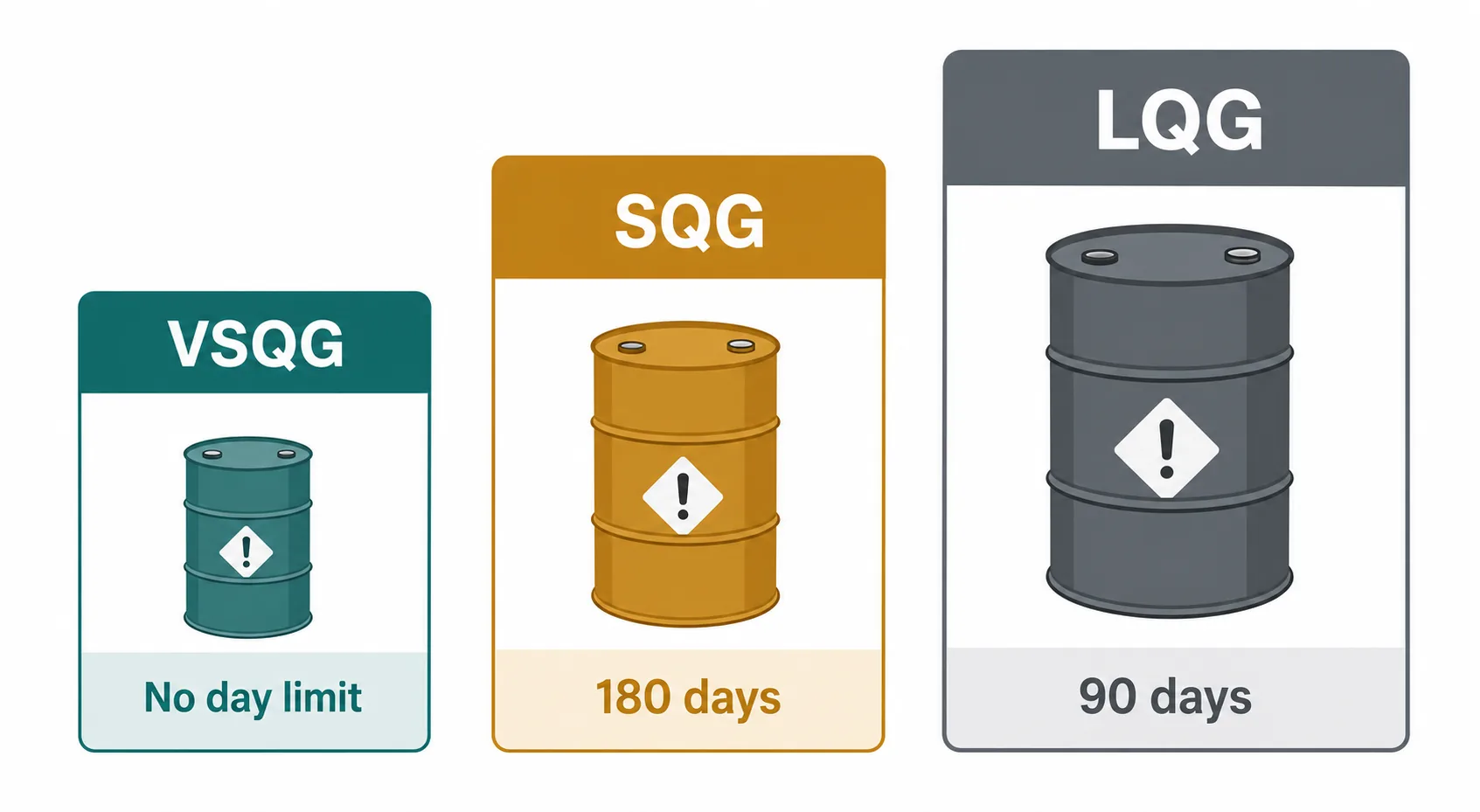
The 90-day limit is tied to generator size. RCRA sorts every generator into one of three categories based on how much hazardous waste it produces per calendar month, and each category carries its own on-site time limit. Correct classification is the single most important step, because the wrong category means the wrong deadline.
Large Quantity Generators (LQG)
An LQG produces 1,000 kilograms (about 2,200 pounds) or more of non-acute hazardous waste per month, or more than 1 kilogram of acute hazardous waste. This is the category the 90 day hazardous waste storage rule was written for. An LQG gets 90 days, full stop, with no distance-based extension built into the base limit.
Small Quantity Generators (SQG)
An SQG generates between 100 and 1,000 kilograms of non-acute hazardous waste per month. An SQG may hold waste on site for 180 days, or 270 days if the waste ships more than 200 miles to a designated facility. This 180/270-day allowance is a separate rule, not the 90-day rule, and the two are often confused.
Very Small Quantity Generators (VSQG)
A VSQG produces 100 kilograms or less of non-acute hazardous waste per month. VSQGs face quantity thresholds rather than a strict clock, but if accumulation on site climbs past the VSQG limit, the generator can step up into SQG or LQG status and inherit the tighter time limits that come with it.
| Generator category | Monthly hazardous waste | On-site accumulation limit | Storage permit required? |
|---|---|---|---|
| LQG | 1,000 kg or more | 90 days | No, if conditions met |
| SQG | 100 to 1,000 kg | 180 days (270 if shipped 200+ miles) | No, if conditions met |
| VSQG | 100 kg or less | Quantity-based; no fixed clock | No |
A concise, plain-language breakdown of these categories appears in a hazardous waste management fact sheet from the University of Maryland, a useful reference for facility staff who need a quick check on status.
So how long can hazardous waste be stored on site? It depends entirely on your category: 90 days for an LQG, 180 or 270 days for an SQG, and a quantity-capped allowance for a VSQG.
When Does the 90-Day Clock Start?
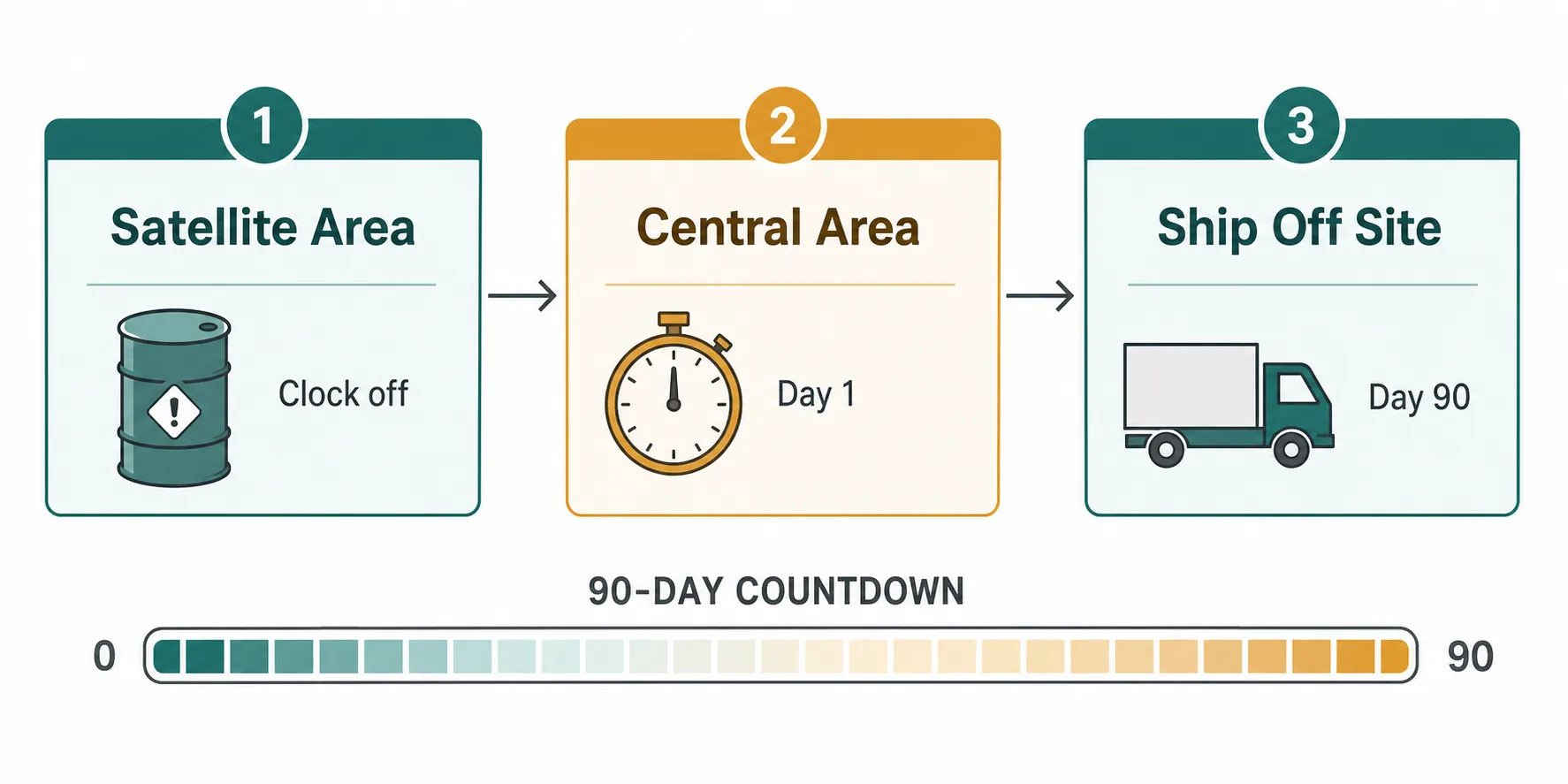
The 90-day clock starts on the date the first drop of hazardous waste is placed into a Central Accumulation Area. That date must be marked on the container. Every day counts, whether the site operates or not, because the limit is measured in calendar days.
Central Accumulation Areas (CAA)
A Central Accumulation Area is the designated on-site location where an LQG consolidates waste before shipment. Each container in the CAA carries a clearly visible accumulation start date, and that date anchors the 90-day count. Once the count begins, it does not pause.
Satellite Accumulation Areas (SAA)
A Satellite Accumulation Area sits at or near the point where waste is first produced, under the control of the operator of that process.
Full satellite accumulation area requirements cover container condition, labeling, and volume limits, but the core number to know is this: waste can sit in an SAA without triggering the 90-day clock, up to 55 gallons of non-acute hazardous waste or 1 quart of acute hazardous waste.
Here is the misconception worth correcting: the 90-day clock does not run while waste stays within SAA limits. Once the 55-gallon (or 1-quart) threshold is exceeded, the generator marks that date and has three consecutive calendar days to move the excess to the CAA, where the 90-day clock then applies.
Vermont’s Department of Environmental Conservation lays out these accumulation and start-date mechanics in a clear state-level fact sheet.
90-Day Hazardous Waste Storage Area Requirements
Permit-free status under the 90 day hazardous waste storage rule holds only when the accumulation area meets a defined set of standards. These 90-day hazardous waste storage area requirements cover containers, labels, inspections, placement, training, and emissions.
Container standards
Containers must be in good condition, free of leaks, and built from material compatible with the waste inside. A corrosive stream needs a container that resists corrosion; a solvent needs a compatible liner or drum. Containers stay closed except when staff add or remove waste.
Purpose-built hazmat storage containers and hazardous material storage containers make this easier, since they are engineered for chemical compatibility and secure closure from the start.
Labeling and dating
Every container is marked with the words “Hazardous Waste,” an indication of the hazards inside (ignitable, corrosive, reactive, toxic), and the accumulation start date, part of the broader hazardous waste drum labeling requirements every accumulation area must meet. The label is the auditable record that proves the container is inside its window.
Weekly inspections and aisle space
Container storage areas get inspected at least weekly for leaks, corrosion, and deterioration, in line with weekly drum inspection requirements, and inspectors log what they find.
Aisle space stays wide enough for unobstructed movement of personnel and emergency equipment.
Where should ignitable or reactive waste be stored?
Containers that hold ignitable or reactive waste sit at least 50 feet from the facility’s property line. Incompatible waste storage requirements mean these streams stay separated so that a leak or spill cannot cause a reaction, and staff use physical barriers or dikes where separation alone is not enough.
Personnel training and recordkeeping
An LQG must train the personnel who handle hazardous waste, so that each worker understands proper handling, container management, and emergency response for the streams on site. Training records, inspection logs, manifests, and the accumulation start dates form the paper trail an inspector expects to see.
Weak documentation undermines an otherwise compliant program, because the burden falls on the generator to prove the exemption was earned.
Air emission, tank, and containment standards
Tanks and containers that hold volatile organics fall under RCRA air emission standards, with controls on vents and equipment leaks. Tank systems need secondary containment and overfill controls.
Fire-rated storage buildings, hazardous materials storage buildings, and safety storage buildings serve as the physical structures that house compliant accumulation areas, with the fire ratings, containment sumps, and ventilation that these standards call for.
Preparedness, Prevention, and Contingency Planning
An LQG must be ready for the day something goes wrong. The regulations require an emergency coordinator on call, arrangements with local police, fire departments, and hospitals, and a written contingency plan that spells out spill response, evacuation, and notification steps.
Decontamination generates its own waste stream, and rinsate is a prime example. Rinsate is the rinse water left after crews clean equipment, drums, or containers that held hazardous material. That rinsate can itself be a regulated hazardous waste, and it counts toward monthly generation totals and on-site accumulation.
Overlook it, and a facility can slip into a higher generator category without realizing it.
Cleanable, corrosion-resistant equipment reduces the rinsate burden. Stainless-steel surfaces and chambers hold up to aggressive decontamination and cut the residue that becomes regulated waste, which matters most in corrosive or radioactive contexts.
The 30-Day Extension and What Happens If You Exceed 90 Days
The rule includes a narrow safety valve. When unforeseen, temporary, and uncontrollable circumstances prevent an LQG from shipping on time, the EPA Regional Administrator may grant a one-time extension of up to 30 days. The extension is discretionary, case by case, and never automatic.
Blow past 90 days without that approval, and the consequences are steep. The site becomes an unpermitted storage facility, exposed to enforcement actions, daily penalties, and the full permitting obligations it had been exempt from. A missed deadline turns a routine accumulation area into a regulatory liability.
The “20x rule” clarified
Searchers often ask about the “20x rule for hazardous waste.” This is not official EPA terminology, and no federal regulation defines a rule by that name, so treat any confident “20 times” claim with caution.
Most people who use the phrase are actually asking about accumulation quantity limits, so the accurate answer points back to the real numbers: a Satellite Accumulation Area caps at 55 gallons of non-acute waste (or 1 quart of acute waste) at the point of generation, and a Central Accumulation Area runs on the 90-day clock.
When in doubt, confirm your specific limits against the federal regulations or your state agency rather than a rule of thumb.
Reducing Hazardous Waste Volume Within the 90-Day Window
Ninety days is finite, and every drum that stays on site is a drum that has to leave before the deadline. That reality makes waste minimization and volume reduction practical compliance tools, not just cost measures. Less volume means fewer containers to track, fewer shipments to schedule, and more margin before day 90.
Waste stream reduction, compaction, and drum crushing shrink the physical footprint of accumulated waste. Compaction systems built for hazardous and low-level radioactive streams cut the volume of saturated solids, contaminated materials, and steel drums, which lowers both storage pressure and disposal cost.
From an engineering standpoint, the equipment that handles these streams safely tends to share a few traits: NEMA 7 explosion-proof components for flammable atmospheres, HEPA and VOC/carbon filtration for airborne contaminants, and stainless platens and chambers that survive decontamination.
These capabilities exist because the streams demand them. A peer-reviewed review on sustainable hazardous waste management reinforces the point that source reduction and volume minimization sit at the top of the waste hierarchy, ahead of treatment and disposal.
Storage choices scale with hazard, too. Hazardous material storage solutions range from modular buildings for secure storage of sensitive materials to blast resistant buildings, blast proof buildings, and blast buildings for streams with explosion potential. The right structure matches the risk of the waste it holds.
Comparison: Storage Structures and Equipment for Hazardous Waste
Different waste types call for different containment. The table below matches common storage structures to the hazards they suit, which keeps selection grounded in the waste rather than the sales sheet.
| Storage structure | Best suited for | Key protective feature |
|---|---|---|
| Fire-rated storage buildings | Ignitable and flammable waste | Fire-rated walls, ventilation, containment sumps |
| Blast resistant / blast proof buildings | Reactive or explosive streams | Blast-rated shells, pressure relief |
| Modular buildings for secure storage | Sensitive or high-value materials | Access control, relocatable, secure envelope |
| Hazmat storage containers | Drummed liquids and solids | Chemical-compatible construction, secure closure |
| Compaction and drum-crushing systems | Saturated solids, steel drums | Volume reduction, explosion-proof and filtration options |
For high-hazard handling, a second layer of safety features can matter as much as the structure itself.
| Safety feature | What it addresses |
|---|---|
| NEMA 7 explosion-proof components | Flammable and explosive atmospheres |
| HEPA and VOC/carbon filtration | Airborne particulates and vapors |
| Secondary containment and sumps | Leaks and spills |
| Stainless steel platens and chambers | Corrosive and radioactive decontamination |
A useful primer on matching handling practices to waste type appears in Delaware’s basic business guide for hazardous waste management, which walks small and mid-size generators through their day-to-day obligations.
Common Compliance Mistakes That Void the 90-Day Exemption
The exemption is easy to lose on small details. These are the errors inspectors flag most often at 90-day accumulation areas:
- Missing or wrong accumulation start dates. A container without a legible date is presumed out of compliance, no matter how recently it was filled.
- Open containers. Lids left off between additions are a frequent citation, and they raise real emission and spill risk.
- Undercounted rinsate and residues. Decontamination water and process residues that go untracked can push a site into a higher generator category.
- Ignitable waste too close to the property line. The 50-foot buffer is often overlooked when space is tight.
- Skipped weekly inspections. No log means no proof, and unlogged inspections are treated as inspections that never happened.
- Misreading SQG limits as the 90-day rule. Applying a 180-day mindset to an LQG site is a fast route to an unpermitted-storage violation.
Frequently asked questions
How long can a large quantity generator store hazardous waste on site?
Does the 90-day rule apply to small quantity generators?
Where should ignitable waste be stored in a 90-day accumulation area?
What is the 20x rule for hazardous waste?
Is there a PDF of the 90 day hazardous waste storage rule?
Closing Takeaway
For a Large Quantity Generator, 90 days is a hard ceiling, not a suggestion. Compliance comes down to three habits: classify your generator status correctly, hold container, label, and inspection discipline every week, and keep a firm plan to ship or reduce waste before day 90. Get the classification wrong or let a label slip, and the permit exemption evaporates.
Volume reduction is where operations and compliance meet. Compaction and hazmat-handling equipment built for hazardous and low-level radioactive streams help a facility shrink what it stores, ship less often, and stay comfortably inside the window the rule allows.