

Article summary: A military hazmat storage building is a prefabricated, fire-rated steel structure that stores, isolates, and dispenses flammables, solvents, fuels, and decon rinsate under DoD, OSHA, EPA, and NFPA requirements. This guide covers fire-rated construction, containment sumps, ventilation, classified electrical, blast resistance, on-base placement, and the spec detail that moves a unit through base approval. Written for installation environmental staff, DPW and base civil engineers, safety officers, and defense contractors who buy hazardous material storage solutions.
What Separates a Military Hazmat Storage Building From a Commercial Unit
On an installation, storage cannot become the constraint on flight line turnaround, motor pool throughput, or a scheduled inspection. That drives most of the spec differences.
Military units face a harder duty cycle and a wider environmental envelope: coastal salt spray, desert UV, arctic cold, repeated relocation between sites. Heavy-gauge double-wall steel, chemical-resistant exterior coatings, tamper-resistant hardware, and controlled access for accountability all follow from that.
Documentation burden is the second difference. A commercial unit needs one sign-off from the local authority having jurisdiction (AHJ). A military unit faces command inspections, environmental audits, and turnover of the safety officer who approved the original install.
Manufacturers of prefabricated hazardous material storage buildings that serve defense customers build the paperwork trail alongside the steel.
Fire-Rated Storage Buildings: 2-Hour vs 4-Hour
A fire rating describes how long an assembly resists a standardized fire exposure. It does not mean fireproof, and it does not replace separation distance.
Related readingFlammable Liquid Storage Building Requirements GuideRead the guide →| Fire-rated class | Typical use case | Common contents |
|---|---|---|
| Non-rated | Isolated pad with generous setback, low-hazard stock | Corrosives, oils, non-flammable chemicals |
| 2-hour | General flammable and combustible liquid storage where separation distance exists | Solvents, paints, fuels in drums and totes |
| 4-hour | Close to occupied structures, fuel points, or high-value assets where setback is unavailable | Flammable liquids, aerosols, mixed hazmat stock |
Vents, doors, and penetrations belong to the rated assembly. Fire dampers on vent openings and self-closing doors keep that assembly intact. An NFPA-compliant storage building carries the detail through the whole envelope, not just the wall panels.
Secondary Containment, Sumps, and Rinsate Capture
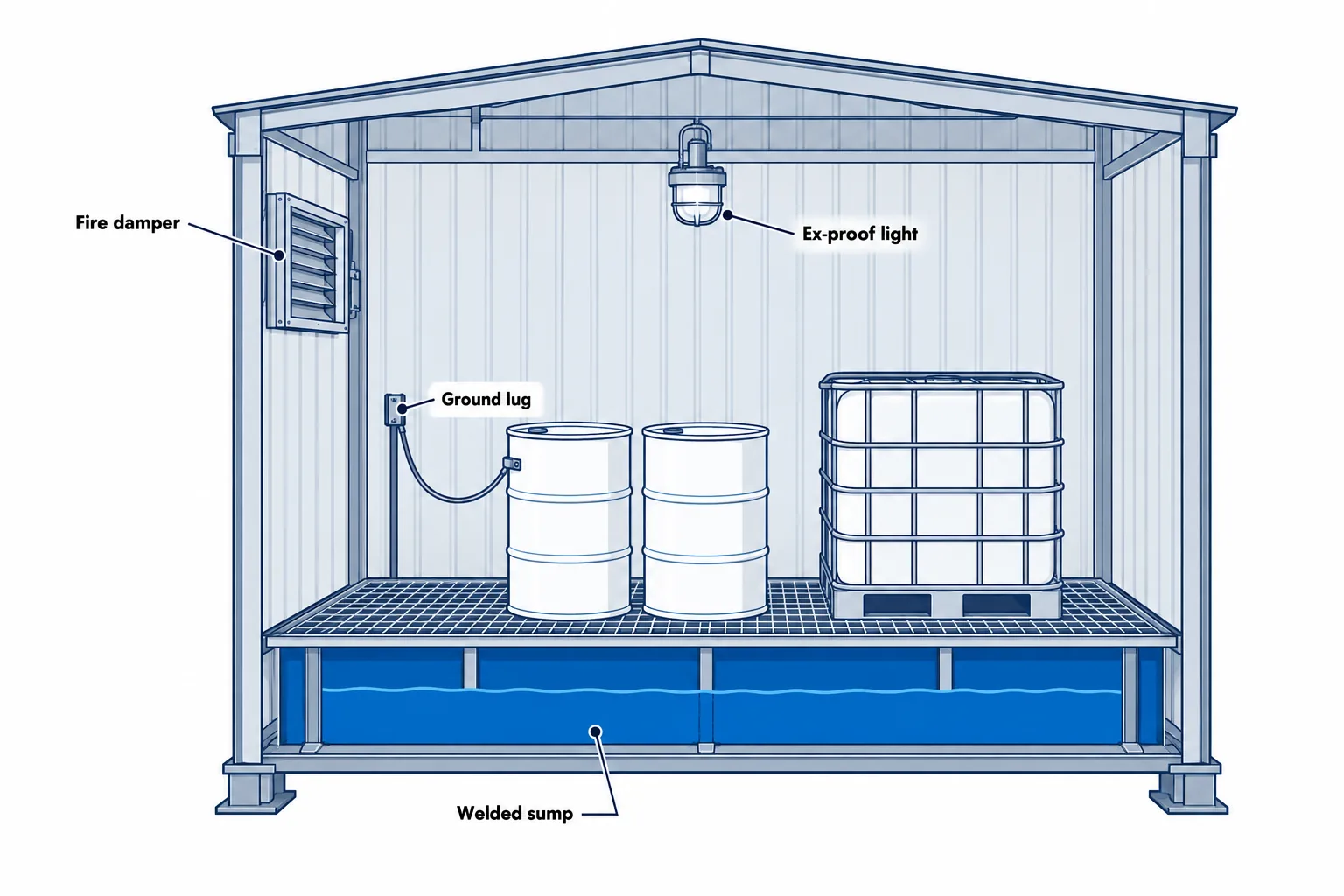
A continuous welded steel sump under the full floor area is the baseline. A removable steel grate over the sump carries drum and tote traffic and holds hazmat storage containers clear of any liquid that collects below.
Federal hazardous waste container rules set a minimum containment capacity tied to the volume stored. Confirm the current figure against the EPA container storage regulation, your authorized state program, and installation policy, because the strictest of the three governs.
Rinsate deserves its own line in the spec. Wash rack water, equipment decon rinsate, spent solvent, and used absorbent carry the same liability as virgin product and need the same containment discipline.
Sloped floors, zero floor drains, sealed penetrations, and chemical-resistant sump coatings matter most for corrosive streams. Incompatible classes get interior partitions or a separate hazardous material locker.
Ventilation, Explosion-Proof Electrical, and Static Ground Connections
Passive vents can serve sealed, low-volatility storage. Mechanical exhaust is the norm where flammable liquids transfer or dispense from drums.
Ventilation rate, vent placement, and electrical classification trace back to the OSHA flammable liquids standard and NFPA 30. Ask the manufacturer’s engineer to state that basis in the submittal instead of a general claim of compliance.
Classified areas need explosion-proof lights, switches, and conduit seals. Static ground lugs belong at every transfer point. Where adhesives, sealants, or lithium batteries sit inside, climate control moves from a comfort item to a spec requirement.
Blast Resistant Buildings, Magazines, and Fire-Rated Hazmat Storage
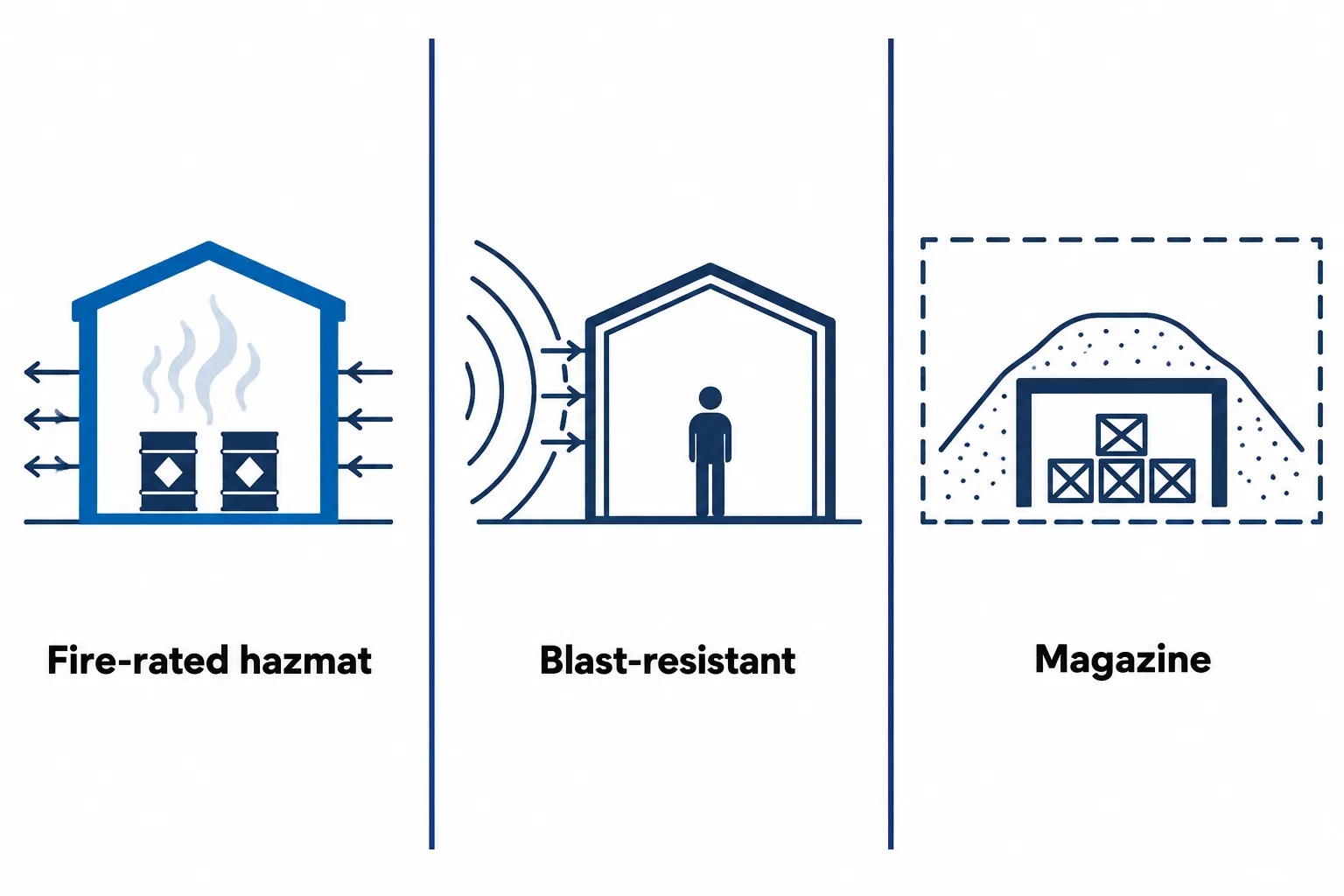
Three separate products, and the terms get mixed constantly.
Fire-rated hazmat storage protects the surroundings from the contents. Blast-resistant buildings protect occupants and assets from external overpressure. Explosives magazines hold ammunition and ordnance under DoD explosives safety criteria, with a separate approval path.
Blast-proof buildings and hazmat lockers are not interchangeable. Define the hazard class and the threat early, because the answer changes wall construction, anchorage, and which office signs off.
The Compliance Stack
| Framework | What it governs | Effect on the spec |
|---|---|---|
| OSHA flammable liquids standard | Storage room construction, ventilation, workplace electrical safety | Wall assembly, exhaust type, classified fixtures |
| EPA RCRA container rules | Hazardous waste container storage and accumulation areas | Containment capacity, labels, inspection routine |
| NFPA 30 and NFPA 400 | Flammable liquid and hazardous material construction, separation, allowable quantities | Fire-rated class, setback, per-building quantity limits |
| DoD explosives safety and installation environmental programs | Ammunition facilities, base environmental compliance | Separation criteria, approval path, documentation |
One practical note: an assembly listed by a nationally recognized testing laboratory gives the base engineer third-party evidence instead of a vendor assertion. That usually shortens review.
Custom Configurations for Real Base Conditions
Standard footprints rarely match the pad you already have, the utility runs, the forklift approach angle, or the setback left after the rest of the site plan.
Configurable variables: drum capacity, door swing or roll-up, interior partitions, shelves, dispense stations, interior lights, HVAC, security hardware. Custom modular construction also lets capacity scale with a changed mission instead of a new MILCON project.
From a design standpoint, lock three inputs before dimensions: the contents list, the worst-case container size, and the growth allowance.
Delivery, Relocation, and On-Base Placement
Prefabricated units arrive assembled and factory-tested. That cuts on-base construction days, escort hours, and the number of trades through the gate.
Forklift pockets and lift lugs matter more than most buyers expect. Units move with the mission, between contingency sites, or to a new pad after a facility plan changes.
Site prep stays real work: level pad or compacted base, anchorage for wind and seismic load, utility drops, vehicle access. Settle gate clearance, crane or forklift availability, escort, and the delivery window before the unit ships.
Common Military Applications
- Aviation maintenance: solvents, hydraulic fluid, paints, sealants, and adhesives near flight lines
- Motor pools and vehicle shops: fuels, lubricants, batteries, used oil accumulation
- Ranges and field exercise support: solvents, decon rinsate, spill response stock
- Shipyards, ports, and shore facilities with corrosive marine exposure
- Satellite and central accumulation areas for installation environmental programs
- Lithium battery storage, a distinct hazard class that needs segregation from flammable liquids
How to Spec a Military Hazmat Storage Building for Procurement
Bring this list to the quote request, and the conversation gets much shorter:
- Contents list and hazard classes
- Largest container volume and total gallons on hand
- Required fire-rated class and the reason (setback, adjacency, AHJ direction)
- Electrical classification and ventilation type
- Climate control and security level
- Pad condition, anchorage requirement, and delivery constraints
- Required documentation: drawings, calculations, listed assembly records, O&M data
When no standard configuration satisfies that list, custom-engineered solutions close the gap without a site-built structure.
Frequently asked questions
Do military hazmat storage buildings need to be fire rated?
How much secondary containment does a hazmat storage building require?
Can a hazmat storage building store ammunition or explosives?
What ventilation does a hazardous material locker need?
Can a prefabricated unit be relocated to another base?
Closing Takeaway
Most failed inspections and expensive rework trace back to a vague spec, not to bad steel.
Contents, fire-rated class, containment capacity, and electrical classification decided up front carry the project through review.
Prefabricated, factory-tested hazardous material storage solutions shorten the path from requirement to operational storage.