

Article Summary
Facilities hit this question once inventory outgrows one cabinet: outdoor chemical storage vs indoor storage. Outdoor means hazmat storage lockers and fire-rated storage buildings on a pad outside the plant. Indoor means flammable safety cabinets and purpose-built chemical storage rooms.
Four axes decide it: code compliance, fire and personnel safety, environmental containment, and total cost. Small working quantities belong indoors in approved cabinets. Bulk volume, incompatible hazard classes, and any need for staff to enter the space push storage outside.
Outdoor Chemical Storage vs Indoor: The Short Answer
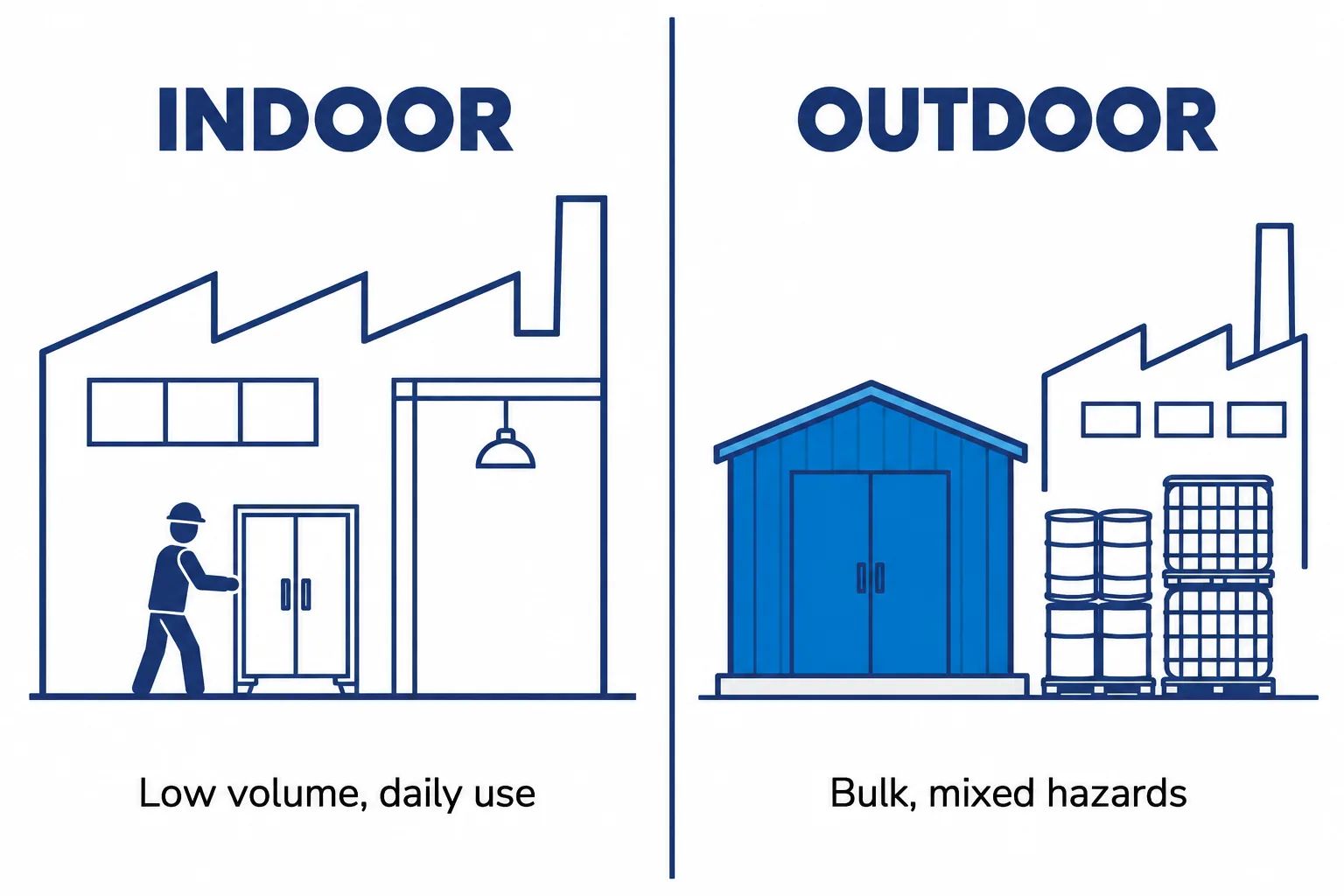
Indoor storage suits low volumes, frequent daily access, and temperature-sensitive product already inside a conditioned plant. Outdoor storage suits drum and tote quantities past cabinet limits, incompatible chemical families that need separated modules, and fuel loads that should not share a fire area with production staff.
Related readingHow to Store Flammable Liquids Outside (Code Guide)Read the guide →Preference rarely settles it. Quantity thresholds in the fire code settle it, along with how the local authority having jurisdiction (AHJ) applies them to your site.
Outdoor chemical storage vs indoor at a glance
| Factor | Flammable safety cabinet | Indoor chemical storage room | Outdoor hazmat storage locker | Outdoor fire-rated storage building |
|---|---|---|---|---|
| Typical capacity | Shift quantities | Room-scale inventory | Drums, pails, totes, cylinders | Racked bulk inventory |
| Fire-rated construction | Listed cabinet build | Rated wall and ceiling assemblies | Non-rated or rated models | 2-hour and 4-hour options |
| Code driver | Quantity per cabinet | Control area limits | Separation distance | Rated construction plus distance |
| Secondary containment | Built-in sump | Sills and rated floor | Integral sump | Integral sump |
| Climate control | Plant HVAC | Plant HVAC | Rare | Optional heat, cooling, insulation |
| Personnel entry | None | Yes | None | Yes |
| Permit burden | Lowest | Highest | Low | Moderate |
| Relocatable | Yes | No | Yes, by forklift | Yes, by truck or crane |
| Cost profile | Lowest per unit | Highest per gallon stored | Low per gallon stored | Moderate per gallon stored |
What Counts as Indoor Chemical Storage
Two different things get called indoor storage, and they carry different obligations.
Flammable safety cabinets
Double-wall steel construction, self-close doors, flame arrester vents, leak-tight bottom sump. A listed cabinet protects contents long enough for evacuation and fire response. It is not a bulk inventory solution.
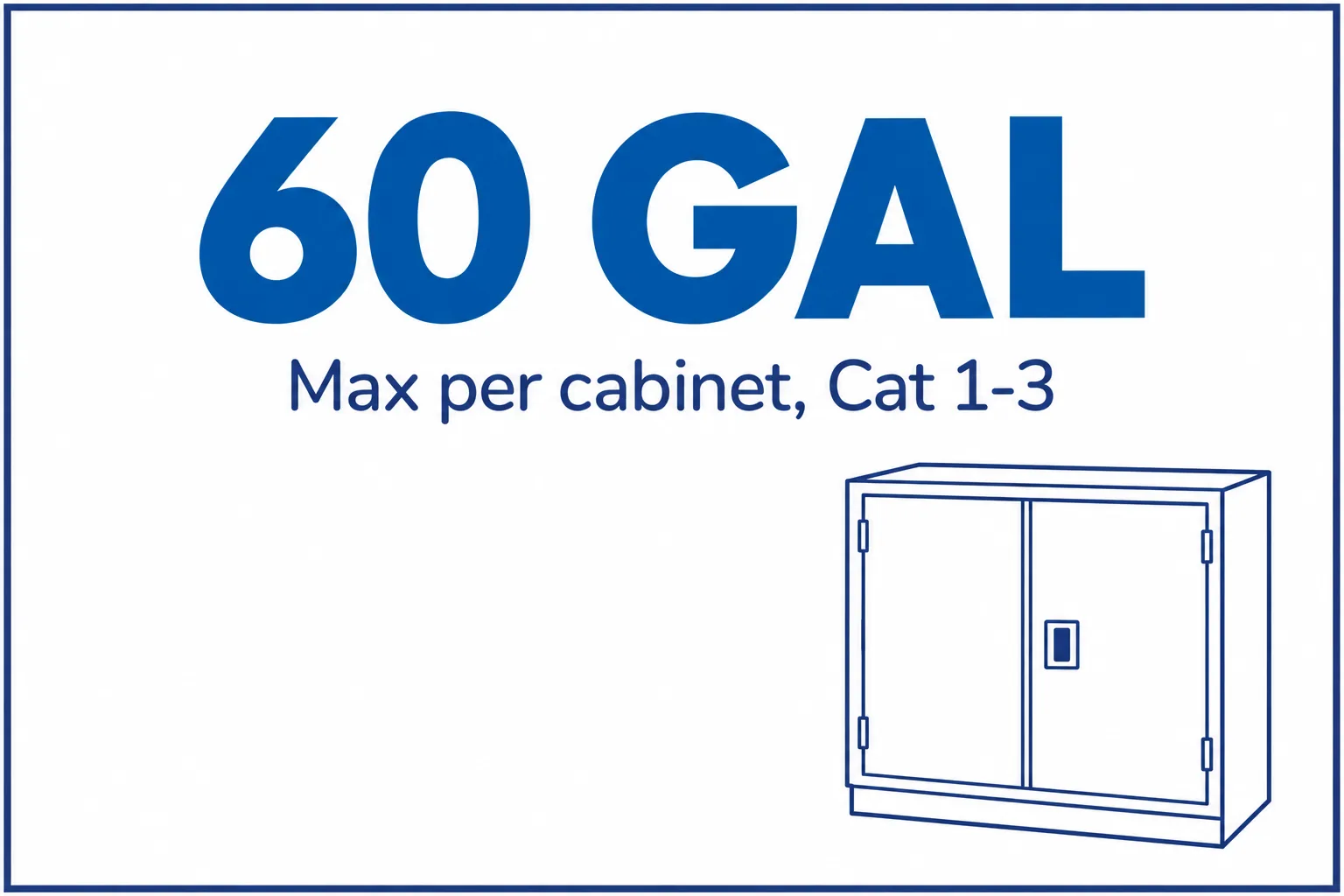
OSHA 29 CFR 1910.106(d)(3) caps a single cabinet at 60 gallons of Category 1, 2, or 3 liquids, or 120 gallons of Category 4 liquids. It does not set how many cabinets one fire area may hold. That number comes from the adopted fire code and from OSHA’s construction standard, 29 CFR 1926.152(b)(3), which caps it at three cabinets in a single storage area.
Current NFPA 30 has moved away from a fixed cabinet count toward a maximum allowable quantity per control area, so confirm the applicable figure with your AHJ before you plan capacity around it.
Indoor chemical storage rooms
A compliant room needs rated wall and ceiling assemblies, mechanical exhaust, explosion relief where required, sprinkler coverage, and liquid-tight sills. It consumes conditioned production floor space and triggers a building permit plus structural review.
A retrofit into a plant already in service is often the most expensive path: HVAC, electrical area classification, and suppression all get reworked around structure that already exists.
What Counts as Outdoor Chemical Storage
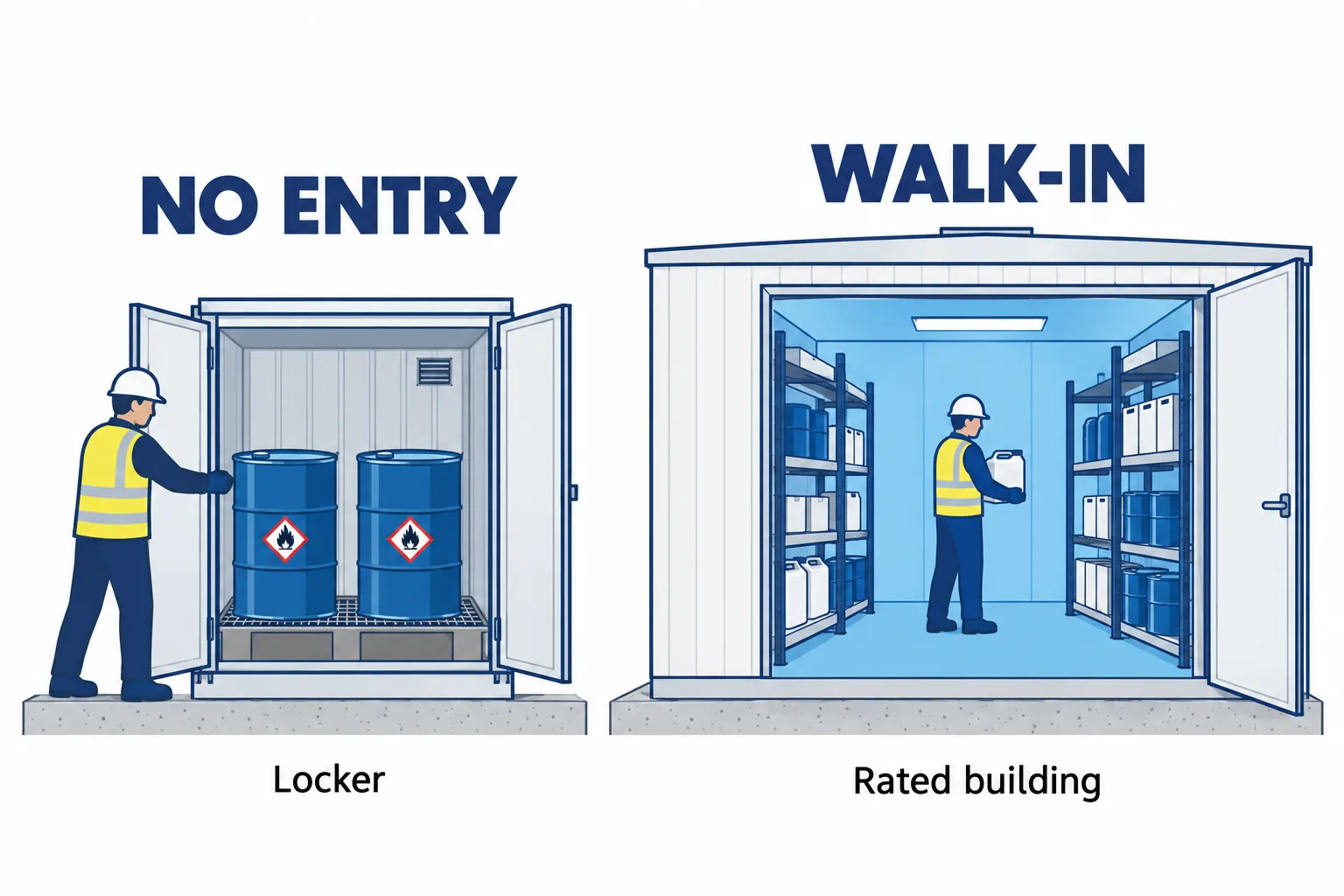
Prefabricated enclosures, factory-tested, delivered ready to set on a pad. The split that matters is personnel entry.
Hazmat storage lockers and containers
A hazmat storage container is a non-occupied structure: it’s accessed from the outside, so no operator steps into a vapor space.
Units are sized for drums, pails, totes, and cylinders, with an integral sump that captures leaks and washdown. Hazmat storage containers carry low cost per square foot, minimal permit work, and forklift portability.
Fire-rated and blast resistant storage buildings
Occupied units are sized for shelves, racks, dispense stations, and staff entry. Fire-rated storage buildings in 2-hour and 4-hour construction change how close a unit may sit to an occupied building or a property line, which is why an NFPA compliant storage building often solves a site-constraint problem no cabinet can touch.
Blast resistant buildings, sometimes specified as blast proof buildings, address overpressure exposure near process units.
Common options on hazmat storage buildings: explosion-proof electrical, continuous mechanical ventilation, temperature control, and gas detection. Scale and staff access decide the format, a distinction covered in our comparison of a chemical storage locker versus a full storage building.
Code Compliance Drives the Decision More Than Preference
Four rule sets shape the outcome. OSHA 29 CFR 1910.106 governs flammable liquid quantities and cabinet construction. NFPA 30 and the International Fire Code set maximum allowable quantities per control area plus separation distances for exterior liquid storage.
EPA rules govern secondary containment and release reports.
And OSHA’s Hazard Communication Standard, 29 CFR 1910.1200 requires employers to keep safety data sheets readily accessible to employees in their work areas during each work shift, with containers labeled by product identifier and hazard information.
According to Jack Rector, OSHA’s area director in Fort Worth, “Chemical facilities can be very hazardous, and deficiencies like the ones found during this inspection should have been promptly corrected when identified. Employers must provide a safe and healthful working environment for their workers.”
Indoor quantity limits vs outdoor separation distance
Indoors, the constraint is volume: gallons per cabinet, cabinets per fire area, hazardous material quantity per control area. Another control area means more rated construction inside an active plant.
Outdoors, the constraint is distance. Unrated units need clearance from occupied buildings, lot lines, and egress paths. Higher-rated construction shortens the required distance. Get the AHJ interpretation on paper before the pad is poured.
Safety Trade-Offs Beyond the Code Book
- Vapor accumulation: outdoor units vent to open air; indoor rooms depend on mechanical exhaust that can fail.
- Fire spread: an exterior unit holds the fuel load away from people, production, and finished goods.
- Segregation: acids, bases, oxidizers, and flammables need separation, which is simpler across several outdoor modules than inside one room.
- Exposure: non-occupied lockers keep staff out of the vapor space entirely.
- Security: exterior units accept locks, alarms, and access control without plant traffic.
Secondary Containment, Rinsate, and Environmental Liability
Sump capacity follows a specific formula, not a rule of thumb. For general hazardous chemical storage, the International Fire Code (IFC §5004.2.2) and NFPA 30 require containment sized to hold the largest single container’s volume, or 10 percent of the combined volume of all containers stored, whichever is greater.
Indoor, sprinklered spaces add the volume of fire-protection water discharged over 20 minutes on top of that figure (IFC §5004.2.2.3). If the material in question is a regulated hazardous waste rather than a hazardous material in active use, the RCRA standard at 40 CFR 264.175(b)(3) applies the same 10 percent/largest-container math.
Rinsate deserves its own plan. Triple-rinse water, equipment washdown, and residue from chemical transfer must be captured, then reused or disposed of as hazardous waste. Storm drains are never an option. Agricultural and turf operations usually pair a graded containment pad and rinsate recovery with the storage building itself.
Outdoor containment sees rain, so roof coverage and sump drain control matter. Indoor rooms avoid rainwater but keep any release inside the building envelope.
Climate Control and Temperature-Sensitive Chemicals
Climate control earns its cost only when the product needs it. Freeze-sensitive liquids, emulsions, and peroxides degrade or separate outside their stated range. The SDS storage section is the authority here, not a rule of thumb.
Indoor storage inherits plant HVAC at no extra equipment cost, though it spends floor space to get it. Outdoor safety storage buildings can be specified with heat, cooling, and insulation, which narrows the gap. Skip climate control for products with wide tolerance, but keep the ventilation rate high: solar gain on unshaded steel pushes internal temperature above ambient.
What Each Option Actually Costs
Compare components, not sticker prices: unit purchase, foundation and pad, utility runs, permits and engineering stamps, suppression, ventilation, annual inspection.
Indoor rooms carry costs that rarely appear in the first estimate: displaced production floor, sprinkler redesign, electrical area classification.
Outdoor units are capital equipment. They relocate with the operation instead of staying with the real estate, which is also why the choice between a prefabricated and a custom-engineered building affects lead time and budget as much as it affects fit.
The trade is simple. Cabinets stay cheapest until quantity forces another control area. Past that point, hazardous material storage buildings usually win on cost per gallon stored.
A Decision Framework for Your Facility
- What volume and hazard class, per the SDS?
- Does that exceed cabinet or control-area limits?
- Does anyone need to enter the storage space?
- Does the product need a controlled temperature range?
- How far can the unit sit from occupied buildings and lot lines?
Answers map to one of four outcomes: cabinet, indoor room, non-occupied locker, or occupied fire-rated building. Most plants land on a hybrid: day-use quantities in cabinets, bulk inventory outside.
Frequently asked questions
What are the OSHA guidelines for chemical storage?
What is the best way to store chemicals?
Is climate controlled storage worth it for chemicals?
What are the different types of chemical storage containers?
Can outdoor chemical storage sit next to my building?
The Takeaway
Quantity drives this decision, not preference. Cabinets and indoor rooms handle day-use stock. Outdoor lockers and fire-rated buildings handle inventory. Build a chemical inventory by hazard class first, match each volume to the code path it triggers, then confirm setback and construction class with your AHJ before you spend on a pad.