

Summary: A prefabricated hazmat storage building is a factory-built, standardized unit shipped ready to place. A custom building is engineered to a specific chemical inventory, site, and code profile. The prefabricated vs custom hazmat storage building decision comes down to speed and predictable cost versus precise fit and scalability, and both paths must satisfy NFPA 30, OSHA, and EPA container standards.
Facility managers rarely ask whether they need compliant chemical storage. They ask which procurement path fits the site in front of them. This guide lays out the trade-offs so you can defend the choice to leadership and to an inspector.
What Is a Prefabricated Hazmat Storage Building?
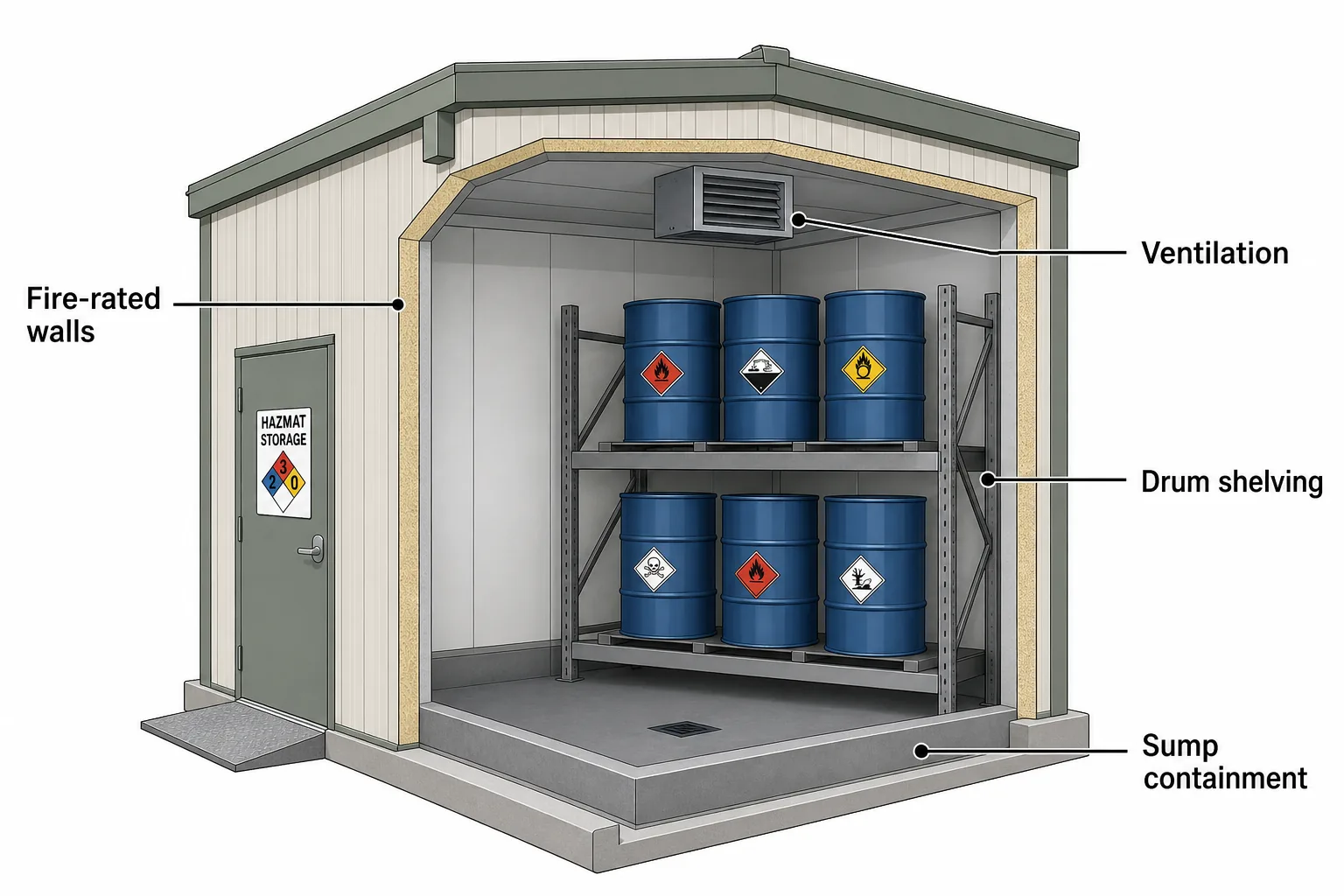
A prefabricated hazmat storage building is produced in a controlled factory, then delivered as a finished unit that drops onto a prepared pad. Footprints, drum capacities, and shelf layouts follow standard configurations, so the specifications are known before you order.
The appeal is practical. Lead times are shorter, factory quality control is consistent, and pricing is predictable because the design already exists. Siting moves fast once the pad and utilities are ready.
Standard configurations typically include drum lockers, two-hour fire-rated walls, mechanical ventilation, and sump-based secondary containment. These features are not cosmetic. Storage that holds flammable and combustible liquids must meet the design and separation rules set out in OSHA’s flammable liquids standard, 29 CFR 1910.106, which shapes wall ratings, ventilation, and quantity limits. Well-built safety storage buildings, fire-rated storage buildings, and factory hazmat storage containers all inherit those constraints.
What Is a Custom Hazmat Storage Building?
A custom hazmat storage building is purpose-engineered around one facility’s inventory, hazard classes, and regulatory profile. It exists because standard footprints do not always match real sites.
Custom work earns its keep when the situation is unusual: incompatible chemistries that demand separated rooms, oversized bulk storage, integrated fire suppression, or blast-resistant construction. Sites with tight property lines or specific segregation needs benefit from a build shaped to those limits rather than forced into a catalog size.
When off-the-shelf dimensions fall short, custom-engineered hazardous material storage solutions give the design room to address each hazardous material storage solution on its own terms, including modular buildings for secure storage of sensitive materials.
Prefabricated vs Custom Hazmat Storage Building: Side-by-Side Comparison
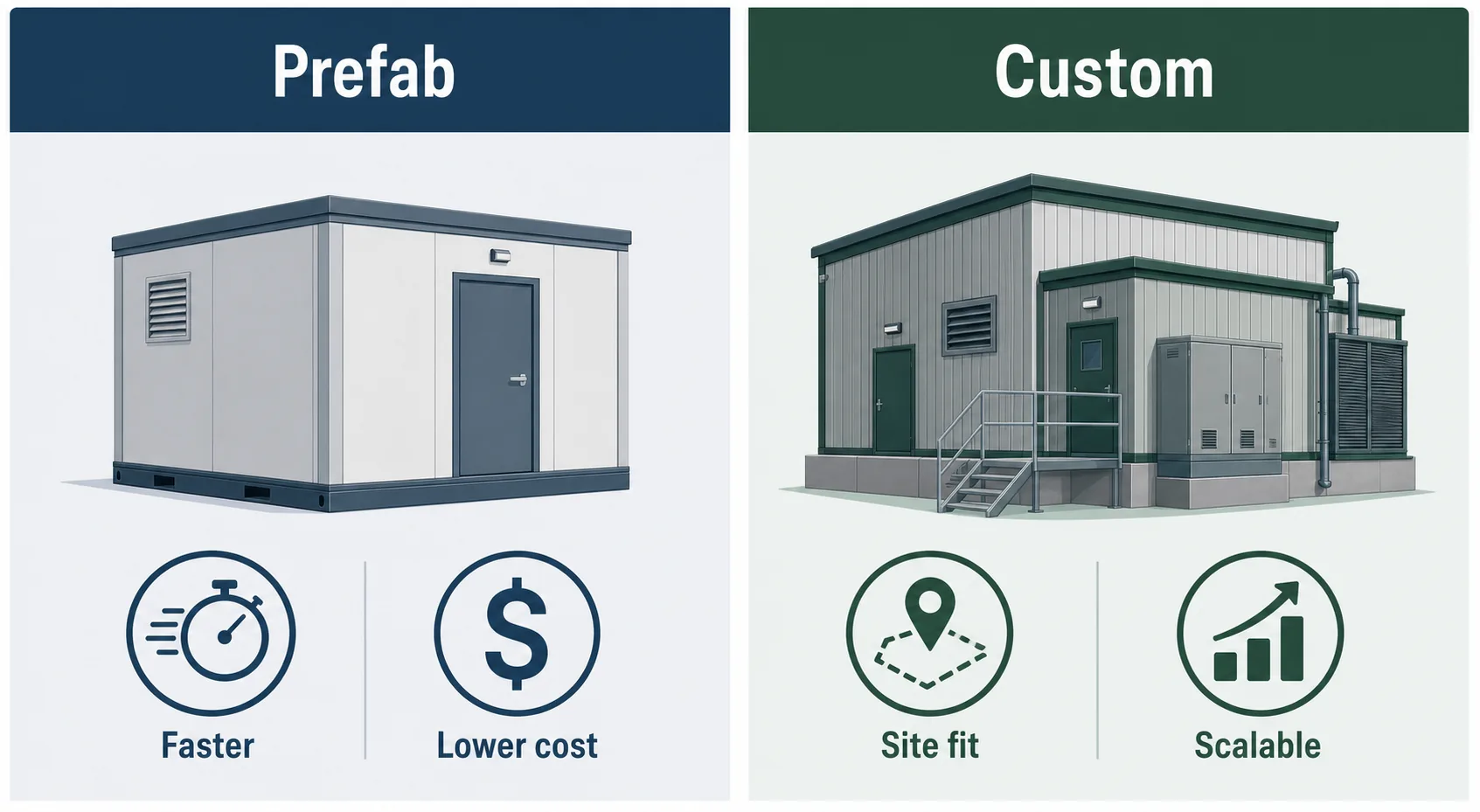
Neither approach is better in the abstract. The right answer is set by inventory volume, hazard class, and site constraints.
| Factor | Prefabricated | Custom |
|---|---|---|
| Lead time | Shorter, unit already designed | Longer, engineered to spec |
| Upfront cost | Lower, standardized production | Higher, dedicated engineering |
| Site and footprint fit | Fixed sizes | Shaped to the site |
| Capacity and scalability | Preset limits | Sized to inventory and growth |
| Code compliance path | Pre-documented package | Engineered to the exact profile |
| Chemical segregation | Standard separations | Room-by-room as needed |
| Fire and blast rating options | Common ratings offered | Full range, including blast-resistant |
| Relocation | Straightforward for smaller units | Depends on the build |
Cost and Lead Time Trade-offs of Prefabricated vs Custom Hazmat Storage Buildings
Prefabricated units carry a lower entry cost and reach the pad faster, which suits standard inventories and compressed schedules. Custom buildings ask for a larger engineering investment and a longer timeline, and they repay it with a closer long-run fit for complex or high-volume operations.
From an engineering standpoint, the timeline gap usually matters more to the decision than the price gap.
Compliance Requirements Both Build Types Must Meet
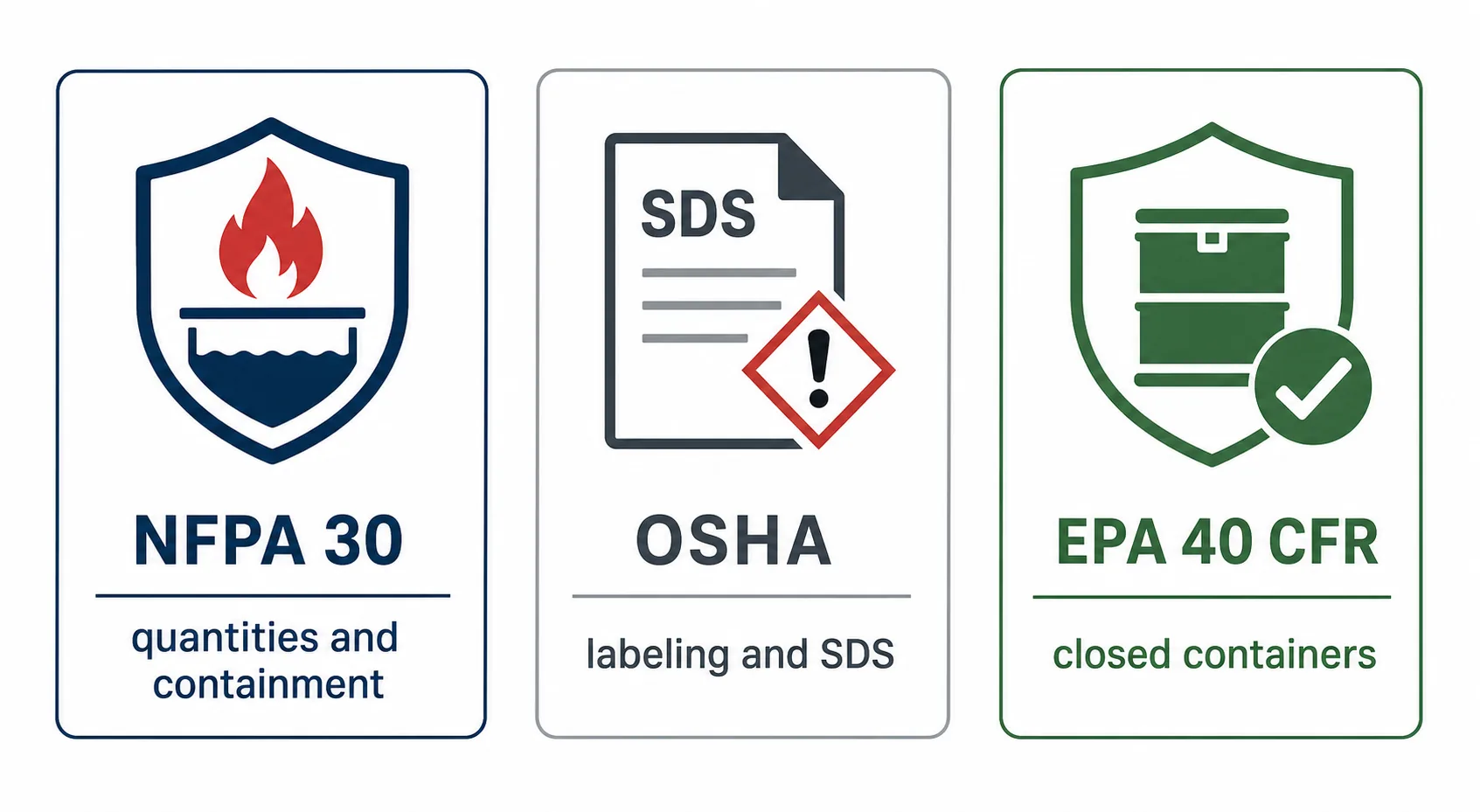
Whichever path you take, the same rulebook applies.
NFPA 30, the Flammable and Combustible Liquids Code, governs how flammable liquid storage buildings classify liquids, cap allowable quantities, space and segregate containers, ventilate the space, and provide secondary containment. Its liquid classes drive most downstream design choices.
OSHA’s Hazard Communication standard adds labeling and safety data sheet duties, while storage-cabinet basics cover grounding and bonding, clear labeling, and separation of incompatible chemicals. Whichever route you pick, documenting compliance for an inspector follows the same sequence, and our checklist walks through it stop by stop. A storage cabinet must keep quantities within limits, seal against spills, and hold incompatibles apart.
Hazardous waste brings a further layer. The EPA container storage standards in 40 CFR Part 265, Subpart I require containers to stay closed, remain compatible with their contents, and sit within adequate containment. Fire-rated wall and roof assemblies, verified by third-party testing, tie the whole package together for hazardous material storage buildings and hazardous material storage containers alike.
Matching the Building to Your Hazard Profile
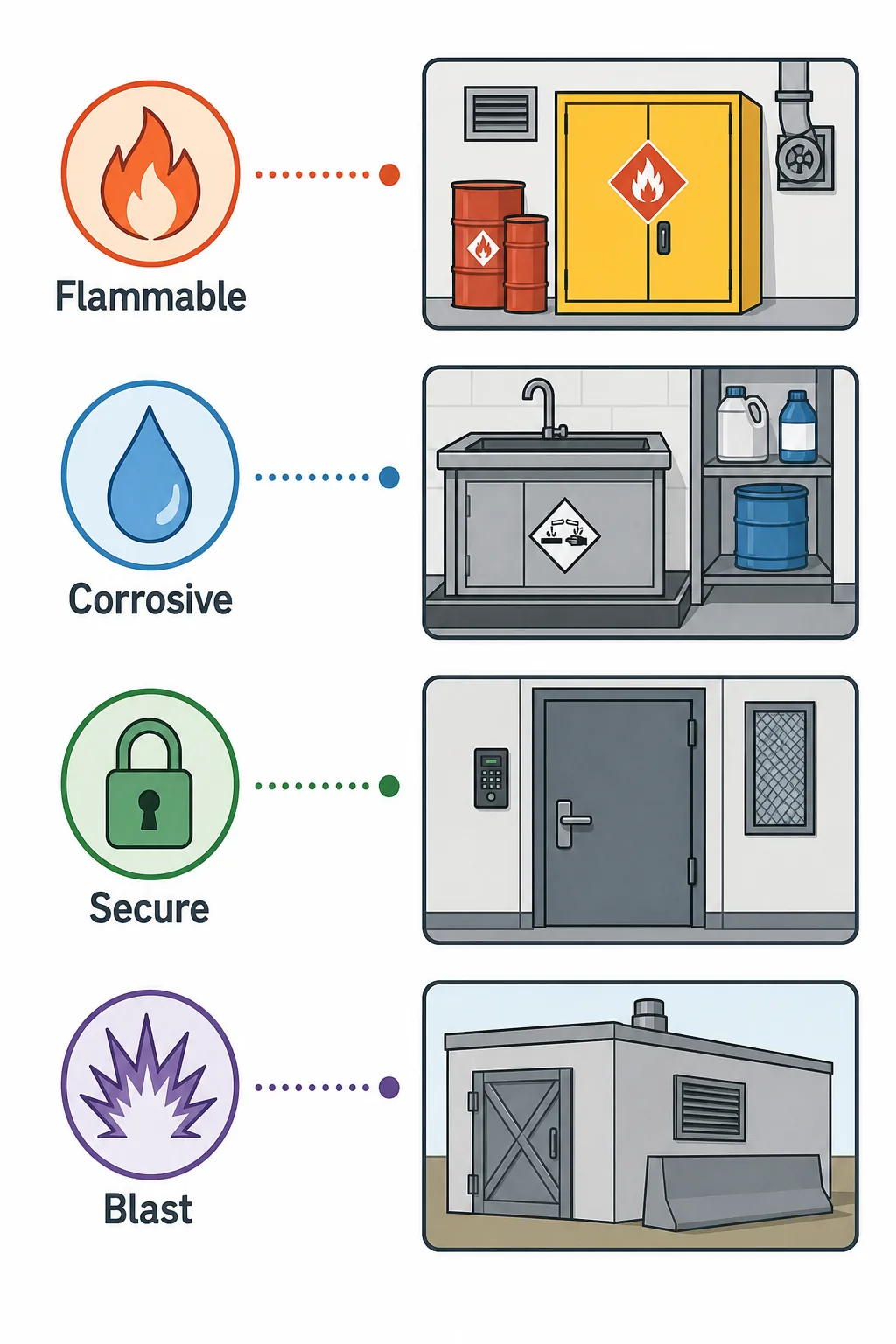
The cleanest way to choose is to start from what you store.
- Flammables and combustibles: prioritize fire rating and ventilation.
- Corrosives and reactives: focus on material selection and firm segregation.
- Sensitive or high-value stock: modular buildings for secure storage of sensitive materials add controlled access.
- Explosive, energetic, or high-vapor environments: blast resistant buildings and blast proof buildings are warranted where an internal or external overpressure event is a credible risk, not a default upgrade.
Agrichemical and pesticide operations add one more concern: rinsate. Rinse water and contaminated runoff must be captured in containment rather than drained. The EPA pesticide container and containment regulations set how that captured rinsate is held and reused, which reinforces why containment sizing belongs in the design from day one.
Siting, Ventilation, and Containment Considerations
Placement follows the codes. Buildings need separation distances from property lines, occupied structures, and ignition sources. Ventilation is either mechanical or natural depending on the liquids and the volume on hand.
Containment is sized around the largest single container plus required freeboard, so a spill stays inside the sump. Electrical classification explains why explosion-proof and NEMA-rated fittings show up in hazmat builds: the fixtures must not become an ignition source. These same principles are what custom modular construction brings to hazardous material storage when a stock layout cannot deliver them.
How to Decide: A Practical Checklist
Run through these before you commit:
- Total inventory volume, now and projected.
- Hazard classes on hand and any incompatibilities.
- Available site space and separation distances.
- Expansion plans over the next several years.
- Budget and required in-service date.
- Local authority having jurisdiction (AHJ) requirements.
- Any need to relocate the unit later.
Prefab tends to win for standard inventories and tight schedules. Custom tends to win for complex chemistries, high volumes, or constrained sites. If you want to start from proven configurations, review the range of prefabricated hazardous material storage building products and measure them against this list.
Frequently asked questions
What is a prefabricated hazmat storage building?
What are the storage requirements under NFPA 30?
What are the general requirements for storing hazardous chemicals in a storage cabinet?
What are the requirements for a hazmat warehouse?
Is a custom or prefabricated hazmat building better for flammable liquids?
Closing Takeaway
The prefabricated vs custom question is really a question about your inventory and your site. Standard volumes and short timelines point toward prefab. Complex chemistries, high volumes, and constrained footprints point toward custom. Either path can meet NFPA, OSHA, and EPA standards when it is engineered to the materials you actually store, so ground the decision in your hazard profile and let the codes confirm the build.