
Quick Summary
A hazardous waste storage compliance checklist verifies six things at a generator site: container condition, labels and accumulation dates, secondary containment, aisle space, documented weekly inspections, and emergency readiness. The federal baseline sits in RCRA (40 CFR Parts 262, 264, and 265), with OSHA 29 CFR 1910 on top for hazard communication, PPE, and emergency response.
| Zone | What the checklist verifies | Frequent failure |
|---|---|---|
| Container | Condition, closure, compatibility | Open bung on a satellite drum |
| Label | Words, hazards, start date | Start date on tape that peels off |
| Area | Containment, aisle space, separation | Pallets parked across the aisle |
| Records | Weekly logs, determinations, plan | A skipped inspection week |
Container Condition and Compatibility
Start at the drum. Each container needs sound walls: no rust-through, dents, bulges, weeps at the chime, or hardened gaskets. A compromised drum goes into an overpack, not a transfer operation out on the pad.
Containers stay closed except when waste moves in or out. Bungs torqued, funnel lids latched, no open-top drum parked under a bench.
Match the container to the chemistry. Corrosives in unlined carbon steel and aggressive solvents in the wrong polyethylene fail the same way, from the inside out. Separate incompatible streams physically, with separate containment where a reaction is credible. Rated hazmat storage containers add a second layer when waste sits outdoors or moves between buildings.
Labels, Marks, and Accumulation Dates
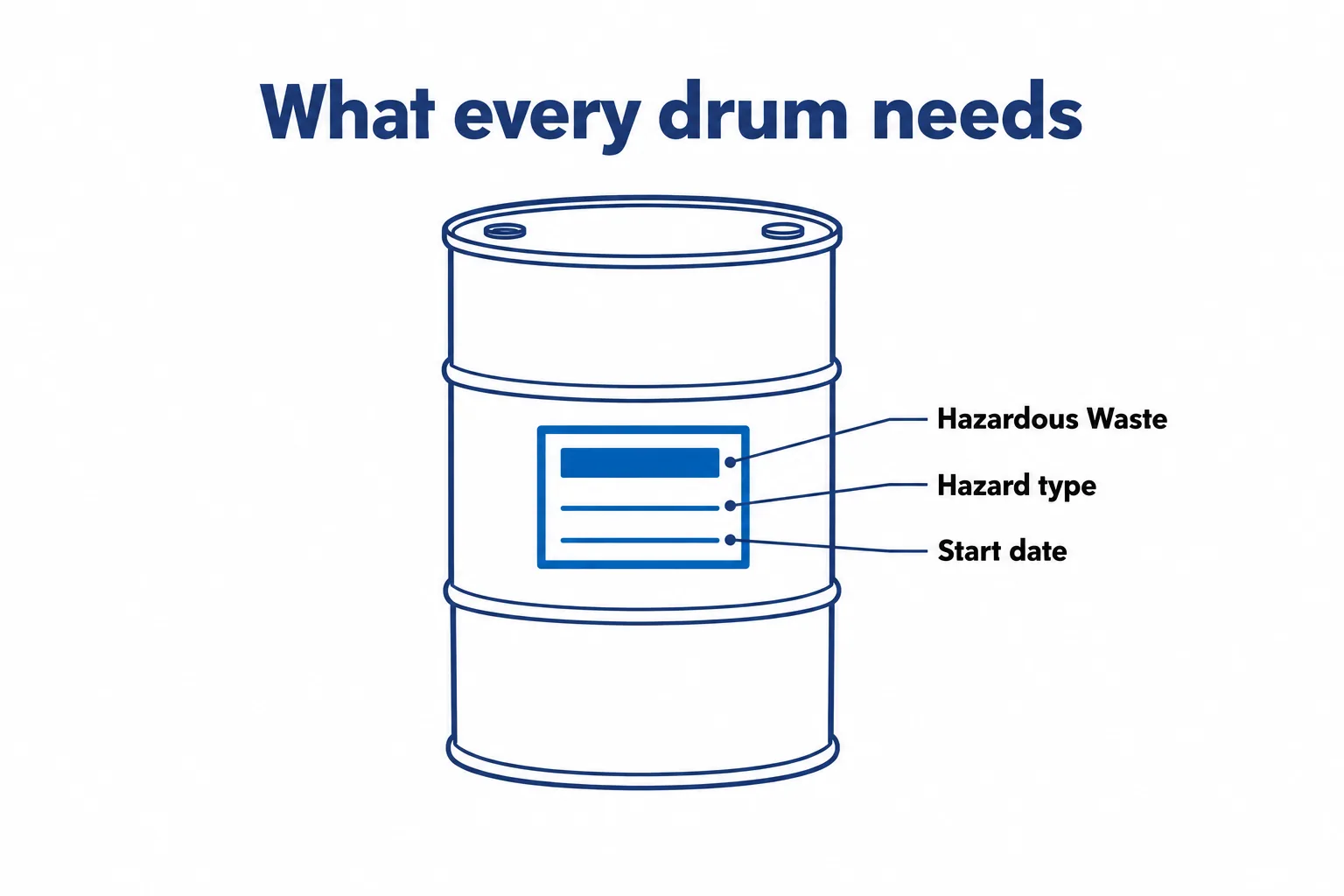
Federal rules require containers at a central accumulation area to carry the words “Hazardous Waste” and an indication of the hazards of the contents, plus the date accumulation began, legible from the aisle. Waste codes and generator details follow where the program requires them, matched to the waste determination on file.
A refresher on container labels and dates under the 90 day hazardous waste storage rule settles most internal debates about what belongs on a drum. Recurring citations are the dull ones: faded marker, a start date on tape that falls off, satellite containers with no label at all.
Accumulation Limits by Generator Category
Scope the checklist to your category, since VSQG, SQG, and LQG sites carry different on-site clocks. At the point of generation, EPA allows a satellite accumulation area to hold up to 55 gallons of hazardous waste, or one quart of liquid acute hazardous waste, under the control of the operator.
Once full, the container moves to the central accumulation area and the clock starts. State programs, Florida DEP among them, can be more stringent than the federal rule, so verify the state citation before the checklist is final.
Storage Area Design: Containment, Aisle Space, and Separation
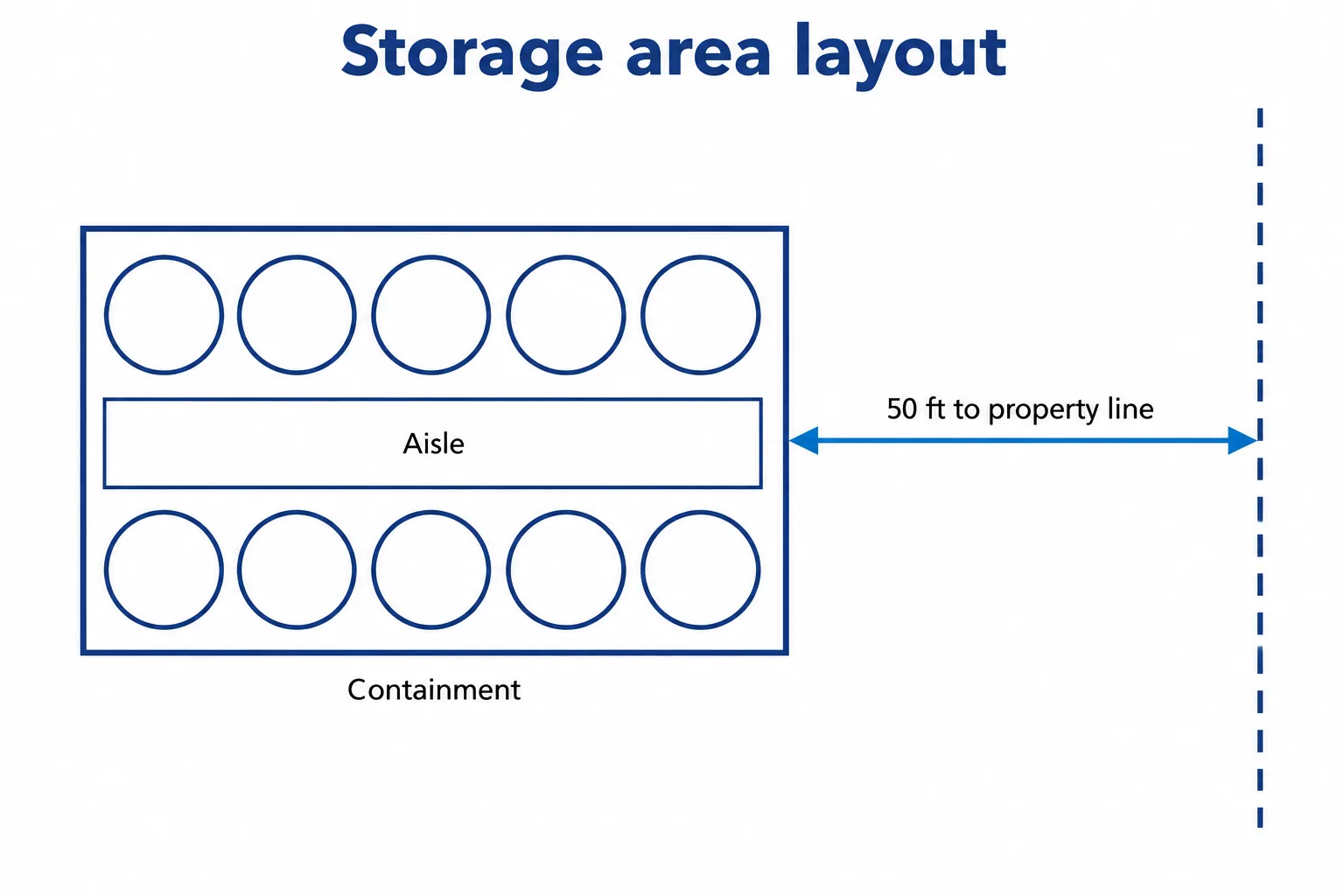
Secondary containment should hold the largest container’s volume plus a precipitation allowance, with sumps kept dry rather than used as a reservoir. The base needs to be crack-free and impervious to what sits on it.
Aisle space must let personnel, spill equipment, and fire protection equipment reach every container unobstructed. Containers of ignitable or reactive waste must sit at least 50 feet from the facility’s property line. Add ignition source control, locked access, and weather protection.
Fire-Rated and NFPA Compliant Storage Building Options
One engineered enclosure closes several checklist items at once: an integral containment sump, ground and bond points, mechanical ventilation, explosion relief. Fire-rated storage buildings suit ignitable waste.
Blast resistant buildings address reactive or high-consequence streams. Specify electrical classification for the hazard class present, with explosion-proof components where the atmosphere warrants them.
Selection of hazardous material storage buildings turns on hazard class, volume, occupancy, and distance to the property line and occupied structures. A single hazmat building also puts safety storage into one inspectable footprint, which shortens the weekly walk.
Weekly Inspections and Records
Generators must inspect hazardous waste containers for condition and leaks at least weekly. The log captures date, inspector, area, observations, corrective action, and close-out date. Keep records for the retention period your program requires and attach photos, since an image of a repaired sump ends an argument fast.
Have the audit package ready: waste determinations, manifests, biennial report, contingency plan, personnel records, and land disposal restriction notifications.
Emergency Readiness and Personnel
Spill kits stocked, sized to the largest credible release, staged outside the spill zone. Eyewash and shower access, extinguishers, and an alarm or communication device within reach of the pad. Name an emergency coordinator, keep the contingency plan current, and confirm arrangements with local responders. RCRA also expects training relevant to the employee’s role, reviewed on an annual cycle. Post emergency contacts at the door.
Hazardous Waste Storage Compliance Checklist Gaps Most Sites Miss
Rinsate from container and equipment washout is a regulated stream. It needs its own determination, container, and label, not a floor drain.
Confirm RCRA empty criteria before any drum leaves the waste stream or goes to a crusher.
Volume reduction changes the arithmetic of the whole program: fewer drums mean a smaller footprint, lower disposal cost, and fewer containers to inspect and document each week.
CTI manufactures industrial compactors for hazardous, low-level radioactive, solid, and saturated waste, with optional NEMA 7 explosion-proof components, liquid removal systems, HEPA and VOC/carbon filtration, drum crush packages, and stainless steel platens and chambers for decontamination.
How to Run This Hazardous Waste Storage Compliance Checklist Before an Audit
Walk the site in inspector order: container, label, containment, aisle, records. Run a documented weekly inspection, a monthly area sweep, and an annual program review. Close every corrective action in writing with an owner and a due date. Rules change, so track updates through the latest hazardous waste storage news.
Related readingPrefabricated vs Custom Hazmat Storage Building GuideRead the guide →Frequently asked questions
How often must hazardous waste storage areas be inspected?
What has to appear on a hazardous waste container label?
Is secondary containment required for all hazardous waste containers?
How much aisle space is required between rows of drums?
Does a satellite accumulation area follow the same rules as a central accumulation area?
Key Takeaway
This checklist earns its keep on routine items, because that is where failures cluster: an open bung, a missing date, a blocked aisle, a skipped week.
Fewer containers and a purpose-built storage area shrink both the risk and the audit surface. Verify the federal baseline against your state program before the checklist is signed.