
Article Summary
A hazmat storage building specification tells bidders what to build, what to prove, and what to deliver. This guide is for municipal, government and engineering buyers who already know they need a unit and now have to put it on paper. It covers each line item, sample spec language, and the submittals that make bids comparable.
Still at the selection stage? Start with our step-by-step guide to choose a hazmat storage building, then return here to write the procurement document.
Why a Vague Spec Costs You Later
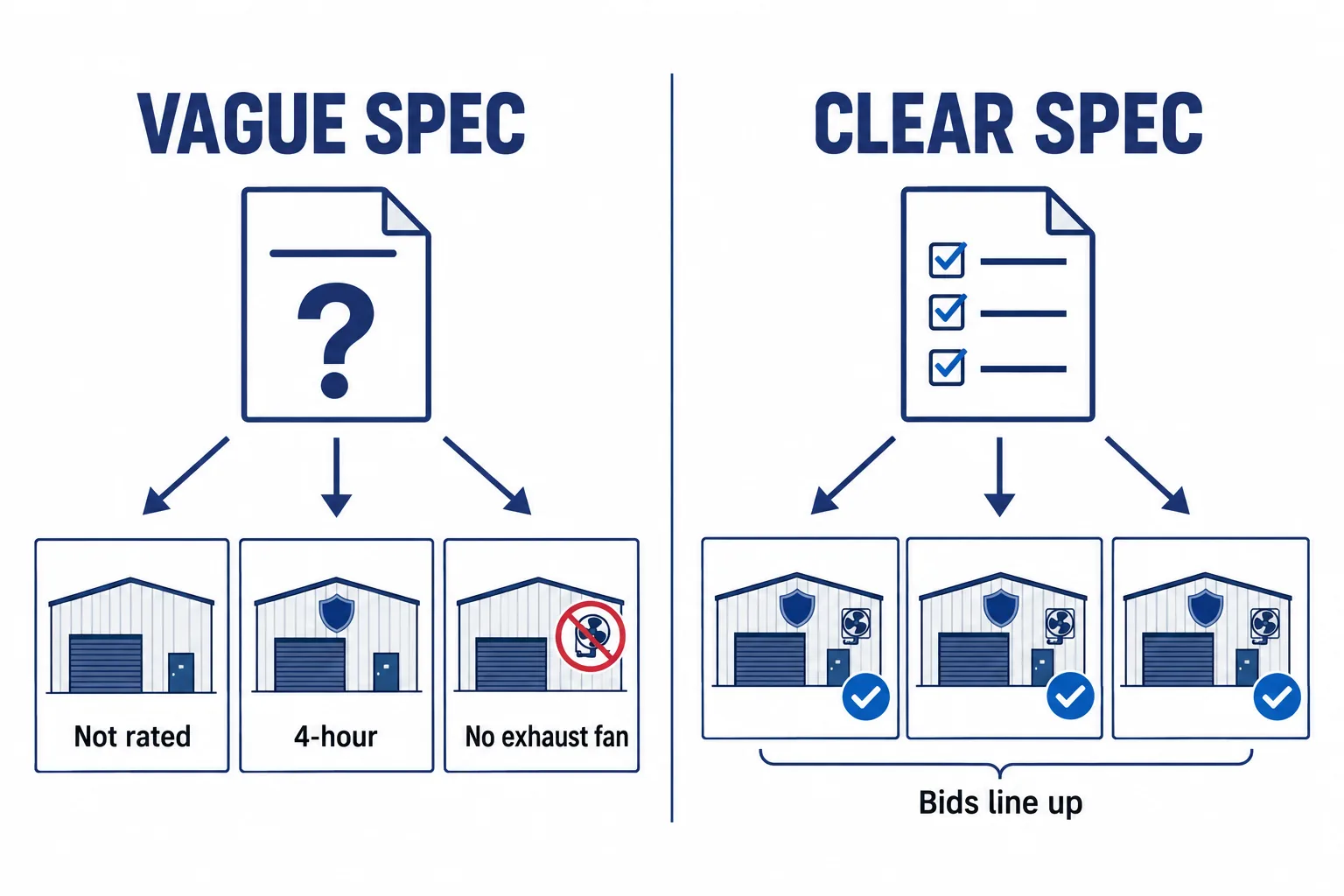
“Fire rated building, approx. 10×12” will draw bids. They just won’t line up. One bidder quotes a non-rated steel unit, another quotes a 4-hour building, and a third leaves out the exhaust fan.
The gaps are predictable: no fire rating direction, no basis for sump capacity, no electrical classification, no list of required submittals. Close them, and you can reject non-compliant bids on paper before award.
A clear hazmat storage building specification is the cheapest way to make every bidder answer the same question.
Timing matters too. A prefabricated hazmat storage building leaves the factory as a finished assembly, so late changes are costly or impossible. Lock requirements in first.
Line Items Every Hazmat Storage Building Specification Needs
Use this table as the skeleton of your RFQ. Each row becomes a numbered clause.
| Line item | What to state | Proof to request with the bid |
|---|---|---|
| Chemical inventory | Products, hazard classes, container sizes, maximum quantity | Bidder confirmation that the design suits the list |
| Fire rating | Non-rated, 2-hour or 4-hour, plus direction | Fire test reports or listing |
| Third-party approval | Named approval and listed model | Approval certificate |
| Containment | Sump volume and calculation basis | Sump calculation |
| Ventilation | Exhaust rate, inlet and outlet location, dampers | Fan data and airflow calculation |
| Electrical | Hazardous location class and division | Schematics and cut sheets |
| Structural loads | Code edition, wind, snow, seismic | Stamped calculations where required |
| Doors | Size, hardware, spill ramp | Door schedule |
| Shelves and racks | Load per shelf, integral containment | Rack drawings |
| Static control | Bonding points, drum grounding | Electrical drawings |
| Warranty and delivery | Terms, lead time, pad requirements | Written warranty and schedule |
Fire Rating and Fire Rating Direction
Fire rating belongs near the top of any hazmat storage building specification, because it sets how far the building must sit from its neighbors.
Tie the rating class to setback. Non-rated units suit isolated pads with generous separation and lower-hazard stock. A 2-hour or 4-hour rating comes into play as the building sits closer to occupied structures, property lines or high-value assets. Your authority having jurisdiction (AHJ) confirms which class applies.
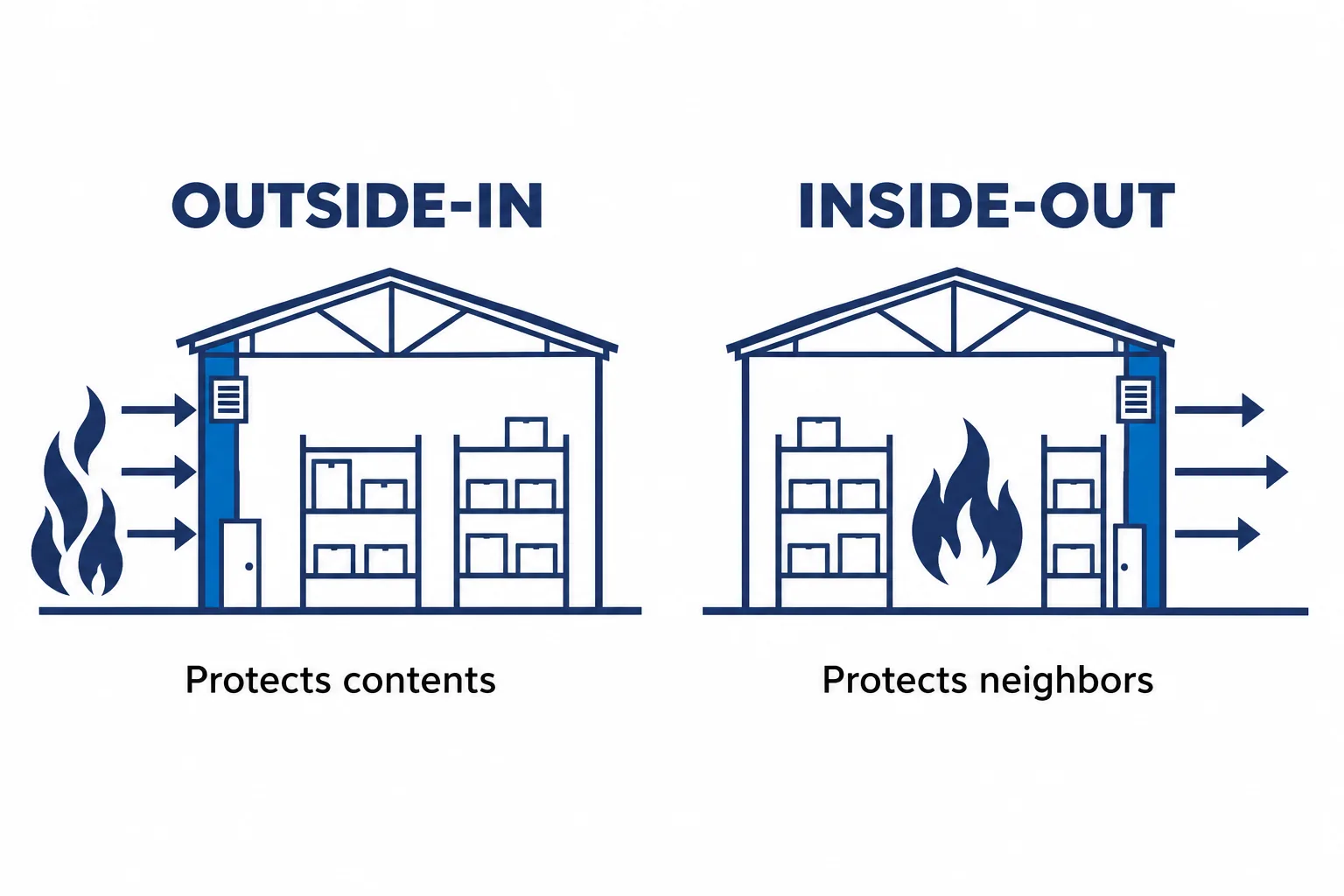
Then state the direction. Outside-in protects the contents from an exterior fire. Inside-out protects neighbors from a fire inside the unit. Many sites need both.
A rated wall is only as good as its weakest opening, so name the accessories: self-closing fire-rated doors and fire dampers with fusible links on every vent.
> Sample language: “The building shall provide a \[2/4\]-hour fire rating in both directions. Doors, dampers and all wall penetrations shall carry a rating matched to the wall assembly.”
Third-Party Approval (FM Approval and Listings)
If your owner or insurer requires FM approval or another listing, say so, and make the bidder cite the exact approval standard and the listed model number. Approvals apply to a specific model and configuration, and added options or field changes may affect them, so ask each bidder to confirm how options affect the listing.
> Sample language: “Bidder shall submit the approval or listing document, with the standard cited and the model identified, with the bid. Documents submitted after award will not be accepted.”
Spill Containment Capacity
State the sizing basis, not just a gallon figure. For hazardous waste container storage, EPA’s containment rule at 40 CFR 264.175 requires capacity for 10% of the volume of containers or the volume of the largest container, whichever is greater. State and local rules may ask for more.
Specify welded, liquid-tight steel sump construction, removable grating, and a chemical-resistant coating where corrosives or rinsate are stored.
> Sample language: “Sump capacity shall be not less than \[X\] gallons. Bidder shall show the calculation basis, including total container volume and the largest single container.”
Ventilation
State the exhaust rate in air changes per hour or CFM per square foot, as your AHJ requires. Place inlet and exhaust openings near floor level, since most flammable vapors are heavier than air. In rated buildings, require a fire damper at every penetration.
> Sample language: “Mechanical exhaust shall run continuously \[or be interlocked with the light switch\], with inlet and exhaust openings located within \[X\] inches of the floor.”
Electrical Classification
For flammable liquids, state the hazardous location class and division (for example, Class I, Division 1 or Division 2) as your electrical engineer determines. List the parts that must be explosion-proof: lights, switches, exhaust fan motor, and any heater or air conditioner.
Where drums are opened or product is dispensed inside, require bonding points, a 55-gallon drum grounding kit, and damage-limiting construction (explosion-relief) panels.
> Sample language: “All electrical components shall be rated for Class \[I\], Division \[1/2\] locations and installed per the adopted electrical code.”
Structural Loads in a Hazmat Storage Building Specification
Name the building code edition your jurisdiction has adopted, plus the design wind speed, ground snow load and seismic design category for the site. Require calculations stamped by a licensed engineer where the jurisdiction calls for them, and state the anchorage method to the pad.
Defense installations often add stricter load cases and security clauses. Our military hazmat storage building specs cover those in detail.
Doors, Shelves and Security
- Doors: width for drum carts or forklift access, self-closing hardware, lockable latch, integral spill ramp.
- Shelves: rated load per shelf, integral containment, and physical separation for incompatible chemicals.
- Security: padlock hasp, hazard signage, and mounts for NFPA hazard placards.
Submittals to Require With the Bid
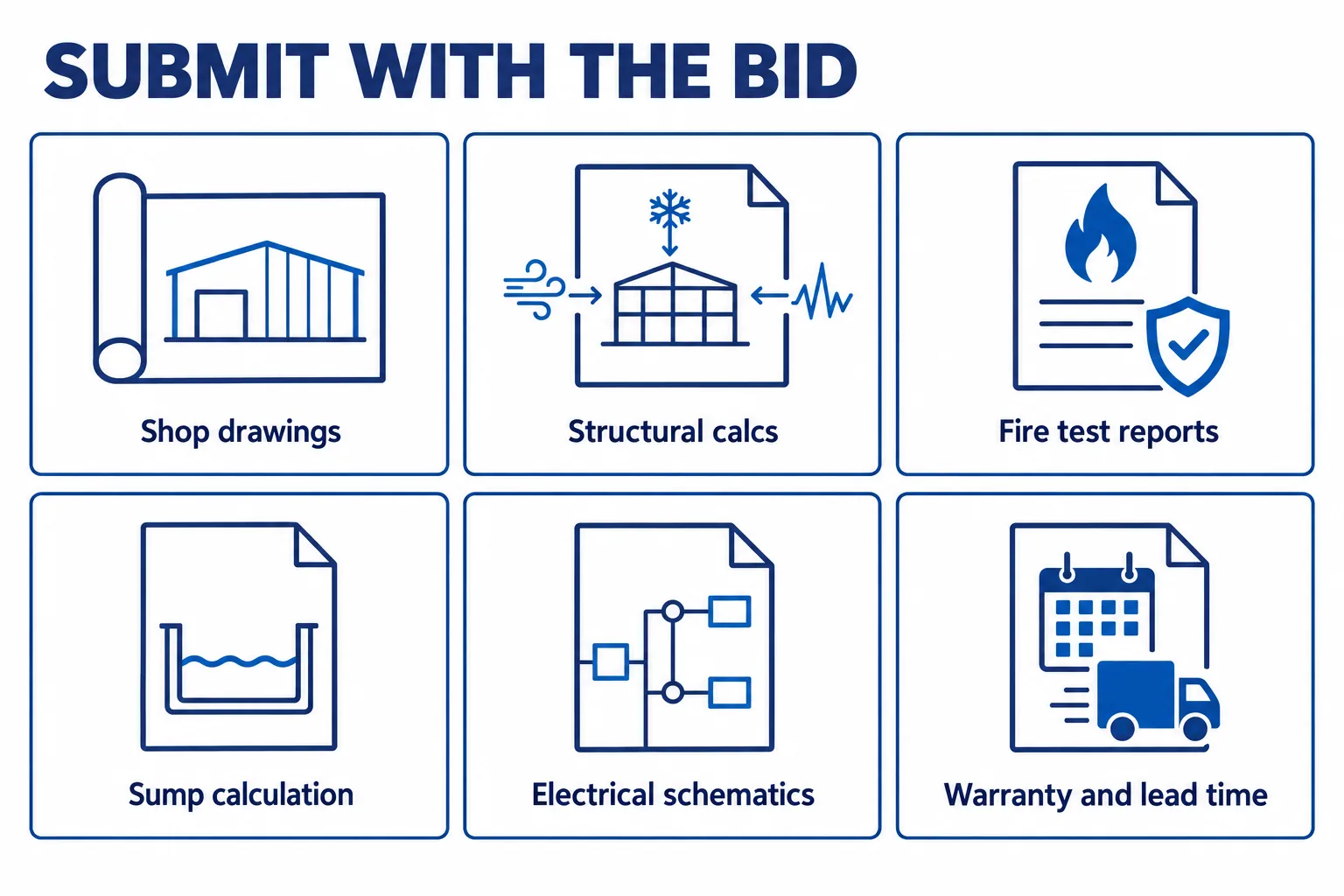
Your hazmat storage building specification should ask for these with the bid, not after award:
- Shop drawings and general arrangement drawings
- Structural calculations for wind, snow and seismic loads
- Fire test reports or approval and listing documents for the stated rating
- Sump capacity calculation
- Electrical schematics and component cut sheets
- Warranty terms, delivery lead time and site pad requirements
Some sites need sizes, loads or layouts outside standard catalog models. In that case, allow alternate proposals and invite custom-engineered hazmat storage solutions rather than force a poor fit.
Codes Your RFQ Should Reference
Your hazmat storage building specification should point to the codes that govern the site, by edition, as adopted locally:
| Code | What it covers | Where it applies in the spec |
|---|---|---|
| OSHA flammable liquids standard | Storage rooms, ventilation, electrical equipment, quantity limits | Ventilation, electrical |
| NFPA code for flammable and combustible liquids | Primary reference for flammable liquid storage, including separation distances | Fire rating, setback |
| National Electrical Code (hazardous location articles) | Wiring and equipment in classified areas | Electrical classification |
| EPA container containment rules (40 CFR 264.175) | Hazardous waste containers: capacity for 10% of total container volume or the largest container, whichever is greater | Spill containment |
| Local fire code as adopted by your AHJ | Local requirements, including separation distances | All sections, confirmed by the AHJ |
> Sample language: “The building shall comply with all codes adopted by the AHJ at the time of bid. Where requirements conflict, the more stringent shall govern.”
Related readingLaboratory Chemical Storage Building: Specs & PricingRead the guide →Frequently asked questions
What are the OSHA hazmat storage requirements for a storage building?
How far should a flammable storage building be from other buildings?
What NFPA standard applies to hazardous material storage buildings?
What does fire rating direction mean in a hazmat building spec?
Should a spec name a specific manufacturer or model?
Closing Takeaway
A hazmat storage building specification that states rating, direction, containment basis, electrical classification, loads and submittals produces bids you can compare line by line, and a building ready for AHJ review.