
A wind load rating chemical storage building spec runs from a 90 mph baseline up to 170 mph and beyond on large or coastal-rated units. The number your project needs comes from ASCE 7 and the local authority having jurisdiction, not from a catalog sheet. Below: the rating math, typical ranges by size class, the construction and anchorage behind the number, and the documents to demand before purchase.
What a Wind Load Rating Actually Measures
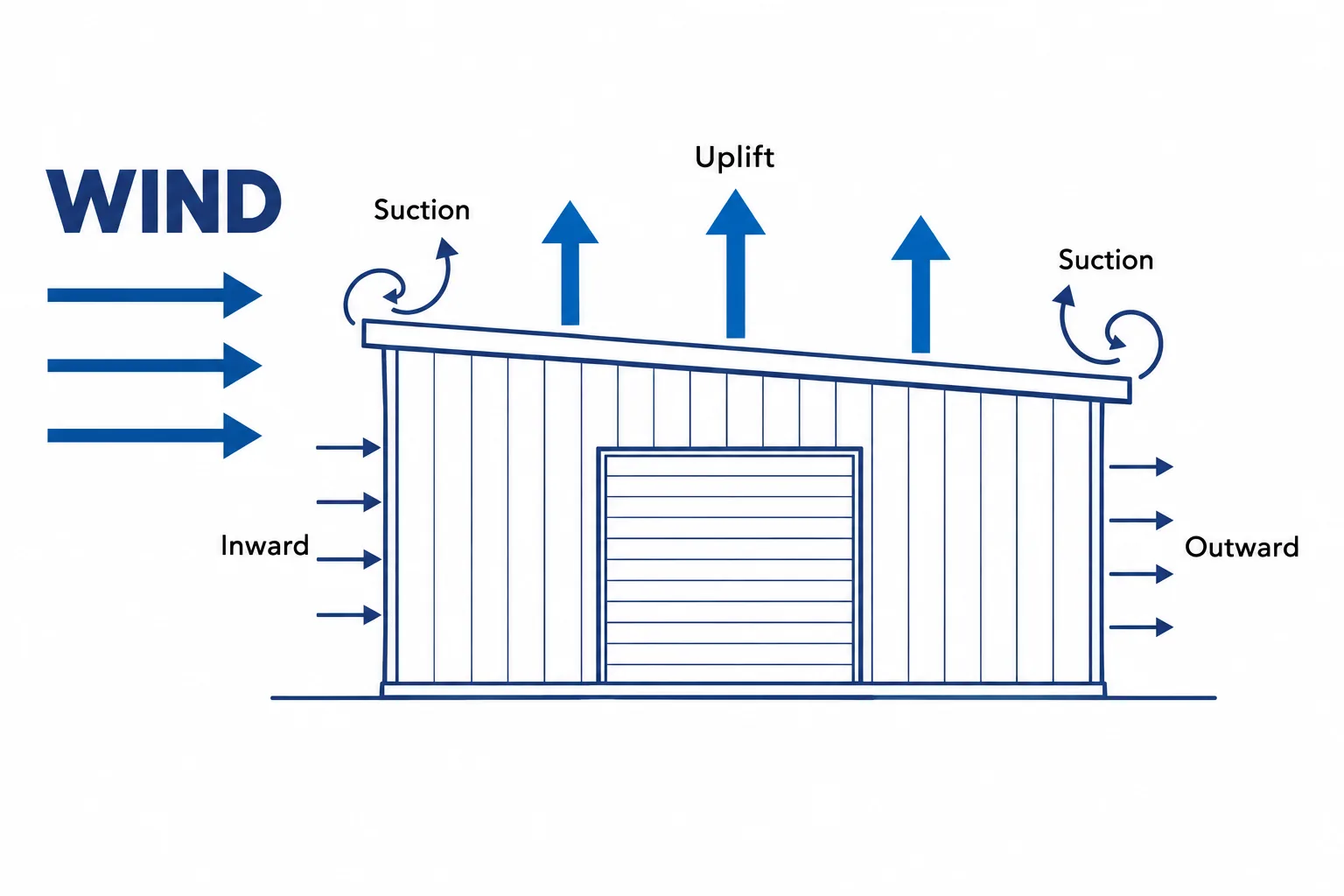
Two distinct numbers appear on every quote, and buyers conflate them. Design wind speed is stated in mph as a 3-second gust. Design wind pressure is stated in pounds per square foot (psf), the force that gust applies to walls and roof.
Velocity pressure varies with the square of wind speed. A move from 90 mph to 150 mph is not a 67% jump in load, it is roughly 2.8x. That is why a high-wind version of the same model needs heavier framing, not a few extra fasteners.
Pressure acts inward on the windward wall and outward on leeward walls and the roof. Uplift across roof panels, plus suction at corners and edges, usually governs. Doors, louvers, and vents fail first.
A 150 mph frame with 90 mph door hardware is a 90 mph building.
Treat the figure as a system rating. Frame, panels, fasteners, door hardware, and anchorage all carry the same speed.
Ultimate vs. Nominal Wind Speed: Why Two “90 mph” Buildings Differ
ASCE 7-10 and later editions publish basic wind speeds as ultimate, strength-level values. Earlier editions published nominal, allowable-stress-level speeds. The two are not interchangeable. A legacy 90 mph nominal rating represents different real capacity than 90 mph quoted against a current map.
Ask any supplier two questions: which ASCE 7 edition does the rating reference, and is the speed ultimate or nominal? Most product pages state neither, which makes this the most common spec error in the category.
Wind Load Rating Chemical Storage Building Specs by Size Class
| Building class | Approximate footprint | Commonly offered design wind speed | Typical design pressure | Typical anchorage |
|---|---|---|---|---|
| Compact hazardous material locker | Under ~100 sq ft | 90 mph baseline | Commonly cited 20–28 psf band | Bolt-down anchor plates to slab |
| Standard prefabricated unit | Up to ~1,200 sq ft | 90–120 mph, upgradeable | Commonly cited 20–28 psf band | Perimeter anchor plates, engineered pad |
| Large modular unit | ~1,600 sq ft and above | 150–170 mph or custom | Site-specific | Hold-down brackets, thickened footing |
These are typical market values, not design values. Your project number comes from a stamped calculation for your address.
Larger footprints carry higher published ratings because sail area forces heavier framing and deeper foundations anyway. Compact hazmat storage containers and lockers ship with a baseline rating, while hazardous material storage buildings above roughly 1,200 sq ft get engineered case by case.
How ASCE 7 and Local Code Set the Number You Need
Five site inputs drive the design speed: the wind map value at your coordinates, risk category, exposure category (B, C, or D), topographic factor for hills and escarpments, and enclosure classification.
Each input changes the design speed or pressure in a different way.
| Site input | What it is | How it changes the design |
|---|---|---|
| Wind map value | Basic wind speed at your coordinates | Sets the baseline speed |
| Risk category | Classification by occupancy and hazard | Hazmat above exempt amounts falls into an elevated category, which raises the design speed compared with an ordinary shed |
| Exposure category (B, C, or D) | Surrounding terrain | Open farmland or a coastal pad (C or D) sees higher pressures than a unit shielded inside a dense plant |
| Topographic factor | Hills and escarpments near the site | Adjusts the design speed for terrain that speeds up wind |
| Enclosure classification | How sealed the shell is | Heavily louvered or gravity-vented buildings can classify as partially enclosed, which raises internal pressure and the required capacity |
Risk category deserves attention. Under the International Building Code, structures that hold hazardous materials above exempt amounts fall into an elevated risk category, which raises the design wind speed compared with an ordinary shed on the same site.
Exposure matters as much as geography. A unit on open farmland or a coastal pad sees Exposure C or D pressures well above one shielded inside a dense plant.
Enclosure classification catches people out. Heavily louvered or gravity-vented chemical buildings can classify as partially enclosed, which raises internal pressure and drives up the required capacity of the same shell.
The authority having jurisdiction approves the calculation, not the catalog. Confirm which code edition your jurisdiction enforces before you issue a purchase order.
Construction Features That Deliver the Rating
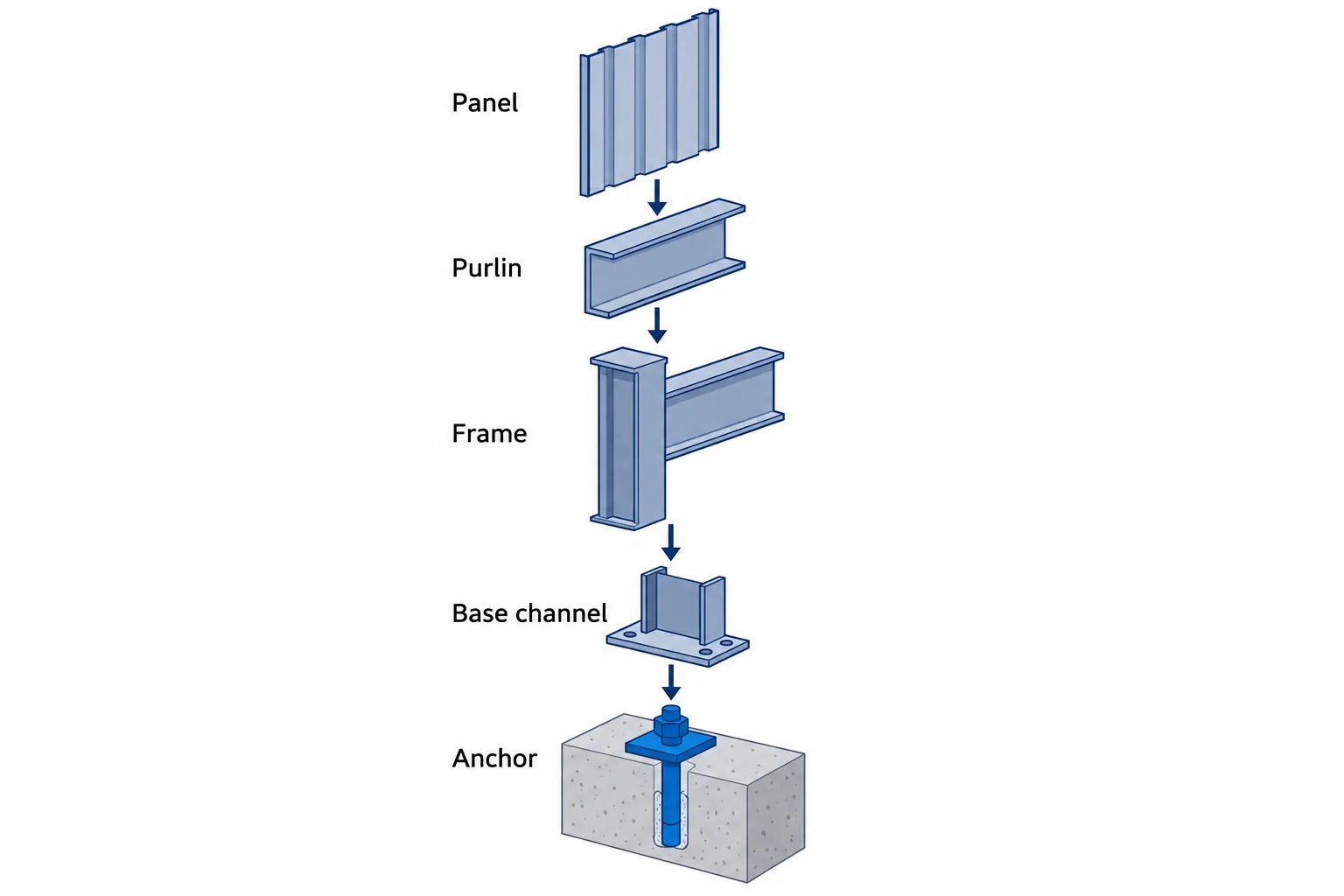
All-welded heavy-gauge steel framing and exterior panels outperform bolted light-gauge assemblies under cyclic pressure. The load path stays continuous: panel to purlin, purlin to frame, frame to base channel, base channel to anchor.
Doors are the weak link. Three-point latches, reinforced frames, and hardware with its own pressure rating. Roll-up doors and personnel doors each need a documented rating that matches the shell.
Fire-rated storage buildings add mass and multi-wall construction, which generally helps lateral performance while it raises anchorage and foundation loads. That trade belongs in the calculation, not in a sales conversation.
Anchor Plates, Uplift, and the Concrete Pad
Hold-down brackets and bolt-down anchor plates transfer uplift and overturning into the slab. Anchorage to concrete falls under ACI 318, which controls embedment depth, edge distance, and breakout strength in tension and shear.
The pad is part of the rating. Slab thickness, reinforcement, and edge detail must suit the same speed the building claims. Skid-mounted or unanchored placement voids most published ratings outright.
Secondary containment sumps and rinsate collection pans sit inside the footprint and change base detailing, so hand those drawings to the foundation designer early.
What Proves a Wind Load Rating Chemical Storage Building Claim
Request five items with every quote:
- PE-stamped structural calculations sealed for the project state
- ASCE 7 edition cited, with speed basis identified as ultimate or nominal
- Risk category, exposure category, and enclosure classification listed
- Anchorage details plus the reaction loads imposed on the foundation
- Third-party product approval or test reports where the jurisdiction requires them
Wind Rating Is Not a Blast or Seismic Rating
A wind rating covers one load case. Everything else is specified and engineered separately.
| Load or requirement | What it is | Covered by the wind rating? |
|---|---|---|
| Sustained wind | Pressure and uplift from a 3-second gust | Yes |
| Blast overpressure | Short-duration shock load | No. A 170 mph shell carries no defined blast capacity |
| Deflagration venting | Pressure relief for reactive or flammable inventory | No. It works against a wind-tight enclosure, so engineer both together |
| Snow load | Roof load from ground snow | No. Specified alongside wind and can govern roof framing |
| Seismic design category | Earthquake load | No. Specified alongside wind and can govern roof framing |
| NFPA rules for flammable liquids | Construction, ventilation, separation, electrical classification | No. These sit outside the structural calculation |
Blast resistant buildings and blast proof buildings address short-duration overpressure, a different load case than sustained wind. A 170 mph shell carries no defined blast capacity.
Deflagration venting for reactive or flammable inventory works against a wind-tight enclosure, so both get engineered as one problem. An NFPA compliant storage building for flammable liquids also has to satisfy construction, ventilation, separation, and electrical classification rules that sit outside the structural calculation.
Snow load and seismic design category are specified alongside wind and frequently govern roof framing on their own.
Specification Worksheet Before You Request a Quote
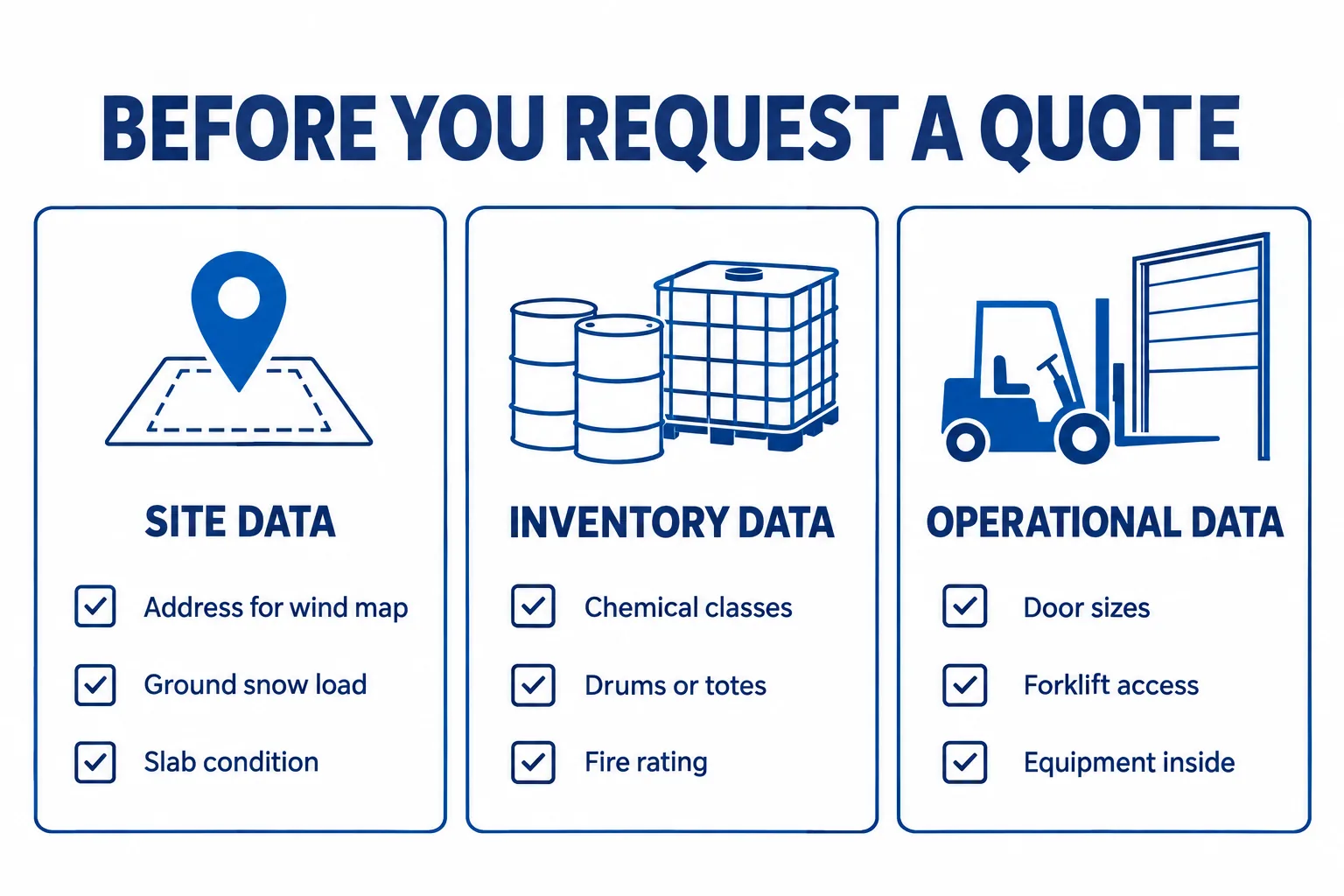
Site data:
Street address for the wind map lookup, exposure category, risk category, ground snow load, seismic design category, existing slab condition.
Inventory data:
Chemical classes, quantities against exempt amounts, container type such as drums or totes, ventilation rate, fire rating requirement.
Operational data:
Door sizes and swing, forklift access, equipment installed inside. From an engineering perspective, that last line gets skipped too often.
Waste compaction units, drum crushers, and filtration skids add concentrated point loads and their own anchorage needs, and in hazardous atmospheres they carry electrical classification requirements such as NEMA 7 explosion-proof components alongside HEPA or carbon filtration duties.
Size the slab and the envelope around the equipment, not after it arrives. Hazardous material storage solutions that ignore interior equipment loads get redesigned twice.
Related readingLaboratory Chemical Storage Building: Specs & PricingRead the guide →Frequently asked questions
What wind load rating do I need for a chemical storage building?
Is 90 mph enough?
Does a higher wind rating require a thicker concrete pad?
Can an existing building be upgraded to a higher rating?
Do small hazardous material lockers need a wind rating?
Closing Takeaway
Treat the wind number as a project deliverable with paperwork behind it, not a catalog feature. Rating, anchorage, and foundation form one system, and the weakest of the three sets your real capacity. Confirm the code edition your jurisdiction enforces, then buy against a stamped calculation.