
Article Summary
Hazmat storage requirements do not come from one rulebook. OSHA, the EPA, NFPA and the International Fire and Building Codes each control a different slice: worker labels, waste time limits, cabinet construction, and how much product a room can hold.
This guide maps which rule covers what and routes you to our detailed posts for the depth.
Short answer: store by hazard class, separate incompatibles, use approved containers and cabinets, stay within quantity limits, label every container, and keep exits and ignition sources clear.
Who Sets Hazmat Storage Requirements? A Rule-by-Rule Map
Related readingPharmaceutical Chemical Storage Building: Buyer’s GuideRead the guide →| Rule | Body | What it governs | Applies to |
|---|---|---|---|
| 29 CFR 1910.106 | OSHA | Flammable liquid containers, cabinets, inside storage rooms | General industry |
| 29 CFR 1926.152 | OSHA | Flammable liquids on construction sites | Construction |
| 29 CFR 1910.1200 (HazCom) | OSHA | Labels, Safety Data Sheets, worker training | Employers with hazardous chemicals |
| 1910 Subpart H | OSHA | Compressed gases and other hazardous materials | General industry |
| RCRA (40 CFR 262, 264, 265) | EPA | Hazardous waste accumulation, containers, time limits | Waste generators |
| SPCC (40 CFR 112) | EPA | Oil storage, spill plans, secondary containment | Sites above the oil threshold |
| NFPA 30 / NFPA 400 | NFPA | Flammable liquids; oxidizers, peroxides, toxics | Via adopted fire codes |
| IFC / IBC | ICC | Maximum allowable quantities, Group H occupancy | Jurisdictions that adopt them |
States and cities often adopt these codes with local amendments. Your authority having jurisdiction (AHJ) has the final word on how they apply at your site.
The same codes bind every structure type, a point our comparison of prefabricated vs custom hazmat storage buildings covers in full.
OSHA Hazmat Storage Requirements
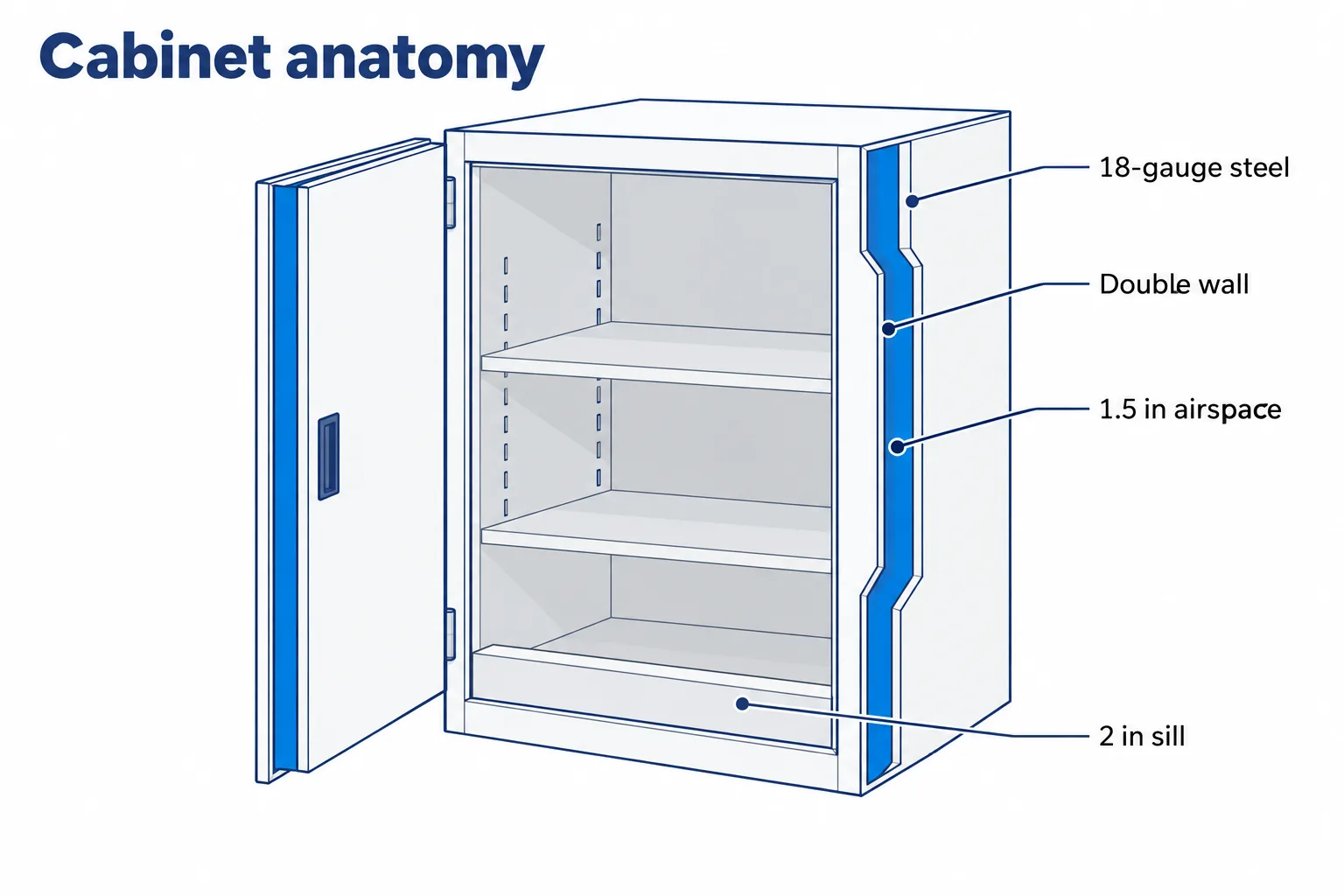
OSHA has no single hazmat storage standard. Its rules sit across 1910.106 for flammable liquids, 1910.1200 for hazard communication, and Subpart H for other hazardous materials. Together they set container types, cabinet specs, per-room quantity caps, and the label and SDS access workers need.
Flammable Liquid Hazmat Storage Requirements Under 1910.106
1910.106 sets three limits: how much flammable liquid can sit outside an approved cabinet in one room, how much a single cabinet can hold by liquid category, and how many cabinets can share one area. Pull exact figures from the current text, since they shift by category and room type.
Cabinet construction is specific. University safety guidance on flammable liquids storage cabinet construction sets metal cabinets at 18-gauge steel or heavier, double-walled with a 1.5-inch airspace, door included, with a raised sill of at least 2 inches and a “Flammable – Keep Fire Away” label.
For Class I liquids, ground and bond drums before you transfer product.
HazCom Labels and Safety Data Sheets
Every container needs a label with the product identifier and hazard information. That covers secondary containers such as spray bottles and transfer cans, unless the worker who fills one uses all of it right away.
Safety Data Sheets must stay accessible to workers on every shift.
EPA Rules: Hazardous Waste and Oil Storage
RCRA governs waste, not product inventory. A drum of new solvent falls under OSHA and the fire code; once spent, the same drum becomes a RCRA waste container.
| Product inventory | Hazardous waste | |
|---|---|---|
| Rulebook | OSHA and the fire code | RCRA (EPA) |
| Time limit | No federal clock; follow the manufacturer’s shelf life | Set by generator status; large quantity generators get a shorter window than small ones |
| Container rules | Approved containers and cabinets, within quantity limits | Good condition, leak-free, compatible with contents, closed except when adding or removing waste |
| Example | A new drum of solvent | The same drum once the solvent is spent |
Waste containers must stay in good condition, free of leaks, compatible with the contents, and closed except when you add or remove waste. Rinsate from container cleanout can be a regulated waste too, so characterize it before disposal.
How long can hazardous materials be stored? For hazardous waste, the limit depends on generator status, and large quantity generators get a shorter window than small ones. Our guide to the 90-day hazardous waste storage rule explains each category. Product inventory has no federal clock; shelf life comes from the manufacturer.
Where empty drums pile up, a drum crusher can cut the floor space a waste area needs.
SPCC applies to facilities whose aboveground oil capacity passes an EPA threshold and could reach navigable waters. Those sites need a written spill plan and secondary containment. Confirm the current threshold in 40 CFR 112.
Segregation and Chemical Compatibility
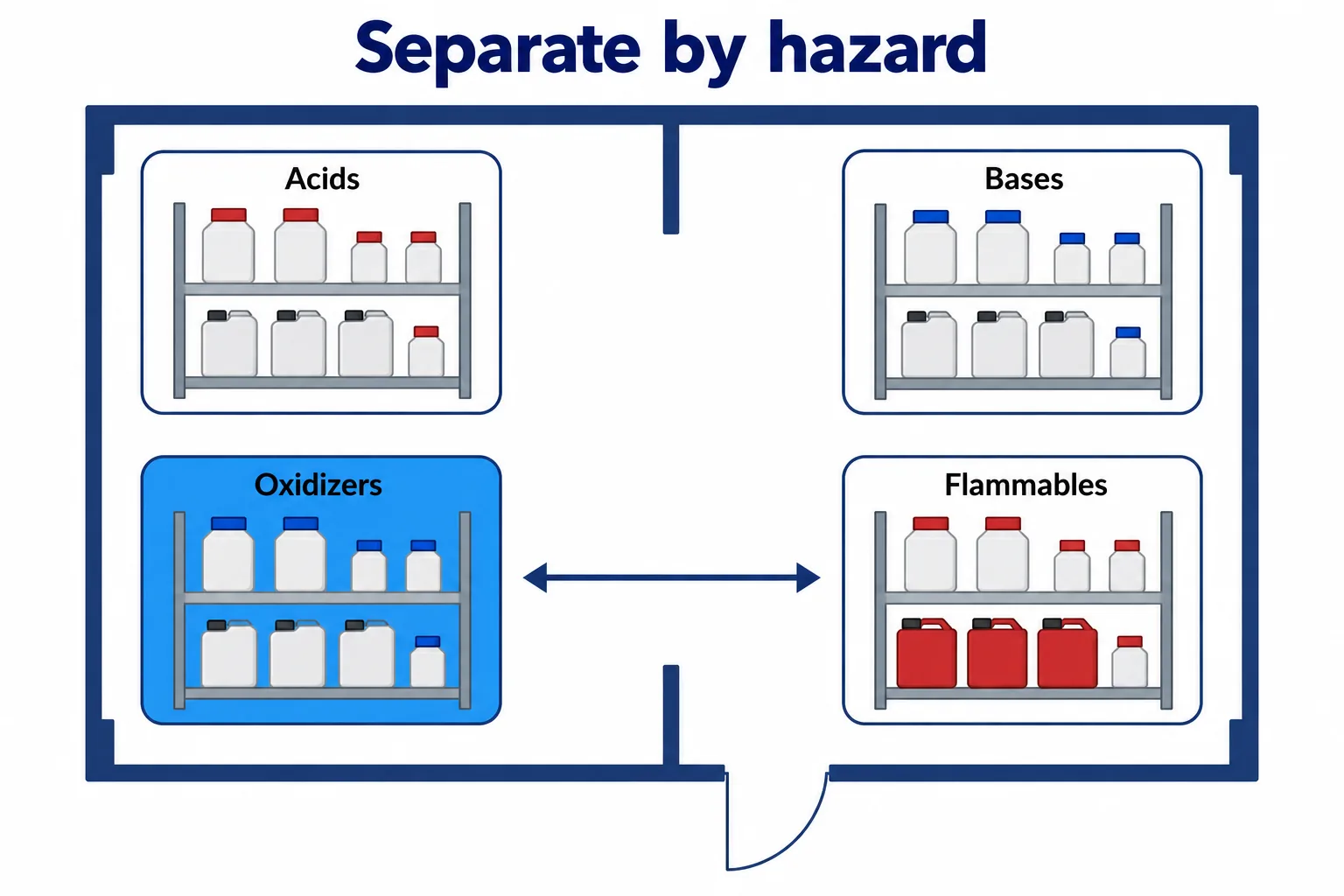
Segregation is where the rules meet daily practice. How should hazmat be stored?
- Group by hazard class, never alphabetically.
- Keep acids away from bases.
- Keep oxidizers away from flammables and combustibles.
- Keep water-reactives away from aqueous solutions.
- Store heavy and corrosive containers below eye level.
- Keep aisles, stairways and exits clear.
Separation can mean distance, separate cabinets, barriers, or separate structures. Our chemical compatibility storage chart lays out the full group tables.
Fire Code Quantity Limits (IFC/IBC and NFPA 400)
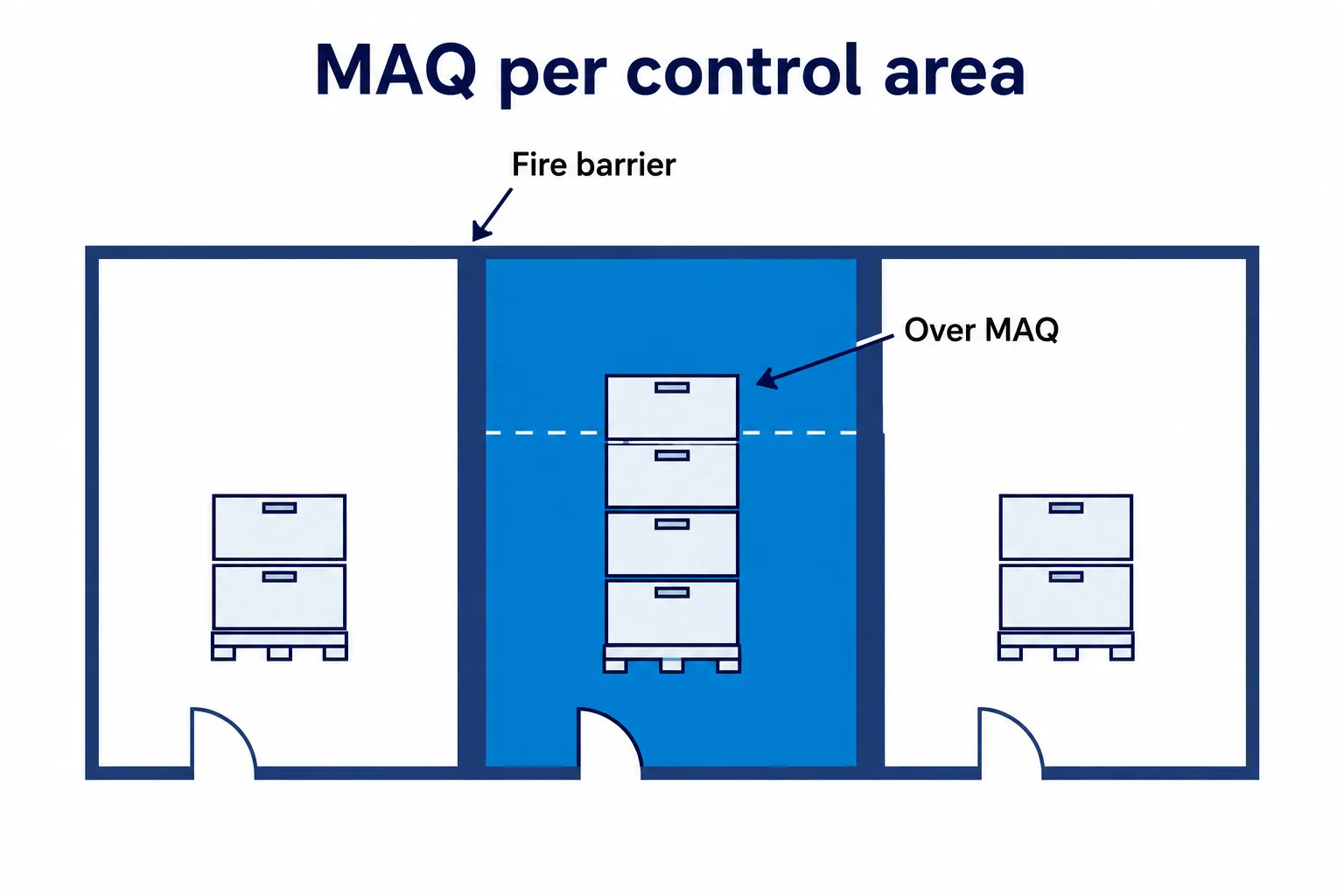
The IFC and IBC set a maximum allowable quantity (MAQ) for each hazard class per control area, a space bounded by fire barriers. Exceed the MAQ and the space may need Group H occupancy construction, added sprinkler protection, or a detached structure.
MAQs vary with code edition, sprinkler status and approved cabinets. Use the table from the edition your jurisdiction adopted, and confirm with your fire official.
NFPA 400 adds class-specific rules for oxidizers, organic peroxides, toxics and other hazards outside NFPA 30.
When Hazmat Storage Requirements Call for a Dedicated Structure
Common triggers:
- Inventory above cabinet limits or MAQs
- Incompatible classes that need full separation
- Outdoor drum storage
A hazmat storage building near property lines or occupied structures may need fire-rated construction; see our fire-rated buildings. For size and layout, read how to choose a hazmat storage building.
Secondary Containment, Ventilation and Inspections
Containment. SPCC, RCRA and fire codes each call for spill control in some form, usually sumps or sills. Size them to the volume the governing rule specifies.
Ventilation. A vent is an opening in a fire barrier. Ask the cabinet maker and your AHJ before you vent a flammable cabinet, and ask how any duct must run.
Inspections. RCRA waste areas need regular, documented checks, and product storage benefits from the same habit. Our hazmat storage inspection checklist walks through each item.
Hazmat Storage FAQ
What are the OSHA hazmat storage requirements?
How long can hazardous materials be stored?
What are the rules for storing hazardous materials?
Do flammable cabinets need vents?
Who enforces hazmat storage rules at my site?
Closing Takeaway
Each rulebook covers one slice: OSHA protects workers, the EPA protects the environment, and NFPA and fire codes control fire risk. Start with an inventory by hazard class and quantity, then match each item to the rule that governs it. That map turns hazmat storage requirements from a pile of codes into a plan.