
Summary: A chemical compatibility storage chart maps hazard classes against each other so EHS and facility staff can tell which materials may share a cabinet, containment area, or building. Below: the segregation matrix, the pairs that must never meet, the physical controls behind the chart, and the federal rules that make segregation a legal duty rather than a preference.
How to Use a Chemical Compatibility Storage Chart
The chart answers one narrow question: can two hazard classes occupy the same space without risk of fire, toxic gas release, or violent reaction? Treat it as a first-pass screen, not a final answer.
Confirm every decision against Sections 7 and 10 of each Safety Data Sheet, the GHS-mandated fields that cover storage conditions and reactivity. The chart sorts classes; the SDS governs the specific product on your shelf.
One scope note trips people up: storage compatibility differs from container material compatibility. A class-level chart says nothing about whether HDPE, stainless steel, glass, or a fluoropolymer gasket survives contact.
The Nine Storage Groups Most Charts Use
- Flammable and combustible liquids (solvents)
- Oxidizers and organic peroxides 3. Inorganic (mineral) acids 4. Organic acids 5. Bases and caustics 6. Water-reactives and pyrophorics 7. Toxics and poisons 8. Cyanides, sulfides, and other acid-sensitive salts 9. Compressed gases (subdivide by flammable, oxidant, inert, toxic)
Non-reactive general chemicals form a tenth baseline group that holds the remainder.
These nine groups trace back to the same DOT hazard class system used on shipping placards and SDS labels, so a chemical’s transport classification is usually the fastest first cut for sorting it into a storage group.
Chemical Compatibility Storage Chart (Segregation Matrix)
Legend: C = co-storage acceptable · S = separate · N = never store together
Related readingHow to Pass a Hazmat Storage Inspection: Full ChecklistRead the guide →| Group | 1 | 2 | 3 | 4 | 5 | 6 | 7 | 8 | 9 |
|---|---|---|---|---|---|---|---|---|---|
| 1 Flammable liquids | – | N | S | S | S | N | S | S | S |
| 2 Oxidizers / peroxides | N | – | S | N | S | N | S | N | S |
| 3 Inorganic acids | S | S | – | S | N | N | S | N | S |
| 4 Organic acids | S | N | S | – | N | N | S | N | S |
| 5 Bases / caustics | S | S | N | N | – | N | S | C | S |
| 6 Water-reactives | N | N | N | N | N | – | S | S | S |
| 7 Toxics | S | S | S | S | S | S | – | S | S |
| 8 Cyanides / sulfides | S | N | N | N | C | S | S | – | S |
| 9 Compressed gases | S | S | S | S | S | S | S | S | – |
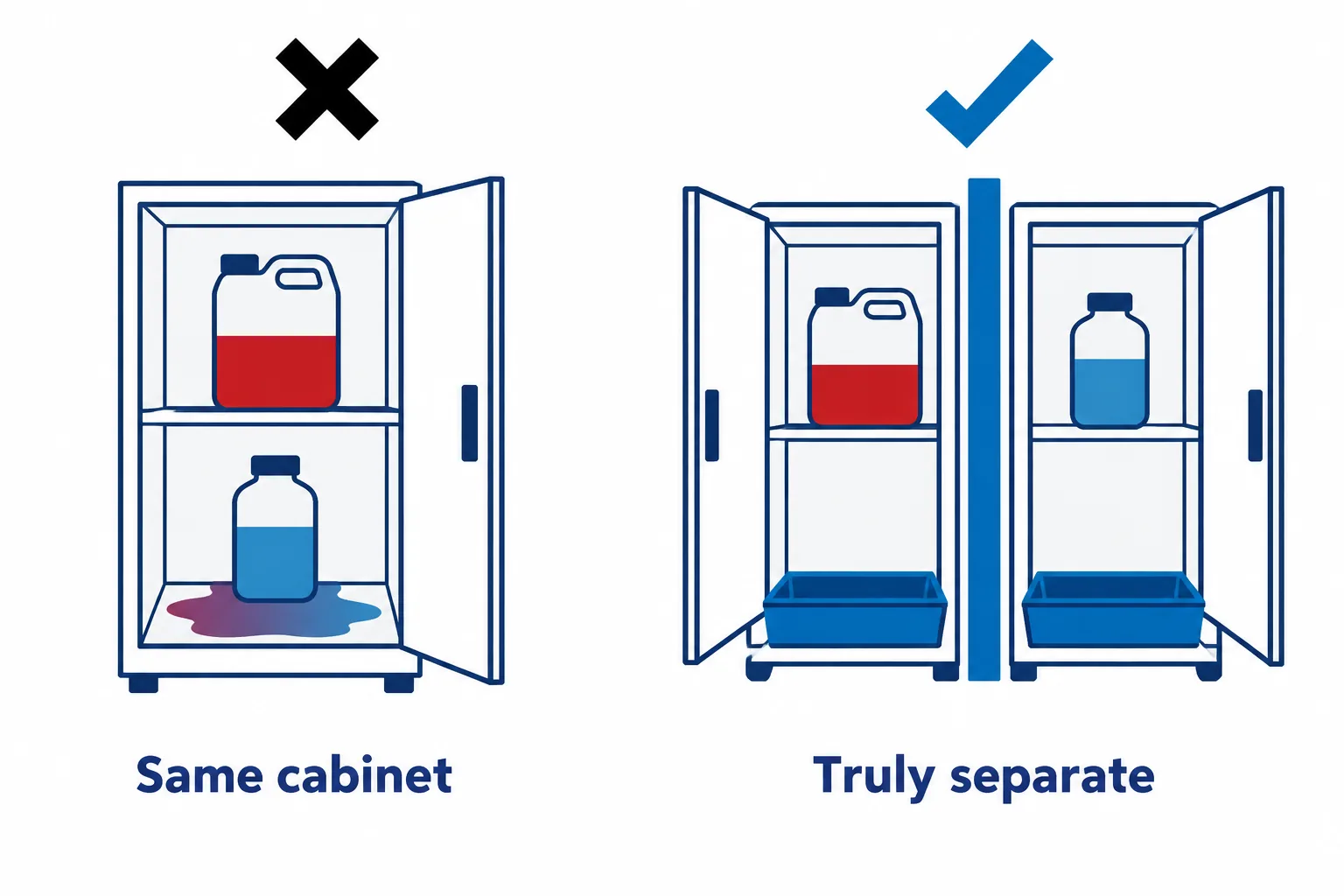
“Separate” carries a specific meaning: distinct secondary containment, a noncombustible barrier, or meaningful distance. A different shelf in the same cabinet does not qualify, because one spill or one sprinkler discharge reaches both.
Post a printed chemical compatibility storage chart PDF at every storage point, inside each hazmat building, and at the waste accumulation area. A chart PDF buried on a shared drive helps nobody at 2 a.m.
What Chemicals Can’t Be Stored Together?
- Acids and bases: violent exothermic neutralization
- Acids and cyanides or sulfides: hydrogen cyanide and hydrogen sulfide gas
- Oxidizers and flammables or organics: a direct fire and explosion pathway
- Nitric acid and acetic acid or solvents: oxidizer against fuel
- Water-reactives (alkali metals, carbides, hydrides) and aqueous solutions: hydrogen release and ignition
- Organic peroxides and heat, friction, or contamination: self-accelerated decomposition, the same runaway reaction regulators track as the self-accelerating decomposition temperature (SADT)
- Ammonia products and chlorine bleach: bleach mixed with ammonia releases toxic chloramine gases
- Hydrofluoric acid and glass or silicates: container attack
Physical Segregation Beyond the Chart
The Bio-Lab Conyers warehouse stored nearly 14 million pounds of reactive chemicals without adequate safeguards. The chemicals were packaged in roughly 5,000 large sacks, some weighing more than a ton, and their storage arrangement contributed to the fire escalating into a catastrophic incident that produced a large plume of toxic smoke and potentially exposed thousands of people.
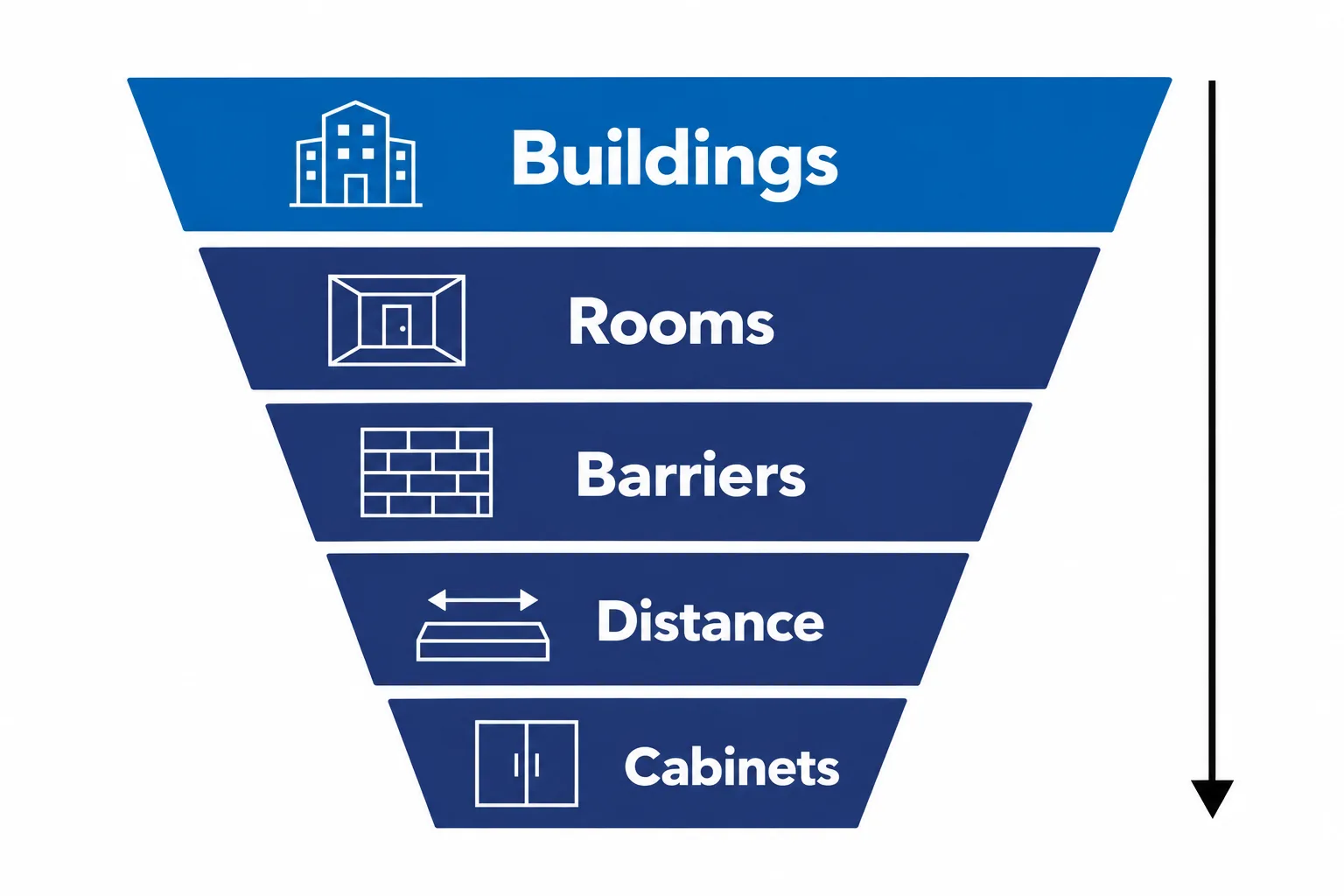
Rank the controls. Separate buildings beat separate rooms, which beat fire-rated barriers, which beat distance plus secondary containment, which beats separate cabinets. Shelf position ranks last.
Store liquids low, never above eye level, with the heaviest corrosives on bottom shelves. Size secondary containment to the largest container plus freeboard, and keep sumps segregated so a spill and its rinsate cannot commingle across classes.
High-volume flammable inventory outgrows cabinets. Fire-rated storage buildings and NFPA-compliant storage building designs supply a barrier a cabinet cannot; prefabricated hazmat storage buildings and hazmat storage containers move incompatible classes into separate outdoor units; and blast-resistant buildings apply where reactive inventory sits near occupied space.
Confirm quantity limits per control area with your local fire code official against NFPA 30 and NFPA 400.
Ventilation, bonded and grounded transfer points, and temperature control run in parallel with the chart. No matrix cell substitutes for them.
OSHA, EPA, and NFPA Rules Behind the Chart
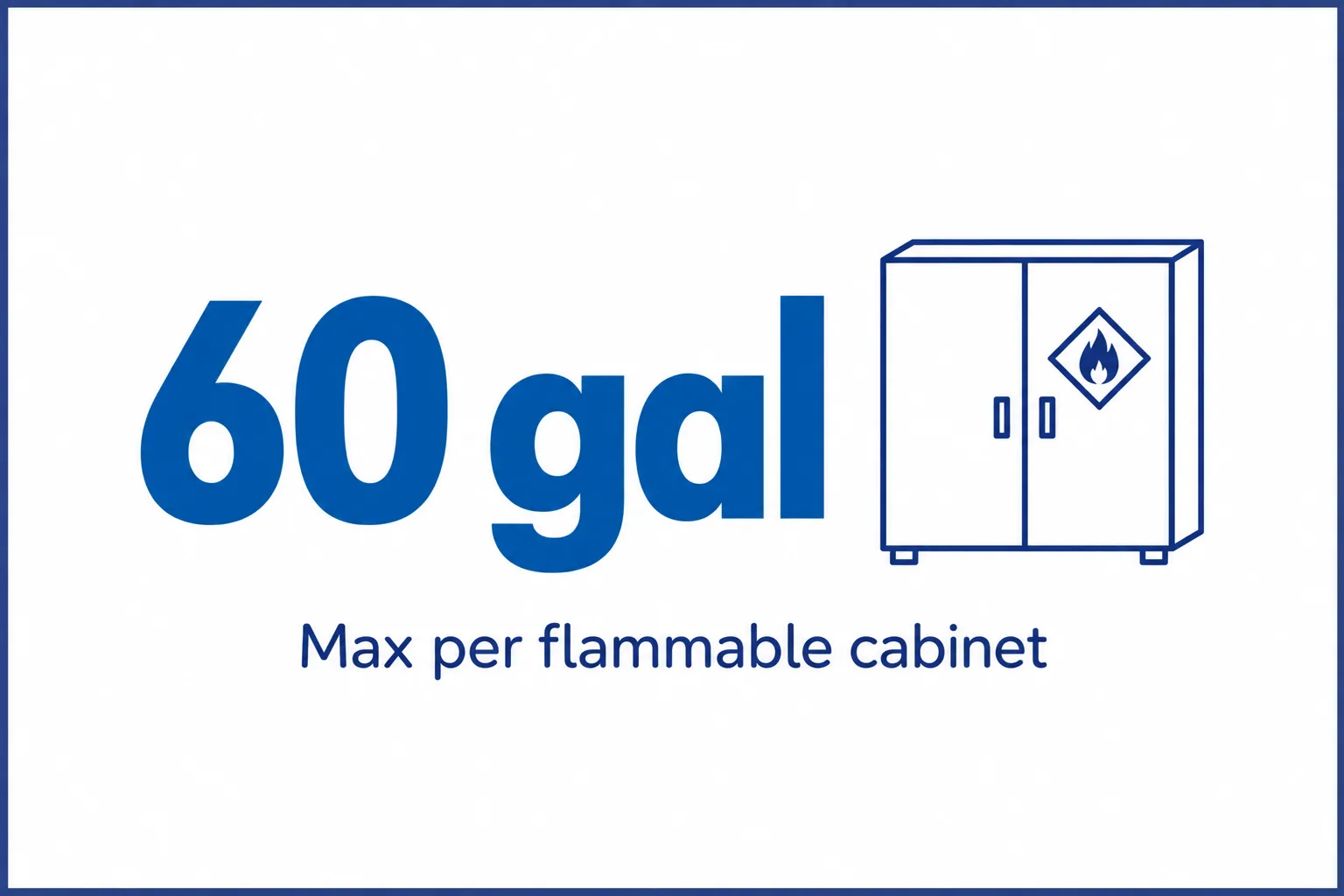
OSHA sets hard numbers for flammable liquid storage safety. Under 29 CFR 1910.106, no more than 60 gallons of Category 1, 2, or 3 flammable liquids may sit in a single storage cabinet, and Category 4 liquids cap at 120 gallons. Hazard Communication (29 CFR 1910.1200) supplies the labels and SDS access that make a segregation decision defensible to an inspector.
According to Vonzella Vincent, Lead Investigator at the U.S. Chemical Safety and Hazard Investigation Board, some highly reactive chemicals fall outside the coverage most facilities assume applies: “Although the chlorinated isocyanurates and other substances involved in this incident have reactive characteristics and the inherent ability to produce toxic gas, they are not covered by the U.S. Occupational Safety and Health Administration’s Process Safety Management standard or the U.S. Environmental Protection Agency’s Risk Management Plan rule.”
On the waste side, EPA RCRA rules state that incompatible wastes must not be placed in the same container unless the conditions at 40 CFR 265.17(b) are met. The same subpart bars placing hazardous waste in an unwashed container that previously held an incompatible waste, so drums and totes reused after a class change fall under the rule.
Waste Streams, Rinsate, and Compacted Debris
Compatibility rules apply to waste with the same force they apply to virgin product. An accumulation area needs the same matrix on the wall.
Rinsate from decontamination inherits the parent chemical’s hazard class.
Segregate it to match, and never route two classes into one shared sump. Saturated absorbents and solids keep their reactivity, so incompatible streams must never share a compaction chamber.
Volume reduction cuts drum count in a given footprint, which cuts incompatible-neighbor exposure. CTI compaction systems use stainless steel platens and chambers that crews clean and decontaminate between streams, with optional NEMA 7 explosion-proof components, inert-gas purge, fire-extinguishing fittings, and HEPA plus VOC filtration for hazardous and low-level radioactive work.
Facility Checklist: Put the Chemical Compatibility Storage Chart to Work
- Build a full inventory with a hazard class assigned per SDS
- Map each item to a storage group, then to a physical location
- Post the chart at every storage point and accumulation area
- Verify container and gasket material compatibility separately
- Inspect quarterly: peroxide-former expiry dates, container integrity, sump condition
- Train staff per HazCom and document the segregation logic for inspectors
Frequently asked questions
What are the OSHA guidelines for chemical storage?
What are the legal requirements for chemical storage?
What are the general guidelines for chemical storage?
Is alphabetical storage acceptable?
Does a compatibility chart replace an SDS?
A chart on the wall changes nothing by itself. Value appears once every item carries a hazard class, the groups match real physical barriers, and waste receives the same discipline as product.