

Article Summary
Two documents set the eyewash station requirements chemical storage areas must meet: OSHA 29 CFR 1910.151(c), the enforceable rule, and ANSI/ISEA Z358.1, the design and performance benchmark most corporate programs adopt. Five numbers carry most of the weight: 10 seconds of travel time, roughly 55 feet, a 15-minute flush, tepid water between 60°F and 100°F, and weekly activation backed by an annual performance test. This guide is written for plant managers, EHS coordinators, and operations directors responsible for hazardous material storage solutions and waste transfer areas.
Why Chemical Storage Areas Trigger Eyewash Obligations
The trigger is exposure potential, not container count.
One 5-gallon pail of 50% caustic soda creates the same duty as a tank farm when a worker can take a splash to the face.
Safety Data Sheet Section 4 (first-aid measures) and Section 8 (exposure controls and personal protection) are the primary evidence a site uses to justify a station or to rule one out. An SDS that calls for 15 to 20 minutes of eye irrigation answers the question by itself.
Sealed storage rarely stays sealed. Decant work, sample draws, drum moves, spill cleanup, and compactor loads all put an open container and a human face within a few feet of each other.
A hazardous material locker, hazmat storage containers, or a locked outdoor cage reduces the odds of an uncontrolled release. None of them remove the obligation, because workers still open, move, and transfer what sits inside.
Separate routine tasks from emergency-response tasks in the assessment. A spill responder in a full-face respirator carries a different risk profile than an operator who pumps acid by hand twice a shift.
OSHA 1910.151(c): What the Regulation Actually Says
The rule is one sentence. OSHA’s interpretation of the quick-drench requirement restates 29 CFR 1910.151(c): where the eyes or body of any person may be exposed to injurious corrosive materials, suitable facilities for quick drenching or flushing of the eyes and body shall be provided within the work area for immediate emergency use.
Read what the text omits. No flow rate, no temperature, no travel distance, no test schedule. The rule is performance-based, so a compliance officer evaluates the result rather than a part number.
ANSI/ISEA Z358.1 fills that gap. The standard is voluntary on its face, yet it defines what equipment manufacturers build to, what most corporate EHS programs adopt internally, and what a plaintiff’s expert holds up after an eye injury.
Other rules intersect. 29 CFR 1910.132 covers the PPE that should prevent the splash in the first place, 1910.1200 governs the hazard communication program that identifies corrosives, and several substance-specific standards in Subpart Z carry their own quick-drench language with stricter duties than the general rule.
The defensible record is a written hazard assessment that ties your SDS inventory to each station location. An undocumented judgment call looks like an oversight once an inspector asks why the nearest station sits 90 feet away.
Eyewash Station Requirements Chemical Storage Areas Must Meet Under ANSI/ISEA Z358.1
Z358.1 turns the OSHA sentence into measurable criteria. The table below summarizes the performance figures a purchaser or designer needs. Verify them against the current edition of the standard before you finalize a specification, since ANSI/ISEA revises the document on a multi-year cycle.
| Criterion | Eyewash | Eye/Face Wash | Drench Shower | Combination Unit |
|---|---|---|---|---|
| Minimum flow | 0.4 gpm (1.5 L/min) | 3.0 gpm (11.4 L/min) | 20 gpm (75.7 L/min) | Both, at the same time |
| Flush duration | 15 minutes | 15 minutes | 15 minutes | 15 minutes |
| Activation | 1 second or less, single motion | 1 second or less, single motion | 1 second or less, single motion | Independent valves |
| Outlet height | 33 to 45 in. above floor | 33 to 45 in. above floor | Head 82 to 96 in. above floor | Per component |
| Clearance | 6 in. minimum from wall or obstruction | 6 in. minimum from wall or obstruction | 16 in. from center to nearest obstruction | Per component |
| Fluid temperature | Tepid, 60°F to 100°F | Tepid, 60°F to 100°F | Tepid, 60°F to 100°F | Tepid, 60°F to 100°F |
Three of those lines cause most field failures.
The valve must stay open without hand pressure. A victim with a chemical in both eyes needs both hands free to hold the eyelids apart, which is the only way flushing fluid reaches the surface that matters.
Tepid delivery is not a comfort feature. Water at 45°F drives people off the station in two or three minutes, well short of the 15 minutes the SDS calls for, and cold water on a chemically burned cornea can worsen the injury. Water above 100°F can accelerate absorption of some chemicals.
Height and clearance decide usability. A station crammed behind a support column or a stack of hazardous material storage containers technically exists and practically does not.
The 10-Second Rule: Placement and Travel Path
OSHA has emphasized that accessibility is the practical test:
> “Employees must be able to reach a quick-drenching or flushing facility in time to prevent an acute or serious injury from occurring.”
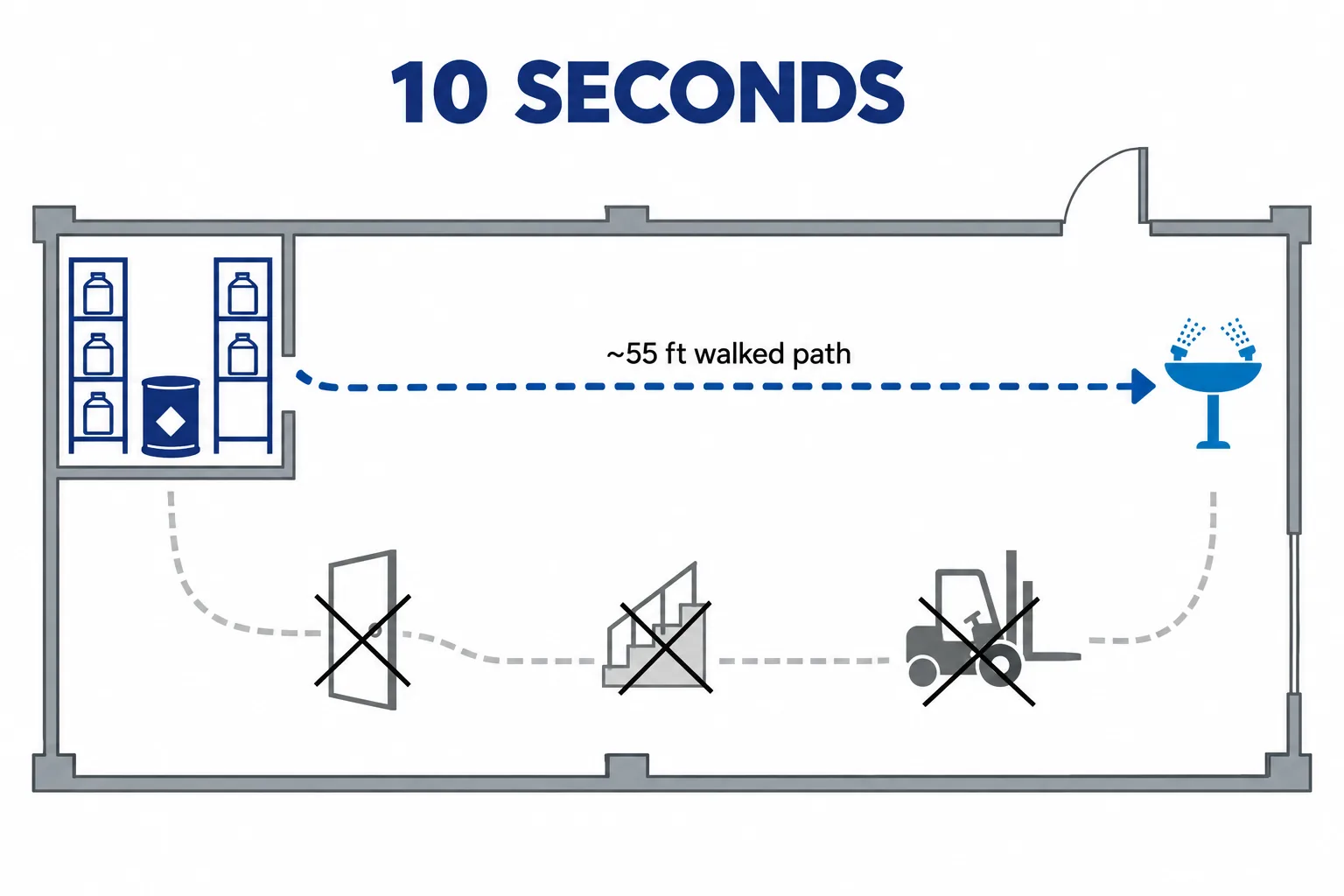
Z358.1 puts the equipment within 10 seconds of travel from the hazard, a figure the industry commonly renders as roughly 55 feet. Measure it as a walked path, not as a straight line drawn on a CAD layout.
Same floor level. No stairs, no ramps, no self-closing fire door with a latch, no badge reader, no forklift aisle to cross. Each of those adds seconds an injured worker does not have.
Highly corrosive acids and caustics justify immediate adjacency instead of the maximum allowable distance. Strong alkalis penetrate ocular tissue in seconds, so 50 feet of travel is a poor trade against a station mounted at the transfer point.
Keep the location well lit, marked with high-visibility signage, and clear of staged pallets. Paint the floor footprint if your safety storage area doubles as temporary staging, because temporary staging becomes permanent by week three.
A useful audit: walk the route with your eyes closed, a guide at your elbow, and a stopwatch running. That simulates the real condition of a worker with a splash to both eyes and exposes the door handle nobody counted.
Plumbed vs. Self-Contained Units for Chemical Storage Zones
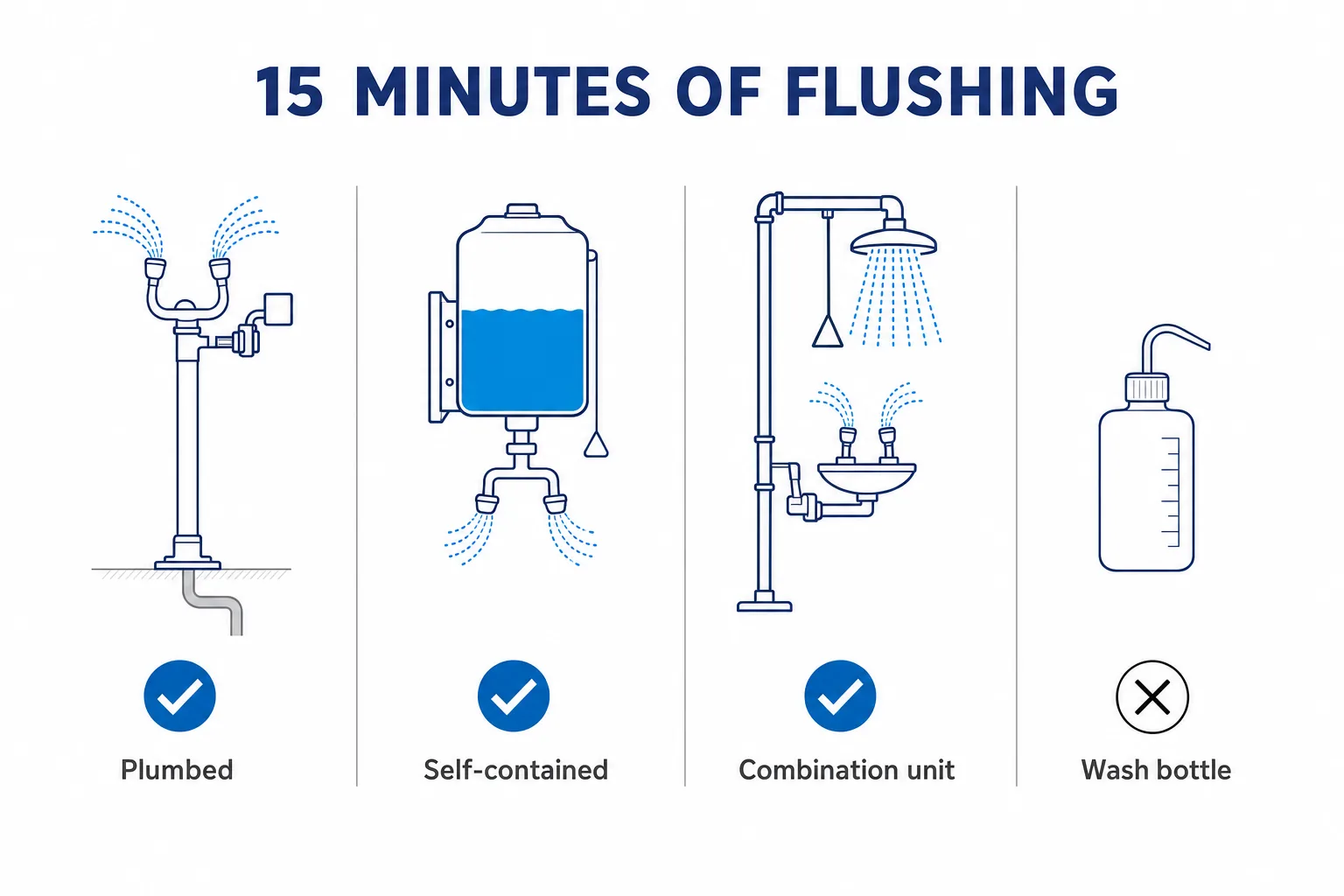
| Unit type | Best fit | Meets 15-minute rule alone | Key upkeep |
|---|---|---|---|
| Plumbed eyewash or combination unit | Enclosed storage rooms, process areas with potable supply | Yes | Weekly activation, annual performance test |
| Gravity-fed self-contained station | Remote yards, tank farms, detached hazardous material storage buildings | Yes, when sized and maintained | Fluid or cartridge replacement at the manufacturer’s stated interval |
| Personal wash bottle | Immediate first response on the way to a full station | No | Check seal and expiration date |
| Combination shower and eyewash | Body-splash potential from drums, totes, or overhead lines | Yes | Both components tested on schedule |
Personal squeeze bottles supplement a compliant station. They do not replace one, and an inspector who finds a bottle presented as the primary facility will write it up.
Self-contained gravity units earn their place where a potable line is impractical. The trade-off is fluid management: preserved solution or sealed cartridges carry a replacement interval measured in months, and a missed interval turns the tank into a culture medium.
Tepid delivery for plumbed units comes from a thermostatic mixing valve sized for full flow, heat-traced and insulated supply lines, or an instantaneous heater. Undersized mixing valves that serve a 0.4 gpm eyewash but stall at 20 gpm shower flow are a recurring specification error.
Stations Inside Fire-Rated, NFPA, and Blast Resistant Buildings
Prefabricated enclosures complicate a simple fixture. Fire-rated storage buildings, NFPA compliant storage buildings, and blast resistant buildings all restrict where plumbing, drainage, and conduit can penetrate the envelope without compromising the rating.
Decide interior versus exterior placement against the credible incident. A station inside a hazardous material storage building must stay reachable when the release happens inside that building. If the atmosphere will be untenable, the station belongs at the exterior door with a clear path to it.
Blast proof buildings add another constraint. Explosion-relief panel layouts, blast door swing, and internal partitions can all stretch the walked path past 10 seconds even when the plan view looks compliant.
Climate drives the rest. Northern sites need freeze protection on any outdoor unit and its supply line. Southern sites need shade or insulation, because a sun-loaded tank easily exceeds the 100°F ceiling by mid-afternoon.
Classified areas require rated components. A heater, thermostat, or alarm switch in a Class I, Division 1 zone must carry the appropriate rating, the same discipline that governs NEMA 7 explosion-proof electrical components on hazardous-duty processing equipment. CTI specifies that class of hardware on compactors destined for solvent and volatile-residue service, and the logic carries over directly to safety fixtures in the same room.
Rinsate, Drainage, and Wastewater Handling
Most published guidance stops at the nozzle. The question that follows a real activation: where do 15 minutes of contaminated water go?
Rinsate from an eye or body flush carries whatever the victim was exposed to. Depending on the chemical, the concentration, and your state’s rules, that water can meet the definition of a regulated waste rather than ordinary washdown.
Run the volume math before you design the floor. A drench shower at 20 gpm for 15 minutes produces about 300 gallons, and the eyewash side of a combination unit adds roughly 6 more. A 55-gallon catchment is decorative at that scale.
Containment options that work: a trench or floor drain routed to a holding tank rather than a storm sewer, a sump inside the secondary containment of the storage area, or a portable catchment pan under a self-contained station in an outdoor yard.
Never route a chemical storage area’s flush drainage to a storm drain. That single connection converts a workplace injury into a reportable release.
Fold the result into the site’s waste stream program. Whoever manages your compaction, solidification, and disposal contracts should know that one activation can generate a drum of regulated liquid, so the disposal path exists before the first incident.
Inspection, Testing, and Documentation Cadence
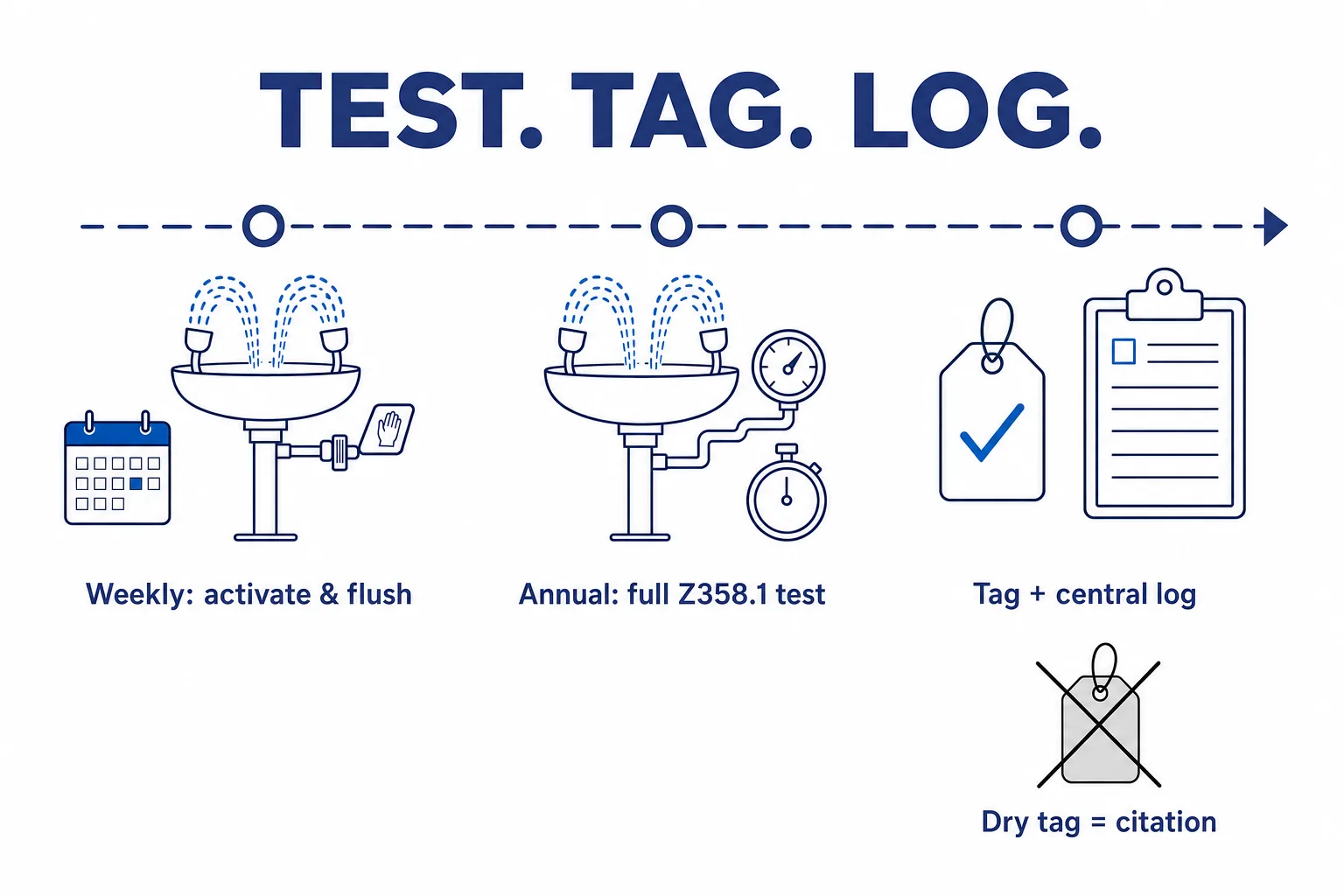
Activate every plumbed unit weekly. The purpose is twofold: confirm the valve and flow pattern work, and push stagnant water out of the dead leg between the branch tee and the nozzle.
That dead leg is a microbial risk. Water that sits warm and still in a rarely used branch line supports biological growth, which is the main reason the weekly flush exists.
Run a full performance inspection annually against every Z358.1 criterion: flow rate, spray pattern and height, temperature at the outlet, valve activation time, clearances, and the full 15-minute duration under load.
Self-contained units follow the manufacturer’s schedule for visual checks, plus fluid or cartridge replacement at the stated interval. Put that date on the unit tag, not only in a binder.
Document at two levels: a tag at the station with date and initials, and a central log retained for inspector review. A dry tag is the fastest citation in the building.
Worker instruction closes the loop. Every person who enters the area should know where the station sits, how to hold the eyelids open, that contact lenses come out under the stream, and that 15 minutes means 15 minutes on a clock, not until it feels better.
Where Chemical Storage Eyewash Programs Fail Inspection
As OSHA Atlanta-East Area Director William Fulcher explains:
> “Employers have a legal duty to continuously identify and eliminate safety and health hazards at their work sites.”
Eyewash Station Requirements Chemical Storage Sites Miss Most Often
- Blocked access. Pallets, a hazmat storage container, or seasonal inventory parked in front of the unit. Fix: mark and enforce a clear floor footprint.
- No test record. Equipment works, tag is blank. Fix: assign the weekly activation to a named role with a calendar trigger.
- Cold water only. No mixing valve, or one undersized for shower flow. Fix: specify a thermostatic valve rated for full combined flow.
- Missing dust caps. Nozzles exposed to airborne dust and corrosive vapor. Fix: replace caps and confirm they clear automatically on activation.
- Wash bottles as the primary station. Common in small storage rooms. Fix: install a compliant 15-minute unit and keep bottles as first response.
- Wrong side of a door. Station separated from the hazard by a self-closing fire door or a controlled entry. Fix: relocate to the hazard side of the barrier.
- No hazard assessment on file. Nothing connects the SDS inventory to the station layout. Fix: write a one-page assessment per area and date it.
Build a Defensible Eyewash Program for Your Site
Five steps, in order. Inventory the chemicals and pull Sections 4 and 8 from each SDS. Map the tasks where exposure is credible, not the places where drums merely sit. Plot the walked travel path from each of those points. Select the unit type that suits the utilities and climate. Set the test cadence and name the owner.
Reassess when anything changes: a new chemical, a new process step, a relocated rack, a new door. Layout changes silently break a 10-second path.
Treat the eyewash plan as part of the containment, ventilation, and waste equipment package rather than a fixture someone hangs at the end. From an engineering standpoint, the cheapest time to place a station is on the general arrangement drawing, before the slab is poured and the building is set.
Related readingHow to Pass a Hazmat Storage Inspection: Full ChecklistRead the guide →Frequently asked questions
Does every chemical storage room need an eyewash station?
How far can an eyewash station be from chemical storage?
Are portable eyewash bottles OSHA compliant on their own?
What water temperature does an eyewash station require?
How often must eyewash stations be tested and documented?
Do I need a safety shower as well as an eyewash?
Key Takeaways
The regulation is one sentence; the engineering behind it is not. Sites rarely fail on equipment selection. They fail on a blocked path, cold water, an empty test tag, and a missing hazard assessment, all four of which cost nothing to correct before an inspector or an injury finds them.
Eyewash planning belongs in the same design conversation as secondary containment, ventilation, electrical classification, and the equipment that processes hazardous waste downstream. CTI applies that same hazardous-duty engineering discipline to compaction systems built for corrosive, volatile, and radioactive waste streams, where safety hardware and process hardware get specified together rather than in sequence.