

Article Summary
The FM approved chemical storage building meaning is narrow: a prefabricated hazardous material structure whose specific model has been tested by FM Approvals and listed against a published Approval Standard, most often FM 6049. Below: who certifies, what the standard puts under test, how fire ratings and secondary containment fit in, why insurers and plan reviewers give weight to a listing, and how to confirm one before a purchase order leaves your desk.
FM Approved Chemical Storage Building Meaning, Defined
FM Approvals is an independent testing and certification body affiliated with FM, the commercial property insurer formerly branded FM Global. It writes Approval Standards, tests submitted products against them, and publishes what passes in the FM Approval Guide.
Approval is product-specific. A model in a defined configuration earns the listing, not the manufacturer as a whole. A company can hold approvals on three product lines and none on a fourth.
Most specification errors start right there. The certification attaches to a model designation and a configuration, so the unit on your quote either matches a listing or it does not.
FM Approved Chemical Storage Building Meaning vs. “Built to FM Standards”
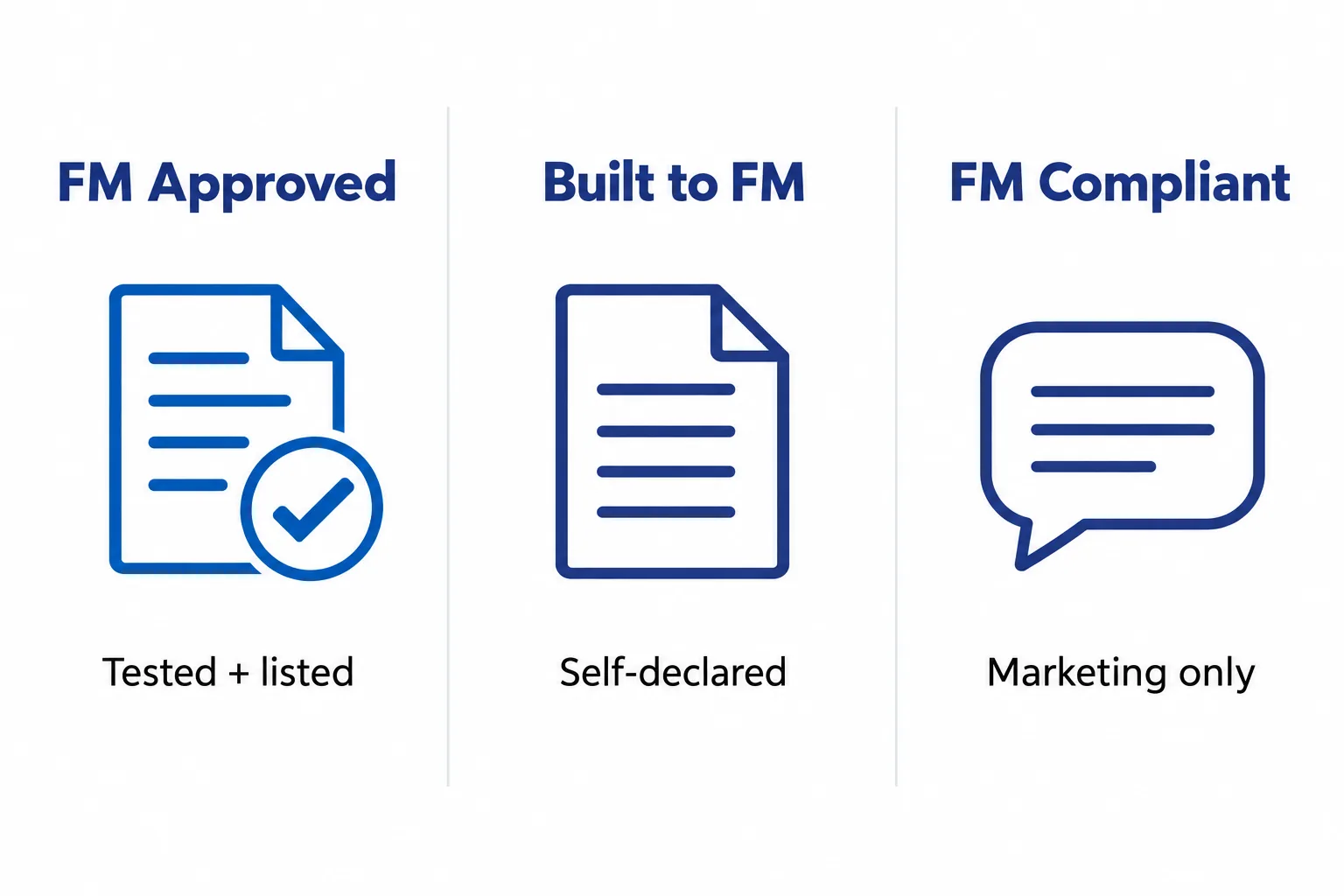
Three phrases circulate on datasheets. Only one carries third-party evidence:
- FM Approved: the model was submitted, tested, and appears in the FM Approval Guide.
- Built to FM standards: a self-declared claim that the design follows the standard. No test report, no listing.
- FM compliant: marketing language with no certification structure behind it.
For a specifying engineer, only the first survives a document review.
Ask for the listing, not the adjective.
FM Approvals vs. Other Marks on a Quote
| Mark or code | What it is | Who enforces it | What it covers on a hazmat building |
|---|---|---|---|
| FM Approvals | Third-party test and certification body affiliated with insurer FM | Not a regulator; recognized by insurers and plan reviewers | Tested and listed building models: fire performance, construction, containment |
| UL / ULC | Independent safety certification organizations | Not regulators; widely recognized by AHJs | Product and component certifications, including electrical equipment and some locker constructions |
| NFPA 30 | Consensus code, Flammable and Combustible Liquids Code | Adopted and enforced by state and local jurisdictions | Liquid classification, container quantity limits, separation and arrangement |
| OSHA 29 CFR 1910.106 | Federal workplace regulation for flammable liquids | OSHA, as federal law | Employer duties for flammable liquid storage and handling areas |
| IBC / IFC | Model building and fire codes | Local building department and fire marshal | Occupancy classification, control areas, permits, inspection |
NFPA and OSHA publish requirements. FM Approvals runs the physical tests. The two layers are complementary, which is why an FM Approved unit still goes through local permits and fire marshal review.
FM 6049: The Approval Standard for Chemical Storage Buildings and Lockers
FM 6049 is the Approval Standard for storage buildings and lockers that hold flammable and combustible liquids. Its scope reaches construction, fire performance, liquid containment, and electrical and grounding provisions.
Fire-rated storage buildings listed under it typically carry 2-hour or 4-hour constructions. The rating reflects tested assembly performance, not a calculation submitted on paper.
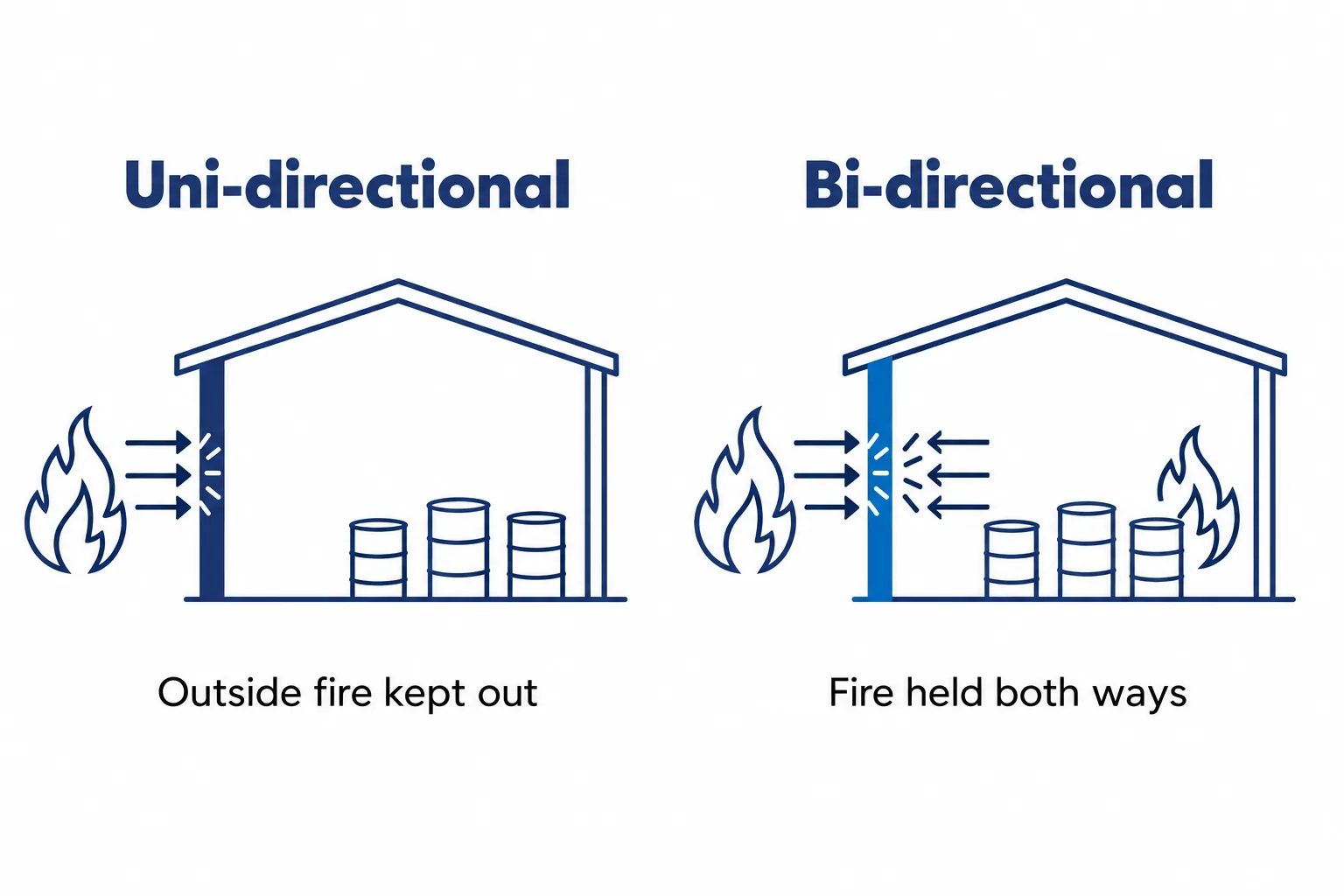
Direction of the rating matters as much as duration. A uni-directional construction is rated to shield stored chemicals from an exterior fire, which suits sites where the hazard sits in the surrounding yard: the 2-hour uni-directional fire-rated hazmat storage buildings in the FS Series are built for that case. A bi-directional construction is rated in both directions, so an internal fire stays contained and does not reach adjacent structures.
Secondary containment sits in the same standard. Listed hazardous material storage buildings include a liquid-tight sump sized against the stored liquid volume, and the applicable capacity figure comes from the Approval Standard together with the codes your jurisdiction has adopted. Confirm that number with your AHJ, not with a brochure.
FM 6049 does not replace NFPA 30. Occupancy classification, liquid class, and quantity limits still apply to the building and to its placement on your site.
What Gets Physically Tested During Approval
- Full-scale fire exposure on wall and roof assemblies
- Structural verification for wind and snow loads
- Liquid-tight performance of the containment sump
- Electrical, bonding, and grounding provisions for flammable liquid service
- Follow-up audits at the production facility, so a listed model stays consistent with the sample that passed
Buyers overlook that last item. Approval is a maintained status under ongoing surveillance, not a one-time certificate.
Why FM Approval Matters for Insurance and Code Compliance
Property insurers and loss-control engineers recognize FM Approved equipment during risk assessments and site surveys. A listed unit gives the loss-control file something concrete: a tested assembly with a traceable model designation.
Plan review moves faster for the same reason. A third-party fire rating cuts the back-and-forth that follows an engineer-stamped calculation, which is why 2-hour bi-directional fire-rated hazardous material storage buildings are a common answer on constrained sites.
The listing also supports the regulatory layer. OSHA 29 CFR 1910.106 governs flammable liquid storage and handling in the workplace, and NFPA 30 sets the liquid classification and container storage limits that apply to outdoor hazardous material storage solutions.
For waste streams, secondary containment expectations under RCRA container storage rules and SPCC plans land on the same feature set: a sealed sump that captures leaks, wash water, and rinsate before any of it reaches soil or a storm drain. Result: a shorter review cycle and a documentation package the authority having jurisdiction can check line by line.
Storage Building vs. Storage Locker vs. Hazmat Storage Container
A hazardous material locker is smaller, non-occupiable, and accessed from outside only. It suits modest drum counts, small cylinders, and point-of-use quantities.
A storage building is occupiable and walk-in, which widens the engineering scope: mechanical ventilation, interior lighting, egress hardware. Occupiable versus non-occupiable is the fastest way to sort which category your inventory needs.
Repurposed ISO or conex hazmat storage containers are a third thing entirely. A shipping box with shelves has no fire listing and no engineered sump, so hazmat storage containers of that kind do not substitute for a listed building in a plan review.
Blast resistant buildings answer a different design basis again. Blast proof buildings are engineered for overpressure, a separate scope from a fire-rated FM listing, and the two requirements get specified independently.
Specification Details That Decide Which FM Approved Model You Need
- Chemical compatibility and segregation: oxidizers, corrosives, and flammables need separated compartments or separate units
- Total stored volume: drives sump size and the applicable quantity thresholds
- Site geometry: distance to property lines, occupied buildings, and ignition sources drives 2-hour versus 4-hour and uni- versus bi-directional
- Atmosphere control: mechanical ventilation rate, explosion relief panels, gas detection, heat or cooling
- Electrical classification: hazardous-location wiring and fixtures for the liquid class stored
- Real duty cycle: battery acid, solvent inventories, and rinsate collection each carry different corrosion and containment demands
When setbacks are tight and stored volume is high, a 4-hour bi-directional fire-rated hazardous material storage building is often the only construction that satisfies the separation math without a site redesign.
How to Verify a Building Is Genuinely FM Approved
Ask the vendor for the model designation and the FM Approval Guide entry, then compare the listed configuration against the quoted one. Options added outside the tested configuration can fall outside the listing.
Request the nameplate or label detail and the Approval report reference. Red flags: a listing reference for a different model, approval claimed at company level, or refusal to name the standard the unit was tested against.
Frequently Asked Questions
Related readingChemical Storage Locker vs Storage Building GuideRead the guide →Frequently asked questions
Is an FM Approved chemical storage building required by law?
What is the difference between FM Approved and FM compliant?
Does FM approval replace a building permit or fire marshal review?
Do I need a fire-rated building for flammable liquids?
Can one building store corrosives and flammables together?
Closing Takeaway
FM approval is testable evidence, not a descriptor. The value sits in the test report, the model designation, and the published listing, which is exactly what an insurer or plan reviewer asks to see.
Match the listing to your actual chemicals, volumes, and site geometry before purchase. From an engineering perspective, the fastest spec review starts with two documents in hand: a current inventory list with liquid classes and volumes, and a site plan that shows distances to property lines and occupied buildings.