

Article Summary
A well-specified hazmat storage building lifespan commonly runs 20 to 30 years, and longer where maintenance stays disciplined. Service life is a specification outcome, not a fixed product attribute. Four levers decide it: steel gauge and weld method, the coating and lining system, containment sump integrity, and the warranty terms behind all three. Site corrosivity and stored chemistry set the pace of wear.
Hazmat Storage Building Lifespan: The Short Answer
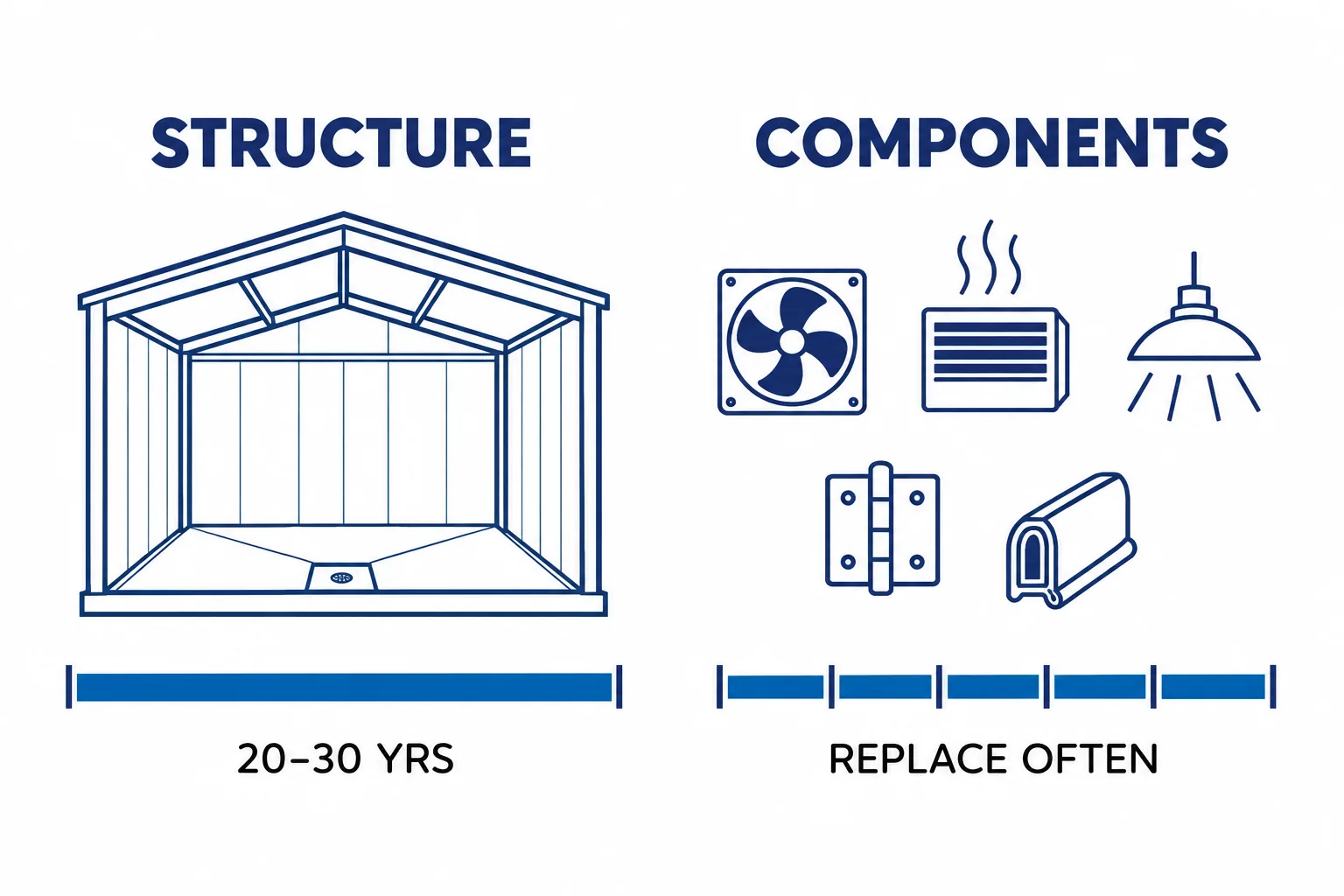
Heavy-gauge, continuous-welded steel units routinely reach two to three decades in outdoor industrial service. Light-duty sheet-metal lockers and repurposed ISO shipping containers fall short, because thin panels, lap seams, and unsealed floors give corrosion an early foothold.
Separate two clocks. Structural life covers the shell, frame, and sump, the parts you cannot practically replace. Component life covers fans, heaters, lights, door hardware, and gaskets, which turn over on far shorter cycles and belong in the budget as consumables.
Relocatable construction changes the math. A prefabricated unit often outlives the process it was bought for, so redeployment to another line or another site recovers real value. That favors purpose-built hazardous material storage buildings over hazmat storage containers improvised from freight equipment.
Safety Storage’s custom modular construction for hazardous material storage works as a spec baseline for both fire-rated and non-fire-rated shells.
Construction Materials and Gauge: The Biggest Variable
Weld method matters more than most buyers expect. Continuous welds resist the racking loads of crane lifts and relocations. Bolted light-gauge panel assemblies loosen, open small gaps, and admit water at the seams.
Fire-rated storage buildings use insulated double-wall construction, which adds thermal mass and a second corrosion barrier over a single-skin non-fire-rated shell. That extra skin buys service life as well as protection time.
Roof design decides a surprising share of premature failures. Slope, drip edges, and clear drainage keep water moving; a flat roof that ponds after every storm works on the coating film without pause. Dissimilar metals at door frames, vent penetrations, and grounding lugs create galvanic cells, so check how those details are isolated.
Blast resistant buildings and blast proof buildings sit at the heavy end of the range. Thicker plate and added stiffeners raise cost, and they also raise the structural reserve a unit carries into year twenty.
Coatings, Linings, and Corrosion Control
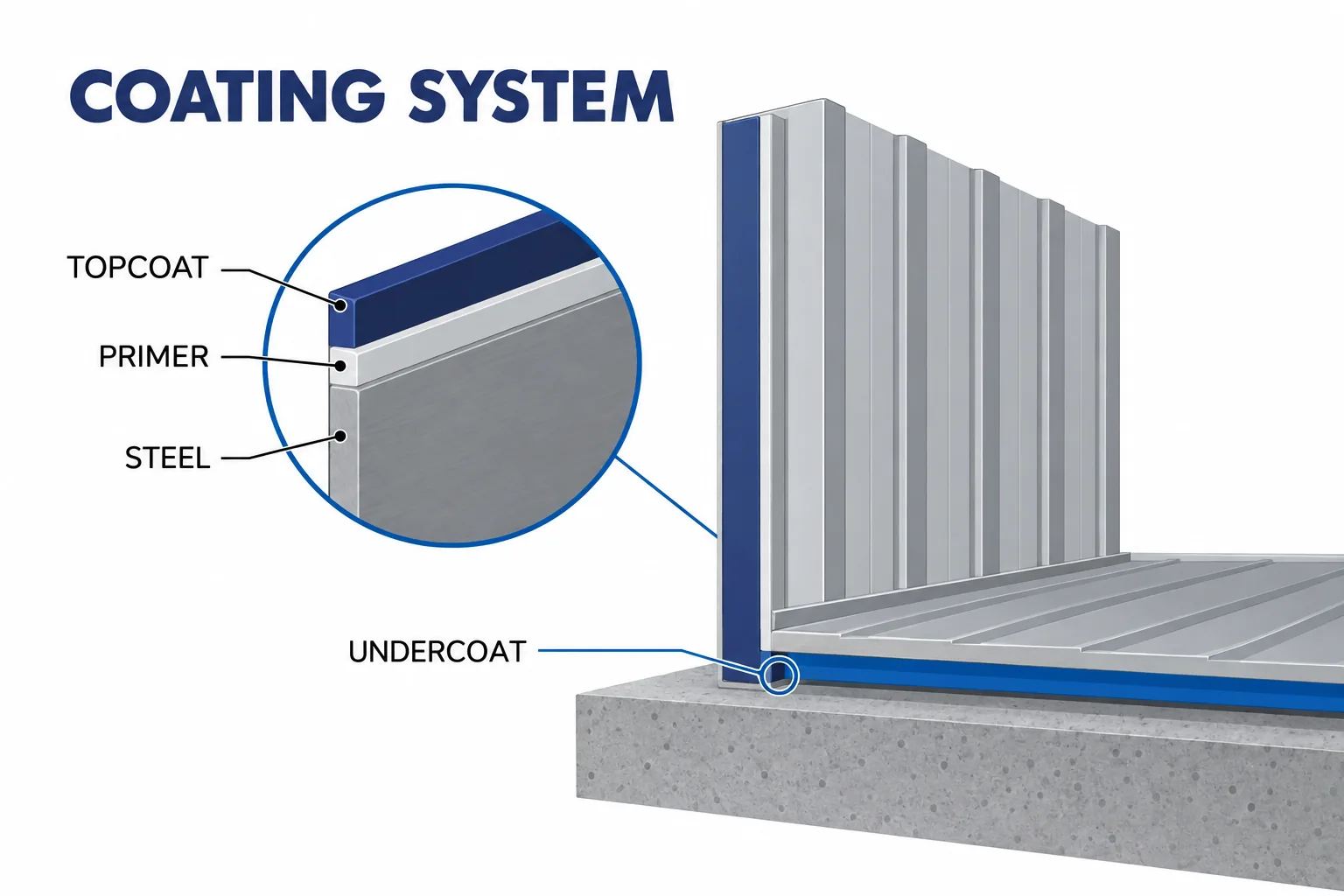
The exterior system should pair a primed substrate with a chemical- and UV-resistant topcoat, plus a protective undercoat on the floor underside where the unit meets a slab or footings. That hidden face is where unseen corrosion starts.
As Bureau of Reclamation coatings specialist Bobbi Jo Merten has noted in research on extending coating service life:
> “Two approaches have been identified to provide cost-savings for Reclamation: maximize service for existing coal tar enamel on penstocks through 100-percent solids epoxy spot repairs and assist the coatings industry in developing a coating or paint that achieves a 50-year service life in below-ground penstocks.”
Interior linings need to match the actual stored product, not a generic chemical-resistant label. Solvent blends, oxidizers, and acids attack different resin chemistries.
Site corrosivity sets recoat intervals. Coastal salt spray, de-icing salt runoff, and acid process exhaust shorten coating life against a dry inland yard, so identical buildings on two sites will not age alike. Touch-up discipline closes the gap: forklift strikes and drum scrapes are where pitting begins, and matched coating applied the same week costs almost nothing.
When you compare hazardous material storage solutions, request the coating specification and dry-film thickness figures, not just a color.
Spill Containment Sumps: Where Most Buildings Fail First
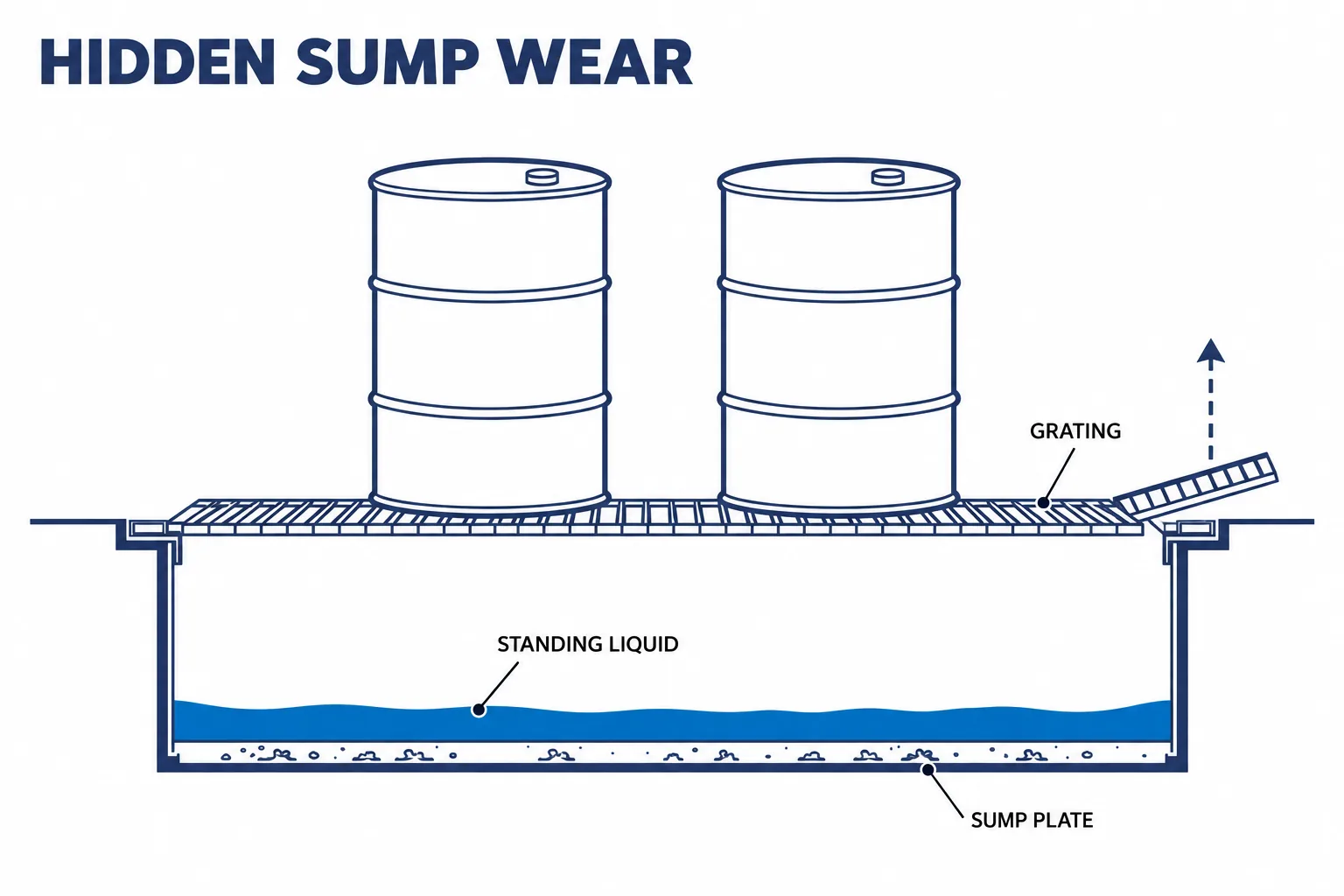
From an engineering standpoint, the continuous-welded, leak-tested steel sump is the structural floor, not an accessory. Corrosion there is a structural failure, and it is a common reason a unit retires early.
Standing liquid does the damage. Condensate, washdown water, and accumulated rinsate collect under the grating and work on the sump plate out of sight. Rinsate needs a defined route: reuse it where the product label permits, or move it into your regulated waste stream. It should never sit in the sump as a de facto holding tank.
Containment capacity for a container storage area is set by the federal rule that applies to your operation, along with a base free of cracks and gaps. Confirm the required volume and base condition with your environmental compliance lead before sign-off, then keep the leak-test record on file. Put grating removal on a written schedule so the sump can be inspected and dried.
Compliance Specs That Extend Hazmat Storage Building Lifespan
Fire-rated construction, explosion relief panels, mechanical ventilation, and proper grounding and bonding protect the asset as well as the people near it. An NFPA compliant storage building specified for the correct hazard class from day one avoids retrofit cutting and welding later, and every field penetration breaks both the coating system and the rated assembly.
Ventilation rate selection keeps corrosive vapor off the interior shell and the electrical package. Match the electrical classification, explosion-proof fittings, and sealed conduit to the stored product rather than to the cheapest available package. Our guide on why fire-rated hazardous storage buildings matter for compliance covers those requirements in depth.
Warranty Terms and What They Actually Cover
Three clocks run at once: structural, coating, and component. A quoted warranty length usually refers to the structure only, so read which parts sit under which term.
Exclusions matter more than the headline number. Chemical attack from products outside the stated compatibility list, unauthorized modifications, improper anchoring, and incorrect lift procedures all void coverage. Ask what invalidates the warranty before the first field modification, not after a contractor has cut a vent.
Retain three documents for the life of the unit: the chemical compatibility list, the sump leak-test record, and the as-built drawings.
Maintenance Schedule That Gets You to 30 Years
Related reading2 Hour vs 4 Hour Fire Rated Building: Which Do You Need?Read the guide →| Interval | Inspection item | Failure it prevents |
|---|---|---|
| Monthly | Sump dry and clear, grating lifted at one bay | Pitting under standing rinsate and washdown water |
| Monthly | Door seals, latches, ventilation fan operation | Corrosive vapor buildup inside the shell |
| Quarterly | Coating touch-up on strikes and scratches | Substrate corrosion at damaged film |
| Quarterly | Fasteners, grounding lugs, roof drainage | Galvanic corrosion and roof ponding |
| Annual | Leak test verification, lining inspection, fire-rated penetration review | Sump perforation and a compromised rating |
| After each move | Lift points, level, anchors, seals | Racked frame and door misalignment |
Secondary containment inside the building still applies to drums and to any hazardous material locker kept within the shell. Keep hazardous material storage containers off the sump floor where practical so the plate stays visible.
Repair, Refurbish, or Replace
Four signals point toward major work: sump perforation, widespread substrate pitting, a fire-rated assembly that has been cut into, and an electrical classification that no longer matches a changed chemical inventory.
Refurbishment usually pays when the frame is sound. Recoat, reline the sump, upgrade ventilation and electrical, replace doors and seals. That package often returns a decade or more at a fraction of replacement cost.
Replace when the process itself changed. A shell sized and classified for an old inventory becomes a compliance liability rather than an asset. Reconfiguration is often the middle path, and custom modular construction reshapes hazardous material storage without scrap of a serviceable structure.
Frequently asked questions
Does an outdoor unit last as long as an indoor one?
Do fire-rated buildings last longer than non-fire-rated ones?
How often should the containment sump be inspected and drained?
Can a hazmat storage container or building be relocated safely?
What is the most common cause of premature failure?
Closing Takeaway
Lifespan gets bought at specification and defended through maintenance.
Three checks before purchase settle most of it: steel gauge and weld method, a coating system matched to both site corrosivity and stored chemistry, and documented sump leak-test results. Bring your chemical inventory and site conditions to the conversation before the spec is signed, and the 30-year outcome stops being luck.