

Budget questions arrive before spec questions, so here is the short version: how much does a hazmat storage building cost depends far less on square footage than on code. Two units with identical footprints can differ by a factor of three once fire rating, ventilation class, and electrical classification are settled. What follows covers published price ranges, the drivers behind them, the site costs most quotes exclude, and the rent-versus-buy math.
How Much Does a Hazmat Storage Building Cost? Ranges by Configuration
Price guidance published across the prefab market starts near $5,000 for a small, non-fire-rated hazardous material locker that holds a few drums, and runs past $100,000 for a large, fire-rated unit with a full mechanical and suppression package. A permanent, site-built room typically clears $150,000 once foundation work, stamped engineering, and permit review are counted.
| Configuration | Nominal drum capacity | Typical fire rating | Published price signal |
|---|---|---|---|
| Hazardous material locker | 2–4 drums | None | from roughly $5,000 |
| Small prefab building | 4–12 drums | Non-rated or 2-hour | low five figures |
| Mid-size prefab with mechanical package | 12–40 drums | 2-hour common | mid to high five figures |
| Large custom prefab | 40+ drums | 2-hour or 4-hour | $100,000 and up |
| Site-built permanent room | Varies | Per local code | $150,000 and up |
One distinction matters before any quote arrives. A repurposed shipping box sold as a hazmat storage container is a shell. An engineered building carries rated wall assemblies, sized secondary containment, classified electrical, and documentation a fire marshal will accept.
Safety Storage builds the second category, and the range of prefabricated hazardous material storage buildings reflects a spread in scope, not a spread in markup.
What Drives the Price of Hazardous Material Storage Buildings
Treat cost as a stack of code-driven requirements, not a menu of upgrades. The drivers below are ordered by dollar impact.
Fire Rating and Separation Distance
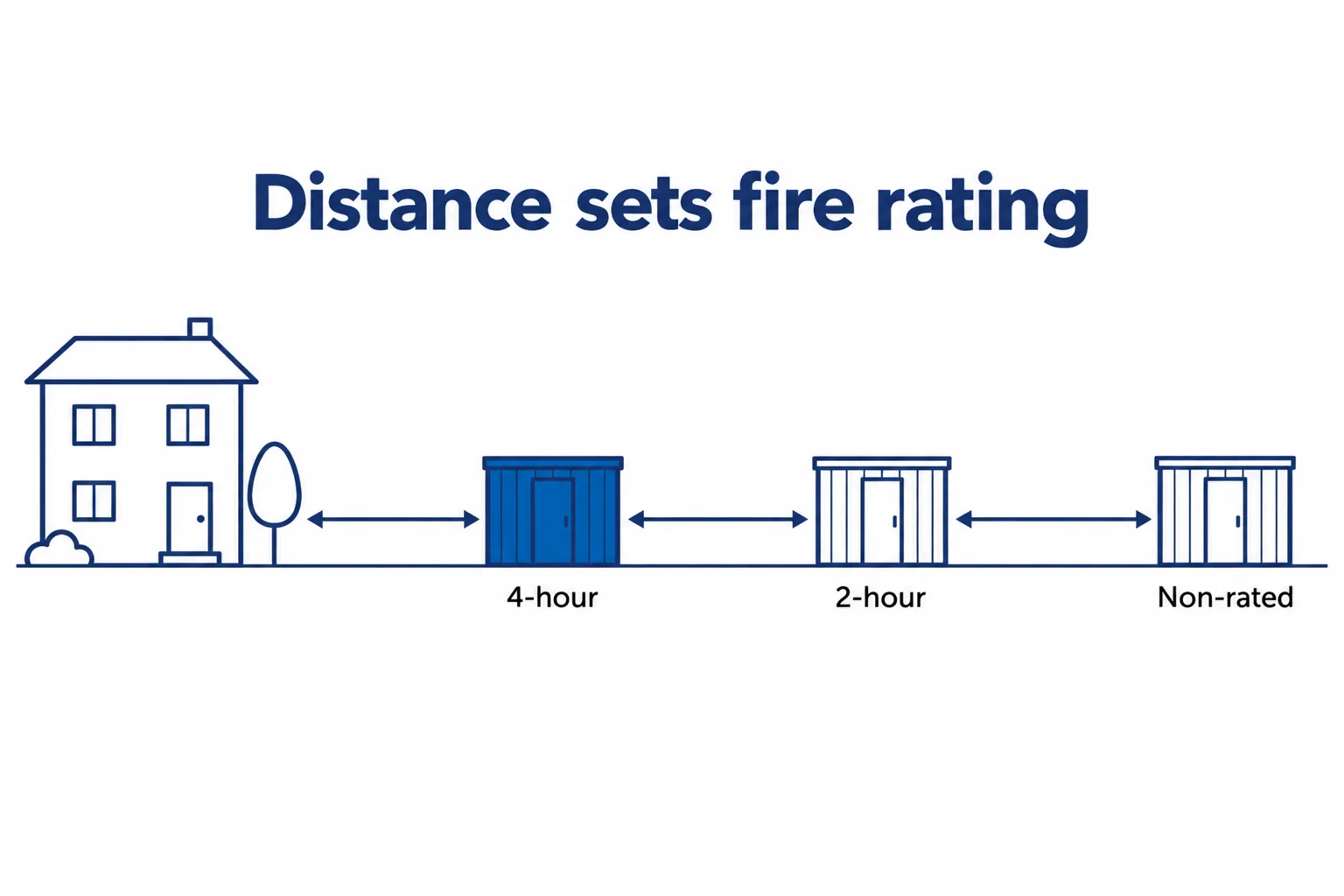
Distance between the unit, occupied structures, and property lines decides the required assembly. NFPA 30, the Flammable and Combustible Liquids Code, ties fire resistance requirements to that separation.
Close placement usually forces a 2-hour or 4-hour rated assembly. Supplier price guidance commonly puts the 2-hour premium at roughly 15% to 20% over a non-rated steel shell, with 4-hour construction adding 30% or more.
That math cuts both ways. Fifty extra feet of asphalt often costs less than rated wall assemblies. Settle the separation question with your fire marshal before you request a single quote, because an NFPA compliant storage building spec written after the purchase order becomes a change order.
Ventilation, Climate Control, and Classified Electrical
Ventilation rates are set by regulation. OSHA 29 CFR 1910.106 requires inside storage rooms for flammable liquids to be ventilated at a minimum of one cubic foot per minute per square foot of floor area, and never less than 150 CFM. Continuous mechanical ventilation is an equipment cost and a utility cost.
Where flammable vapors may be present, NFPA 70 Article 500 classifies the interior as a Class I hazardous location, so fixtures, conduit, panels, and motors must be listed for that classification. Explosion-proof HVAC carries a heavy multiple over commercial equipment. For temperature-sensitive inventory such as resins, reagents, or lithium cells, the mechanical package can exceed the cost of the shell itself.
Secondary Containment, Sumps, and Rinsate Capture
EPA rules at 40 CFR 264.175 require containment for hazardous waste container storage with capacity equal to at least 10% of the total volume of containers, or the volume of the largest container, whichever is greater. That volume sets sump depth, and sump depth sets floor and frame cost.
Chemical-resistant coatings and removable grating add line items and buy service life in corrosive duty. Budget the recurring side too: sump pump-out, wash water, and rinsate from container cleanout may be regulated as hazardous waste under RCRA, with disposal cost attached. Plan reviewers frequently reject first submittals over drain, valve, and sample-port details, so resolve those at the drawing stage.
Suppression, Detection, and Blast Resistant Buildings
Dry chemical or clean-agent suppression, deflagration relief panels, and gas detection each price separately. Relief panels interact with the wall assembly and cannot be added later as a bolt-on. Blast resistant buildings answer a specific overpressure exposure, common near process units in refining and chemical plants. Absent that exposure, blast proof construction spends budget without a matching drop in risk.
Site and Delivery Costs Most Quotes Leave Out
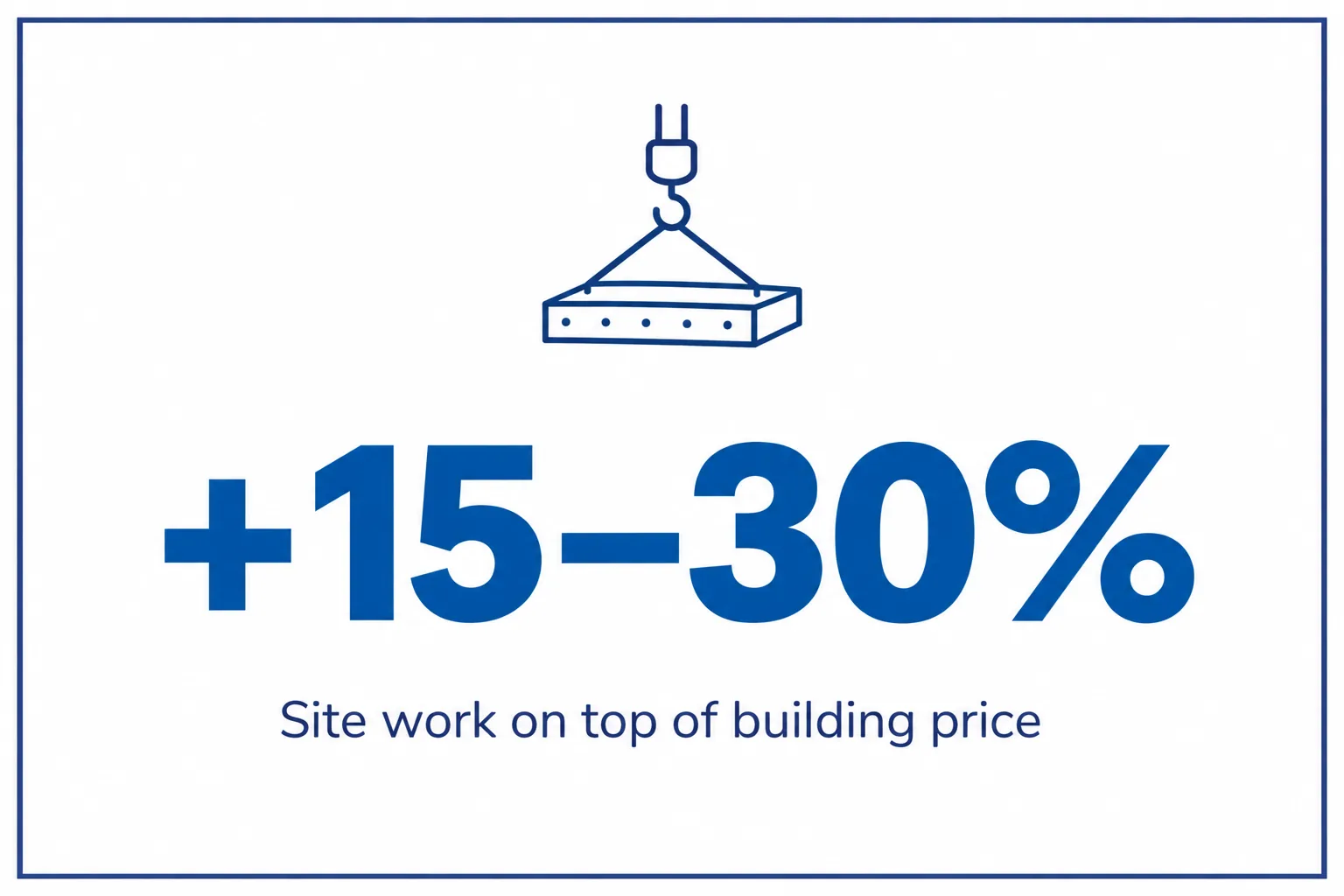
The building price is not the project price. Reserve budget for an engineered pad or foundation, anchorage, permit and plan-review fees, drawings stamped for the state of installation, oversize freight, crane or forklift offload, electrical feed, fire alarm tie-in, bollards, and signage.
A practical planning figure is 15% to 30% of the building price for site and installation scope, higher on remote sites or where a new electrical run is required. Ask early, because a capital request that omits the pad gets sent back.
Design choices shape this line directly, and custom modular construction shrinks field work by moving assembly into the shop. Zoning review and fire marshal sign-off carry schedule cost as well.
Rent vs Buy: How the Math Actually Works
| Factor | Rental | Purchase |
|---|---|---|
| Upfront capital | Deposit and delivery | Full price plus site work |
| Ongoing cost | Fixed monthly fee | Maintenance and utilities |
| Lead time | Days to weeks, stock units | Weeks to months, built to spec |
| Customization | Standard configurations | Any compliant configuration |
| End of term | Return the unit | Retain the asset |
The breakeven test is simple. Divide purchase price plus site cost by the monthly rental rate. The result is the month at which ownership wins. Short remediation projects, plant turnarounds, seasonal surges, and urgent compliance deadlines usually fall on the rental side. Permanent programs, odd footprints, and chemical lists a stock unit cannot serve fall on the purchase side, since rental fleets carry standard configurations only.
How Much Does a Hazmat Storage Building Cost to Own Over 20 Years?
Sticker price is one year of a twenty-year decision. Annual ownership cost includes inspection and recertification, sump pump-out and rinsate disposal, coating touch-up, HVAC and suppression service, and power for climate control.
Galvanized and coated steel assemblies amortize across decades, so a well-specified unit often shows a lower cost per year than a cheap shell replaced twice. Put non-compliance in the model as well: citations, stop-work orders, and cleanup liability dwarf the delta between a rated and non-rated wall.
Where to Cut Cost Without Losing Compliance
- Size drum count to real peak inventory, not aspirational capacity.
- Relocate the unit to gain separation distance and drop the rating requirement, where the site allows.
- Split incompatible classes into two modest units instead of one over-engineered building.
- Classify electrical only in the zones that require it.
- Where site and spec genuinely conflict, custom-engineered hazardous material storage solutions often cost less than forced modifications to a stock unit.
What to Send a Manufacturer for an Accurate Quote
Supply a chemical list with SDS, container types and counts, required separation distance, a site plan with utilities, climate requirements, the local code edition in force, and delivery access constraints. Require every vendor to quote identical scope and to state exclusions in writing: foundation, permits, freight, offload, electrical hookup.
Quote spreads of 40% usually trace to scope gaps, not margin.
Frequently asked questions
Is it cheaper to rent or buy a chemical storage building?
How much more do fire-rated storage buildings cost?
Do I need a permit for a prefabricated unit?
What is the cheapest compliant option for a few drums?
How long does delivery take?
The Bottom Line on Budget
Plan on the building price plus 15% to 30% for site and installation. Expect the total to land anywhere from five figures for a small locker to well past six figures for a large rated unit with climate control. Your chemical list and your separation distance set that number before any vendor answers the phone. Define the spec first, then compare like-for-like quotes.