

When flammable liquid moves through a hose, pump, or drum, friction builds a static electric charge that can spark and ignite vapor. Drum grounding and bonding requirements exist to drain that charge safely. Both OSHA and the NFPA mandate grounding and bonding of conductive drums during Class I flammable liquid transfer. This guide covers the rules, the mechanism, a step-by-step method, the plastic-drum exception, and how to verify compliance.
What Are Drum Grounding and Bonding Requirements?
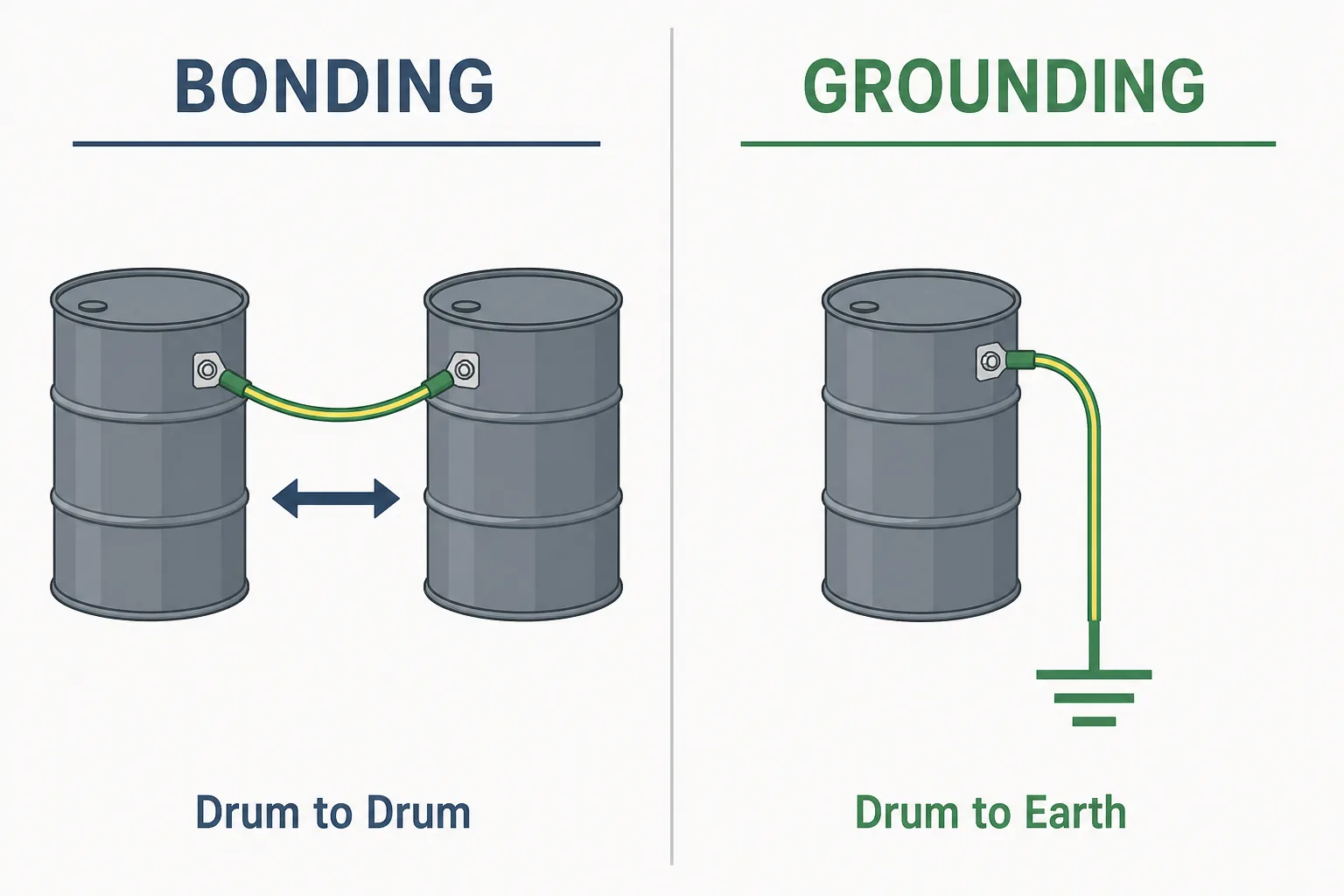
Drum grounding and bonding requirements are safety rules that direct facilities to electrically connect drums during flammable liquid transfer so static charge cannot accumulate and spark. The two terms describe two distinct actions.
Bonding links two conductive objects with a wire so any charge equalizes between them, leaving no voltage difference to jump as a spark. Grounding links a conductive object to the earth so accumulated charge dissipates into the ground. As Ohio State University’s chemistry safety program notes, bonding controls the difference in charge between containers, while grounding controls the charge relative to earth.
Two authorities govern these practices in the United States: OSHA, through 29 CFR 1910.106, and the National Fire Protection Association, through NFPA 30 and NFPA 77.
Grounding vs. Bonding: What’s the Difference?
| Feature | Bonding | Grounding |
|---|---|---|
| Purpose | Equalize charge between two objects | Drain charge to earth |
| Connection point | Drum-to-drum or drum-to-nozzle | Drum-to-earth ground |
| Equipment | Bonding wire and clamps | Ground cable to a verified earth point |
| Prevents | Spark between containers | Charge buildup on a container |
Both steps work together. A drum can be bonded to a source container yet still hold charge as a pair if neither connects to ground.
Why Do Drums Need to Be Grounded and Bonded?
Flammable liquid generates static charge as it flows. Splashing, pumping, and pouring separate electrical charges at the liquid-air and liquid-metal boundaries, and that charge collects on the drum and the liquid surface. Once the voltage climbs high enough, it discharges as a spark, and a spark near flammable vapor is an ignition source. Wayne State University’s environmental health office explains that static discharge during flammable liquid transfer is a well-documented cause of fires and explosions.
So, do 55-gallon drums need to be grounded? Yes. A 55-gallon steel drum is a classic charge accumulator. When it holds or receives a Class I flammable liquid, it must be both grounded and bonded to the container it exchanges liquid with.
OSHA Grounding and Bonding Requirements for Flammable Liquids
The core federal rule sits at 29 CFR 1910.106(e)(6)(ii), which requires bonding and grounding when Class I flammable liquids transfer between metal containers. A Class I flammable liquid has a flash point below 100°F (37.8°C), gasoline, acetone, toluene, and many solvents fall in this group.
OSHA also leans on consensus standards. NFPA 30 (Flammable and Combustible Liquids Code) and NFPA 77 (Recommended Practice on Static Electricity) form the technical backbone the agency references. An OSHA standard interpretation letter on container transfer points back to 1910.106(e)(6)(ii) as the governing requirement.
Grounding and Bonding Requirements Documentation
Searchers often want a citable procedure to keep on file. Rather than a homemade sheet, use authoritative published guidance. Stanford University’s environmental health team publishes a clear bonding and grounding procedure document that facilities can download and adapt for internal training and audits.
How to Properly Ground and Bond a Drum (Step-by-Step)
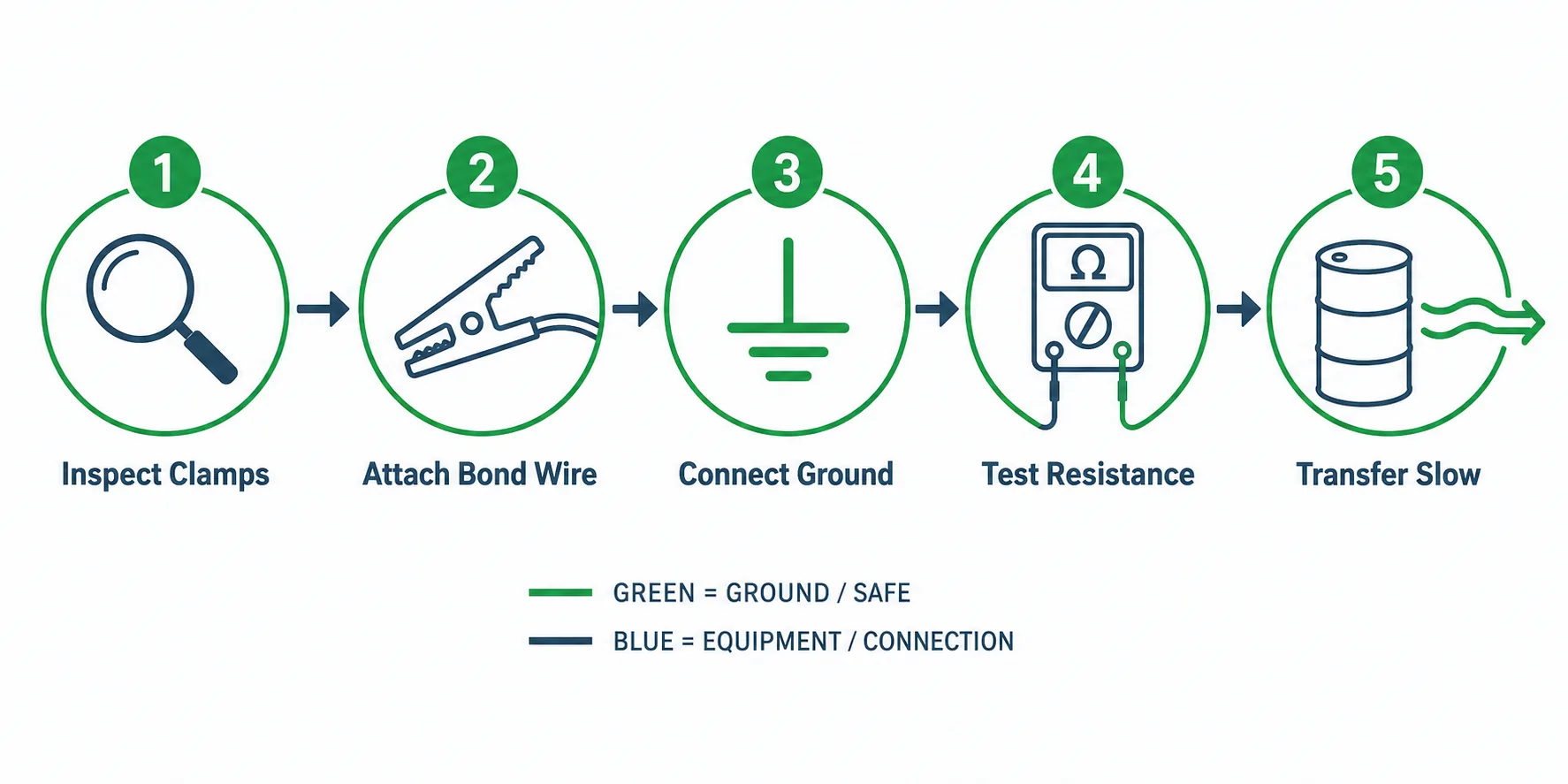
The sequence matters as much as the hardware:
- Inspect clamps and cables for damage, corrosion, and continuity before each use.
- Attach a bonding wire between the source container and the receiving drum, clamped to bare metal.
- Connect the drum to a verified earth ground.
- Confirm a low-resistance path with a continuity or resistance test before flow begins.
- Transfer the liquid slowly to limit charge generation, per NFPA 77 guidance.
- Disconnect in the correct order after transfer completes: remove the ground last.
Self-checking static reels and ground-verification devices confirm a live connection before flow begins, which removes guesswork from the operator’s hands.
Bonding and Grounding During Drum Transfer and Filling
At a fill station, bond the drum to the fill nozzle or the station frame before you open any valve. This holds for solvent dispensing and for filling hazardous material storage containers inside a controlled transfer area, where a single unbonded drum defeats the whole setup.
Plastic and Non-Conductive Drums: The Exception
Plastic and poly drums cannot be grounded or bonded, because the material does not conduct electricity. A clamp on a poly drum connects to nothing. Static still collects on the liquid and the container wall, and it has nowhere to drain.
The correct response is not to force a ground onto plastic. Use approved conductive or metallic containers for Class I flammable liquids, keep fill rates low, apply antistatic additives where the process allows, and follow OSHA guidance on non-conductive containers.
Compliance holds only when verified: a low-resistance path, not a visible wire, is what actually protects the operation.
Common Grounding and Bonding Mistakes and How to Verify Compliance
Most failures trace to a broken electrical path rather than missing hardware. Frequent errors:
- Clamps that bite into paint or a corroded surface instead of bare metal.
- The assumption that a drum resting on a concrete floor is grounded, it is not.
- Painted or rusted contact points that quietly break continuity.
- No periodic continuity or resistance testing.
Documented inspection intervals and routine resistance checks turn a one-time setup into ongoing compliance. Wayne State’s guidance reinforces that a verified low-resistance path, not a visible wire, is what actually protects the operation.
Grounding and Bonding in Hazardous Waste Handling
The same physics applies to waste drums that hold flammable solvents, rinsate, and saturated residues. A waste-transfer point carries the same static ignition risk as a fresh-product fill point, so the same grounding and bonding discipline belongs there. Equipment rated for Class I environments relies on explosion-protective enclosures for the same reason: static and flammable vapor share the same space during handling and decontamination.
Frequently asked questions
Do 55-gallon drums need to be grounded?
Why do drums need to be grounded?
What is the difference between grounding and bonding?
Do plastic drums need to be grounded?
What does OSHA require for grounding and bonding of flammable liquids?
Closing Takeaway
Grounding and bonding are both mandatory for conductive drums under OSHA 1910.106 and NFPA standards, they call for a different approach on non-conductive plastic drums, and they hold up only when verified through routine resistance testing. Meeting drum grounding and bonding requirements is less about owning the right clamp and more about proving, every transfer, that the charge has a safe path to earth.