
Article summary: NFPA 30 flammable liquid storage rules define how facilities classify, contain, and separate flammable and combustible liquids to cut fire and explosion risk. This guide covers liquid classes, cabinet and container limits, storage-room fire ratings, and the point where detached fire-rated buildings become the compliant path. It closes with a decision table and the questions EHS teams ask most.
NFPA 30 sits at the center of any facility that keeps solvents, fuels, or process chemicals on site. The code tells you how much you can hold, in what containers, and behind what kind of fire barrier. Get it right and you protect people, property, and your operating permits. Get it wrong and a single leaking drum becomes a reportable incident. This guide turns the standard into decisions a plant manager or environmental, health, and safety (EHS) professional can act on.
What NFPA 30 Governs (and Why It Exists)
NFPA 30, the Flammable and Combustible Liquids Code, is a consensus standard published by the National Fire Protection Association. It sets the design and operating rules for how flammable and combustible liquids are classified, contained, separated, and protected against ignition. The code addresses container storage, tank storage, piping, spill control, ventilation, and electrical area classification.
A consensus standard is not automatically law. It becomes enforceable when a jurisdiction adopts it by reference. Most U.S. fire codes fold NFPA 30 into their requirements, and federal workplace rules mirror much of its intent. OSHA enforces flammable-liquid handling through its own regulations, and the construction-industry rule at OSHA’s flammable liquids standard tracks the quantity limits many facilities already follow. The general-industry counterpart, 29 CFR 1910.106, covers the same ground for permanent plants and warehouses.
Because of that overlap, a facility that meets NFPA 30 storage requirements usually satisfies its OSHA obligations at the same time. The reverse is not always true, so treat NFPA 30 as the more detailed reference. You can read the current edition free through NFPA’s own codes-and-standards catalog rather than a scraped third-party copy.
How NFPA 30 Classifies Flammable and Combustible Liquids
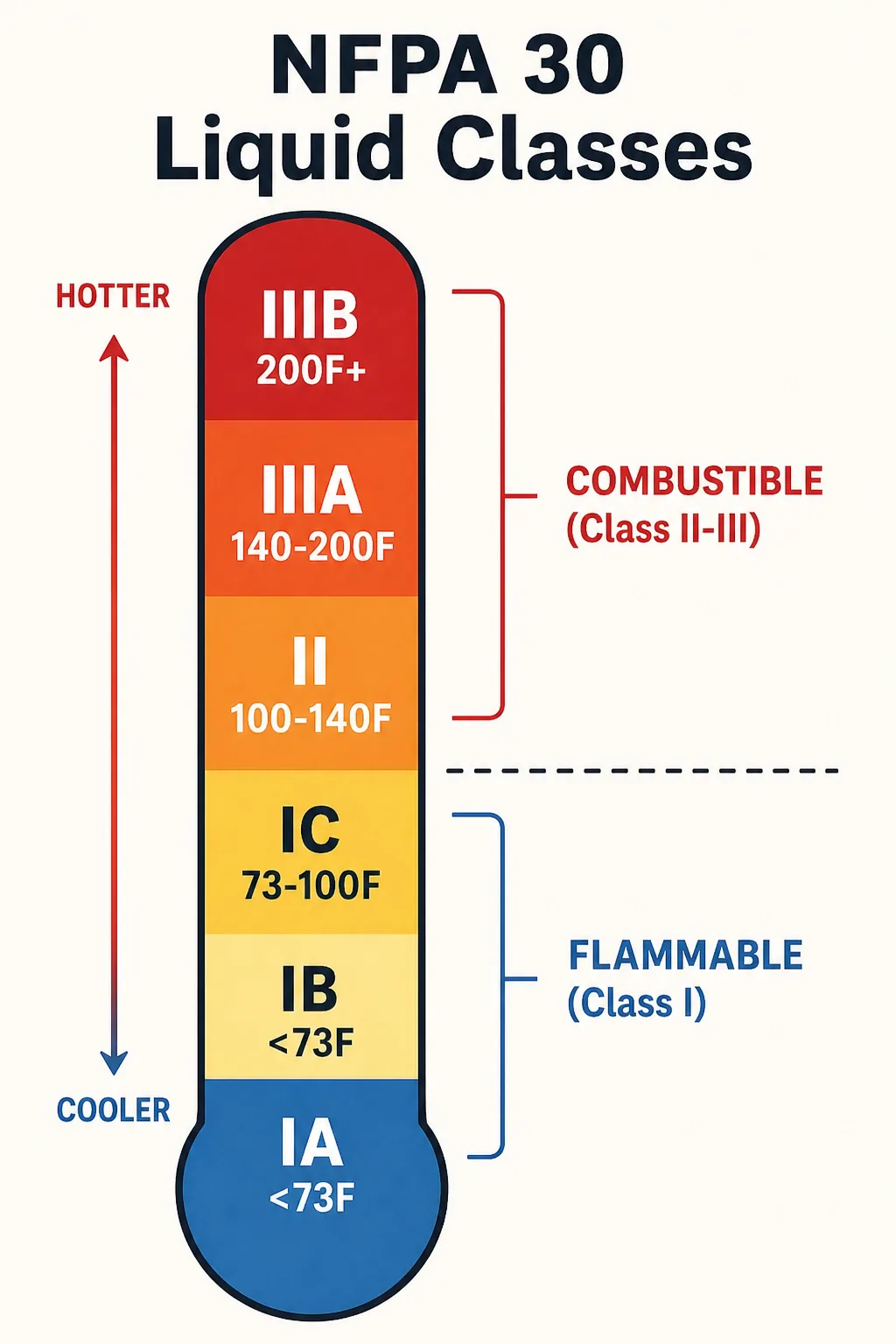
Every storage decision starts with classification. The code does not treat a can of acetone the same as a drum of motor oil, and neither should your storeroom.
Flash point and the classification framework
Flash point is the lowest temperature at which a liquid gives off enough vapor to form an ignitable mixture near its surface. A lower flash point means a liquid that ignites more readily at ordinary temperatures. NFPA 30 sorts liquids by flash point and, for the most volatile group, by boiling point.
| Class | Flash point | Boiling point | Behavior |
|---|---|---|---|
| IA | Below 73°F | Below 100°F | Most volatile; ignites at room temperature |
| IB | Below 73°F | At or above 100°F | Highly volatile |
| IC | 73°F to below 100°F | n/a | Flammable |
| II | 100°F to below 140°F | n/a | Combustible |
| IIIA | 140°F to below 200°F | n/a | Combustible |
| IIIB | At or above 200°F | n/a | Least volatile |
Class I liquids are the flammable ones. Class II and Class III are combustible. That single split drives most of the quantity and separation rules later in the code.
Flammable vs. combustible, and the GHS categories
Here is where facilities get tripped up. Two systems describe the same liquids. The older NFPA class system (IA through IIIB) runs alongside the Globally Harmonized System (GHS) categories used on safety data sheets and OSHA hazard labels. A drum can carry both a class and a category, and reconciling them prevents mislabeled storage.
| GHS category | Flash point | Boiling point | Rough NFPA match |
|---|---|---|---|
| Category 1 | Below 73.4°F | At or below 95°F | Class IA |
| Category 2 | Below 73.4°F | Above 95°F | Class IB |
| Category 3 | 73.4°F to 140°F | n/a | Class IC / II |
| Category 4 | 140°F to 199.4°F | n/a | Class IIIA |
Common liquids and where they land:
| Liquid | Typical class |
|---|---|
| Gasoline | IB |
| Acetone | IB |
| Methanol / ethanol | IB |
| Toluene | IB |
| Mineral spirits | II |
| Diesel fuel | II |
| Motor oil | IIIB |
When a class and a category disagree on your paperwork, resolve it before the liquid goes into storage. The stricter of the two governs the quantity and separation you apply.
NFPA 30 Flammable Liquid Storage Requirements & Maximum Quantities
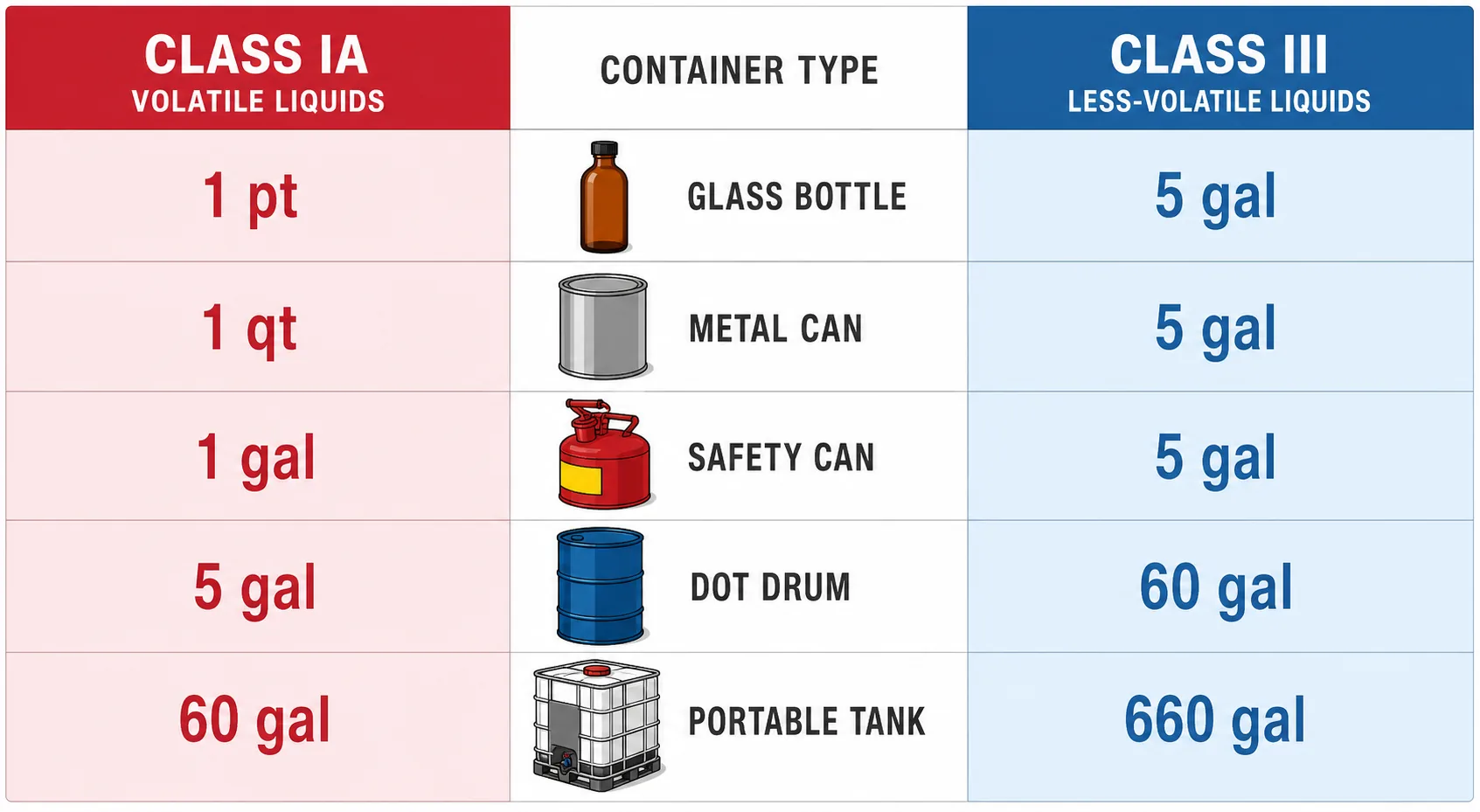
The core question every facility asks: how much can we keep, and where? NFPA 30 answers with container limits, cabinet limits, and per-area caps that tighten as the liquid gets more volatile.
Storage cabinet limits
An approved flammable-liquid storage cabinet is the first line of containment inside a general work area. The widely applied limit, echoed in OSHA rules, is no more than 60 gallons of Class I or Class II liquids, or no more than 120 gallons of Class III liquids, in any one cabinet. A single fire area is generally held to three such cabinets unless it is a dedicated storage room designed for more.
Container size also scales with class. The more volatile the liquid, the smaller the individual container the code allows outside a specialized room.
If you have a low volume of flammable liquids for maintenance use or just in general, I always recommend businesses store them in cabinets.
| Container type | Class IA | Class IB | Class IC | Class II | Class III |
|---|---|---|---|---|---|
| Glass | 1 pt | 1 qt | 1.3 gal | 1.3 gal | 5 gal |
| Metal (non-DOT drum) | 1.3 gal | 5 gal | 5 gal | 5 gal | 5 gal |
| Safety can | 2 gal | 5 gal | 5 gal | 5 gal | 5 gal |
| Metal drum (DOT) | 60 gal | 60 gal | 60 gal | 60 gal | 60 gal |
| Approved portable tank | 660 gal | 660 gal | 660 gal | 660 gal | 660 gal |
Flammable liquids (flash point below 100°F) should never go into a plastic intermediate bulk container (IBC), listed or unlisted, plastic totes fail fast in a fire and can feed it.
Approved metal containers and listed portable tanks are the correct choice for Class I liquids. Across the wider set of steel drums, safety cans, and approved bulk vessels, matching the vessel to the class is the discipline that keeps an audit clean, which is why teams specify purpose-built hazardous material storage containers and cabinets rated to the class they actually store.
Indoor Storage Rooms: Fire Ratings, Doors & Design
When quantities outgrow cabinets, the next step is a dedicated inside storage room built as a fire-rated enclosure. NFPA 30 ties the room’s fire-resistance rating to the door rating and the quantity you intend to keep.
The pattern from the indoor storage-room provisions: a one-hour enclosure needs a self-closing fire door rated at least 45 minutes, and a two-hour enclosure needs a door rated one and a half hours. Rooms also need liquid-tight spill control (a raised sill or a sloped floor draining to a safe point), mechanical ventilation sized to clear vapors, and electrical fixtures rated for the area classification.
| Enclosure fire rating | Required fire-door rating | Typical use |
|---|---|---|
| 1 hour | 45-minute self-closing door | Smaller rooms, moderate quantity |
| 2 hours | 1.5-hour self-closing door | Larger rooms, higher quantity |
| 4 hours (assembly) | Rated per assembly design | High-volume or high-hazard storage |
Ventilation, spill control, and door hardware fail together if any one is neglected. A properly rated door on an unsealed floor still lets burning liquid spread. Facilities that need heavier separation and controlled airflow often move to engineered assemblies such as 4-hour bi-directional fire-rated hazardous material storage buildings, where UL-listed dampers with 165°F fusible links and galvanized-steel blades hold the fire rating on both faces of the wall.
When Indoor Limits Aren’t Enough: Detached Fire-Rated Storage Buildings
Cabinets and indoor rooms cover a lot of ground, but real inventories blow past those limits fast. Once your stock exceeds what cabinets and inside rooms allow, the compliant path is a detached, outdoor fire-rated structure.
Detached safety storage buildings sit apart from the main plant, so a fire inside the store does not threaten production or people. Fire-rated storage buildings carry engineered wall assemblies (one-hour to four-hour), rated doors, spill containment sumps, and code-sized ventilation as a complete package rather than a field-assembled room.
High-hazard occupancies that store Class I liquids in volume often need explosion relief. NFPA 68 governs deflagration venting: panels that open under pressure to release a rapid combustion event before it ruptures the structure. Buildings engineered for this, such as 2-hour uni-directional fire-rated storage buildings with NFPA 68 explosion vent panels, route the pressure wave away from occupied areas. Where a deflagration or detonation threat is credible (reactive chemistries, fine combustible dust, high vapor loads), blast-resistant designs add a hardened envelope built to withstand overpressure rather than simply vent it.
Modularity matters for sites that reconfigure often. Relocatable storage buildings deliver compliant, engineered storage that can move with a project while keeping controlled access and defined fire separation intact as the site plan changes. Over a building’s life, a detached structure often costs less than repeatedly retrofitting an indoor room to chase a growing inventory.
Secondary Containment, Spill Control & Rinsate
Storage does not end at the container wall. NFPA 30 expects a plan for the liquid that escapes it. Secondary containment (curbs, dikes, sumps, or containment pallets) is sized to hold the contents of the largest container plus a margin for firefighting water or rainfall. Diked areas keep incompatible materials apart; the code, for example, keeps LP-Gas containers outside a diked area that holds flammable-liquid tanks.
Spill control carries a downstream consequence that storage planning often ignores: rinsate. Rinsate is the contaminated rinse water or solvent left after you clean containers, mixing equipment, tank interiors, or spill areas. It carries traces of the same flammable and hazardous liquids you were storing, so it is rarely a simple drain-disposal problem. In many cases it becomes a regulated hazardous-waste stream under the Resource Conservation and Recovery Act (RCRA), administered by the EPA. This is the exact seam where flammable-liquid storage meets hazardous-waste handling.
That seam is where waste-handling discipline pays off. Saturated absorbents, solvent-laden rags, contaminated filters, and rinsate residues all leave a storage operation and enter a waste stream that must be volume-reduced, contained, and shipped without added risk. Equipment built for hazardous and saturated waste (liquid-removal systems for solvents and residues, decontaminable stainless-steel chambers, and explosion-rated components for high-risk atmospheres) closes that loop safely. For sites that move drums and bulk vessels through storage and into waste processing, structures like the 2-hour bi-directional fire-rated storage building base built for forklift and crane handling provide open-channel bases that let material move in and out without breaking containment.
Choosing a Compliant Storage Solution
The right asset depends on how much you keep, how volatile it is, and how much room you have. Use this table as a first-pass filter, then confirm quantities against your adopted local fire code.
| Factor | Approved cabinet | Indoor storage room | Detached fire-rated building |
|---|---|---|---|
| Typical max quantity | 60 gal Class I/II per cabinet | Hundreds of gallons | Thousands of gallons |
| Fire rating | Listed cabinet construction | 1 to 2 hour enclosure | 1 to 4 hour, engineered |
| Explosion relief | Not applicable | Limited | NFPA 68 venting available |
| Footprint | Inside work area | Dedicated interior room | Outdoor / detached pad |
| Relative cost | Lowest | Moderate | Higher upfront, scalable |
| Best fit | Small daily-use volumes | Mid-size consolidated stock | High volume or high hazard |
A facility rarely picks one and stops. Cabinets serve the shop floor, an inside room consolidates working stock, and a detached building holds bulk reserves and waste-side residues. Match the storage type to the class and quantity, and the code mostly falls into place.
Frequently asked questions
What is the maximum amount of flammable liquid I can store without a cabinet?
How many flammable-liquid storage cabinets can be in one room?
Can flammable liquids be stored in plastic IBC totes?
What fire rating does a flammable liquid storage room need?
Where can I get the official NFPA 30 PDF?
Closing Takeaway
Compliance with NFPA 30 comes down to one repeatable habit: match the storage asset to the liquid’s class and the quantity on hand. Classify first, cap the volume per container and cabinet, rate the enclosure to the risk, contain the spill, and account for the rinsate and waste that storage leaves behind. Facilities that treat storage and waste handling as one continuous system, rather than two disconnected problems, cut both fire risk and regulatory exposure at once. As inventories grow and chemistries change, the sites that stay ahead plan their next storage tier before the code forces the decision.