
Summary: Segregating incompatible chemicals rests on four controls: group inventory by hazard class, separate the groups by a method fire code recognizes, give each group its own containment, and carry the same discipline into waste and rinsate. A gap in one undoes the other three.
What Safe Segregation Requires
Group every product by hazard class. Separate each group by distance, a noncombustible barrier, or an approved cabinet. Give each group dedicated secondary containment. Done correctly, that sequence blocks four failure modes: fire, explosion, toxic gas release, and violent exothermic reaction.
For product-specific rules, read Section 7 (handling and storage) and Section 10 (stability and reactivity) of each safety data sheet. Those two sections name the materials a given chemical must never sit beside.
What “Incompatible” Means in a Storage Context
Two chemicals are incompatible when contact between them releases heat, generates gas, starts a fire, or forms a product more toxic than either parent material. A different hazard class alone does not make two products incompatible. The reaction does.
Contact incompatibility needs a spill, a container failure, or a shared drain. Condition incompatibility needs only heat, moisture, sunlight, or mechanical shock. Containers fail in ordinary ways: corrosion at the seam, forklift damage, vibration on a rack. Design the layout for the day a drum leaks, not the day it arrives.
Group by Hazard Class, Never Alphabetically
According to Sylvia Johnson, Board Member of the U.S. Chemical Safety and Hazard Investigation Board (CSB):
> “CSB has been calling for greater regulatory coverage of reactive chemicals since 2002. We urge OSHA and the EPA to expand coverage of these hazardous chemicals so that severe incidents, like the one at Bio-Lab Conyers, do not keep happening. These incidents negatively impact workers and the surrounding communities.”
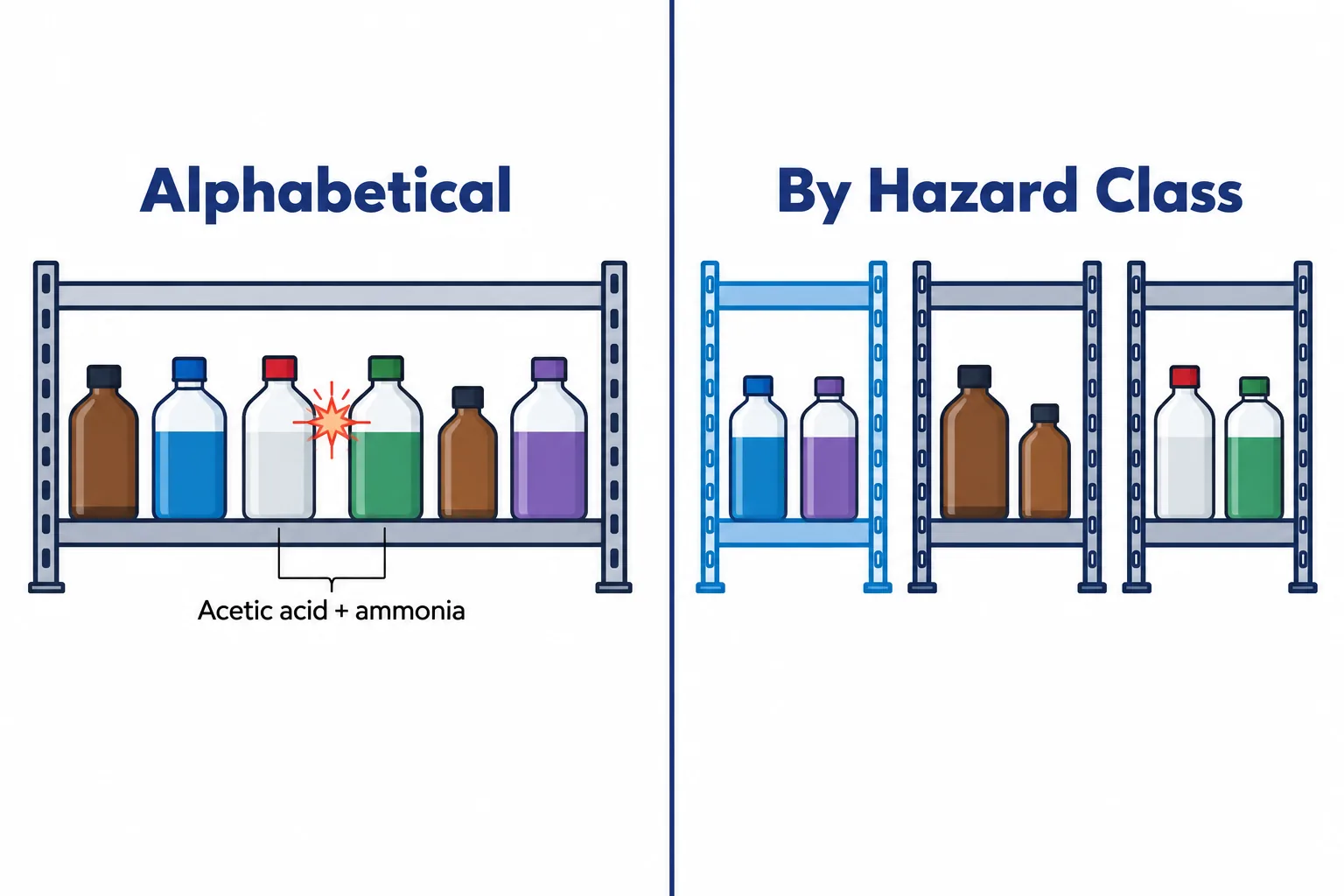
Alphabetical shelves put acetic acid beside ammonium hydroxide. Hazard-class grouping corrects that, and it costs nothing but floor-plan discipline.
Core groups: flammable liquids, oxidizers, strong acids, bases, water reactives, cyanide and sulfide salts, acute toxics, compressed gases, and peroxide formers.
Two refinements matter. Nitric acid behaves as an oxidizer, so keep it apart from other acids and from all organic material. Keep organic acids apart from mineral acids. Alphabetize inside a group only after the groups sit physically separate. NFPA 400, the Hazardous Materials Code, organizes its storage requirements the same way, by hazard class.
Incompatible Pairs and What They Produce
| Chemical | Keep away from | Result on contact |
|---|---|---|
| Sodium hypochlorite bleach | Ammonia, ammonium salts | Chloramine gas, respiratory injury |
| Sodium hypochlorite bleach | Acids | Chlorine gas |
| Strong acids | Cyanide or sulfide salts | Hydrogen cyanide, hydrogen sulfide |
| Sodium, potassium, lithium | Water, moisture, aqueous solutions | Hydrogen gas plus enough heat to ignite it |
| Nitric acid | Organic solvents, alcohols | Violent oxidation, fire |
| Oxidizers | Flammable liquids | Faster ignition, hotter fire, harder suppression |
| Concentrated hydrogen peroxide | Combustibles, organics | Self-heat to ignition |
Bleach and ammonia is the pair most often combined by accident, in janitorial closets as much as in process areas. The reaction produces chloramine gases that cause cough, nausea, and shortness of breath.
Separation Distance, Barriers, and Cabinets Under Fire Code
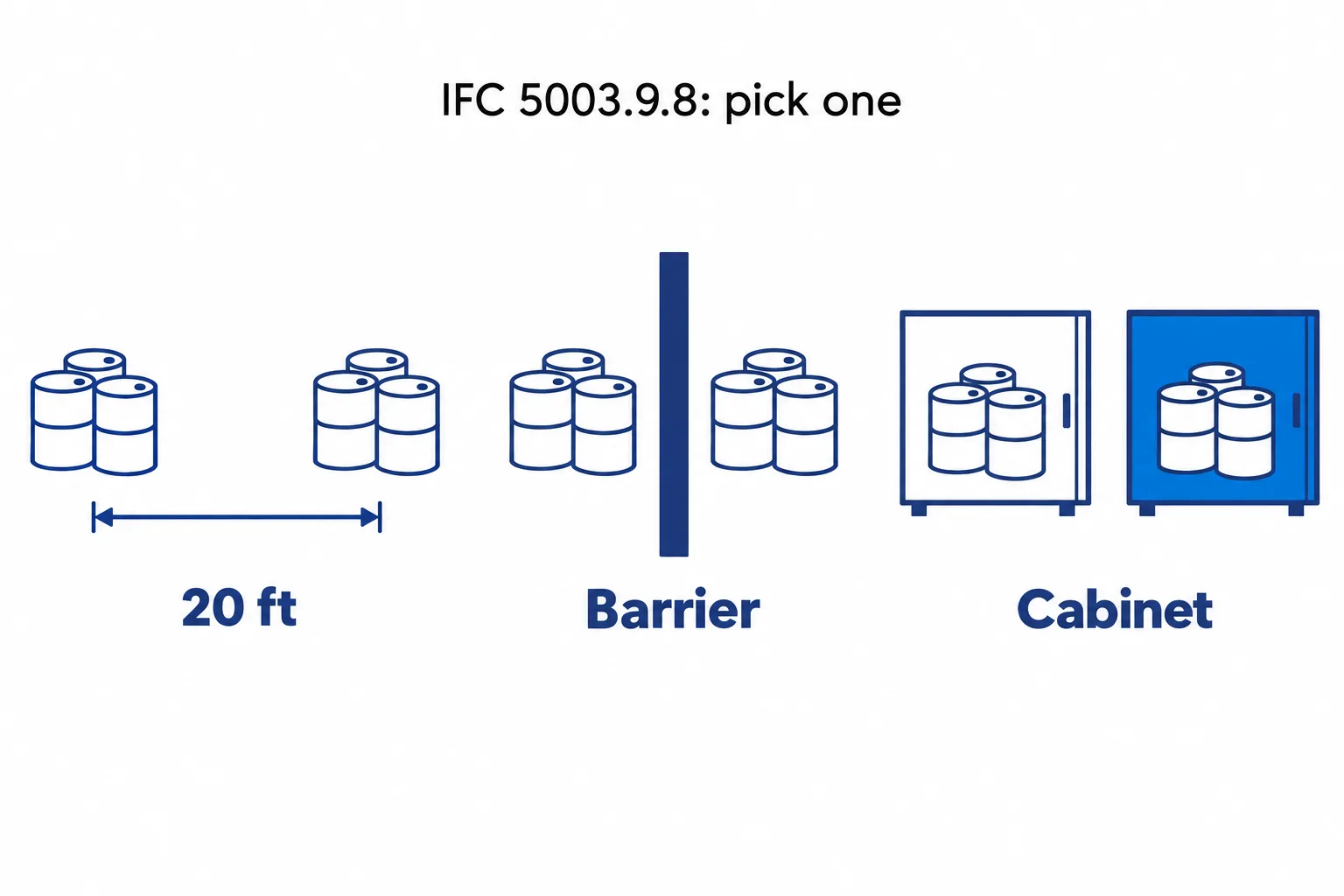
The International Fire Code treats separation of incompatible materials in Section 5003.9.8 and accepts three paths: at least 20 feet of distance, isolation by a noncombustible partition, or storage in approved hazardous material storage cabinets or gas cabinets. Confirm the code edition your jurisdiction adopted before you commit to a layout.
OSHA’s flammable liquids standard, 29 CFR 1910.106, sets quantity limits per approved cabinet and per fire area. Check those figures in the standard against your actual inventory rather than a rule of thumb.
One rule holds without exception in practice: never place two incompatible groups in one cabinet, even on separate shelves. A leak on the top shelf drains to the same sump.
Secondary Containment Sized and Specified Correctly
One containment device per hazard group. Shared spill pallets defeat the entire layout.
Match the material to the chemical. HDPE handles most acids and bases, but fails against many solvents and strong oxidizers. Steel pallets corrode under acid service. Size capacity per the applicable code and permit, commonly the volume of the largest container or a set percentage of the aggregate. Keep sumps dry, since pooled rainwater or rinsate gives two separate leaks a path to each other.
Segregating Incompatible Chemicals in Safety Storage Buildings
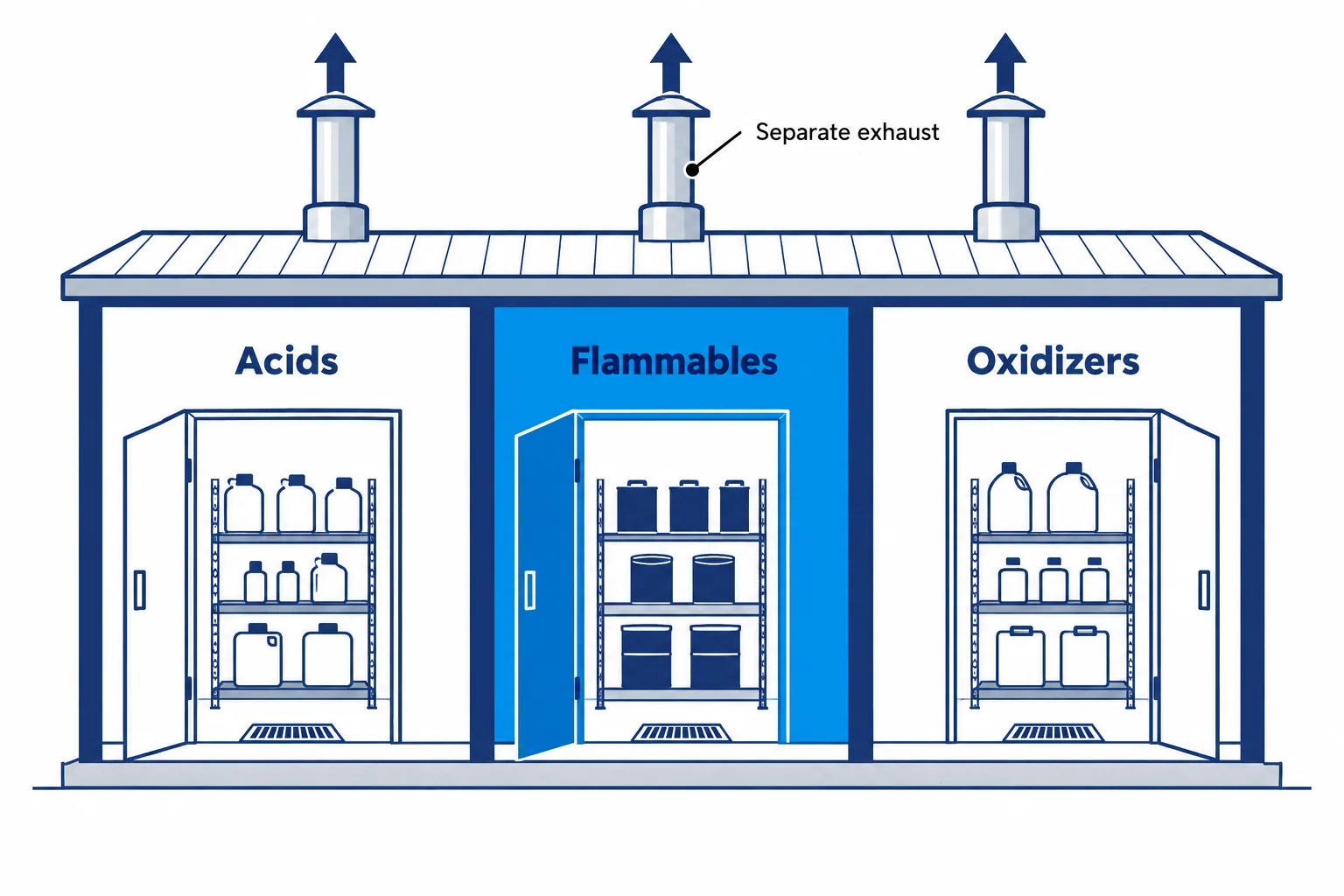
At volume, hazard-class rules turn into physical assets. Fire-rated storage buildings and NFPA-compliant storage building designs support multi-compartment layouts with rated walls between groups, so acids, flammables, and oxidizers each sit behind their own door.
Ventilation carries the same logic: a dedicated exhaust per compartment, so acid vapor and solvent vapor never share a duct. Specify electrical classification per compartment, bond and ground conductive containers, add temperature control where peroxide formers or water reactives are held, and place a spill alarm in every sump.
Smaller inventories fit hazmat storage containers, though a single hazmat storage container earns its place only when it holds one compatible family. Where an adjacent process or the inventory itself presents an overpressure hazard, [blast-resistant buildings](safetystorage.com/benefits-of-modular-chemical-storage-buildings/) protect occupants in ways a standard hazmat building cannot.
Placard every door of a hazardous material storage building so responders know the class behind it.
Segregating Incompatible Chemicals in Waste and Rinsate Streams
Segregation rarely breaks on the storage shelf. It breaks at the waste stage.
EPA rules for on-site generators, 40 CFR 262.17 for large quantity generators and 262.16 for small quantity generators (both incorporating 40 CFR 265.17(b) and mirroring 265.177), prohibit hazardous waste in an unwashed container that previously held an incompatible waste or material, and require separation from nearby incompatible materials by a dike, berm, wall, or other device.
Facilities operating under a permitted treatment, storage, and disposal facility (TSDF) status follow the parallel rule at 40 CFR 264.177.
Rinsate inherits the hazard class of its parent chemical. Route wash water and decontamination liquid to a labeled container that matches the source stream, never to a general drain.
Volume reduction concentrates the problem. Compaction and drum crush operations press residue out of containers, so incompatible waste streams must never enter the same chamber or the same drum.
Equipment built for hazardous and low-level radioactive service answers this with NEMA 7 explosion-proof components, liquid removal systems, inert-gas purge, fire extinguishing fittings, HEPA and VOC or carbon filtration, and stainless steel platens and chambers that survive decontamination between streams.
[CTI Safety Storage](safetystorage.com/cti-in-drum-compactor/) builds compactors to that specification for aerospace, biomedical, university, and cradle-to-grave corporate waste programs.
Write the changeover and decontamination step between incompatible streams into the procedure, and record each one.
Segregation Audit Checklist
- Current SDS on file for every product in storage
- Hazard-group map posted at each storage area
- No two hazard groups on one containment device
- Distance, partition, or cabinet verified against the adopted fire code
- No incompatible group stacked above another
- Waste and rinsate containers labeled at the point of generation
- Quarterly inventory reconciliation and container condition inspection
Two findings dominate audits: alphabetical shelves and shared spill pallets.
Frequently Asked Questions
Related readingHow to Pass a Hazmat Storage Inspection: Full ChecklistRead the guide →Frequently asked questions
What are some examples of incompatible chemicals?
What two chemicals should never be mixed together?
How far apart must incompatible chemicals be stored?
Can incompatible chemicals share a secondary containment tray?
Where do I find a segregation chart or PDF for my inventory?
Key Takeaway
Segregation is a physical system, not a label exercise. Hazard-class groups, code-recognized separation, dedicated containment, and waste stream discipline work as one control set. The same rules follow the material past the storage room door, into the waste drum, and out the gate.