

Article Summary
Fire suppression for chemical storage covers the automatic systems that protect flammable, corrosive, and reactive inventory inside lockers, containers, and detached buildings. This guide compares dry chemical, clean agent, foam, water mist, and condensed aerosol agents, explains how automatic actuation works, maps the codes that govern design and service, and covers what a discharge leaves behind. Written for plant managers, EHS officers, and facility engineers who own the fire risk attached to a chemical inventory.
Why Chemical Storage Needs a Dedicated Suppression System
A storage locker packs a dense fuel load into a small volume. Ignition inside runs on a different clock than a fire in an open warehouse bay.
Class B fires behave differently from a pallet fire. Flame travels across the liquid surface, and hot steel or residual vapor can reignite a pool seconds after knockdown.
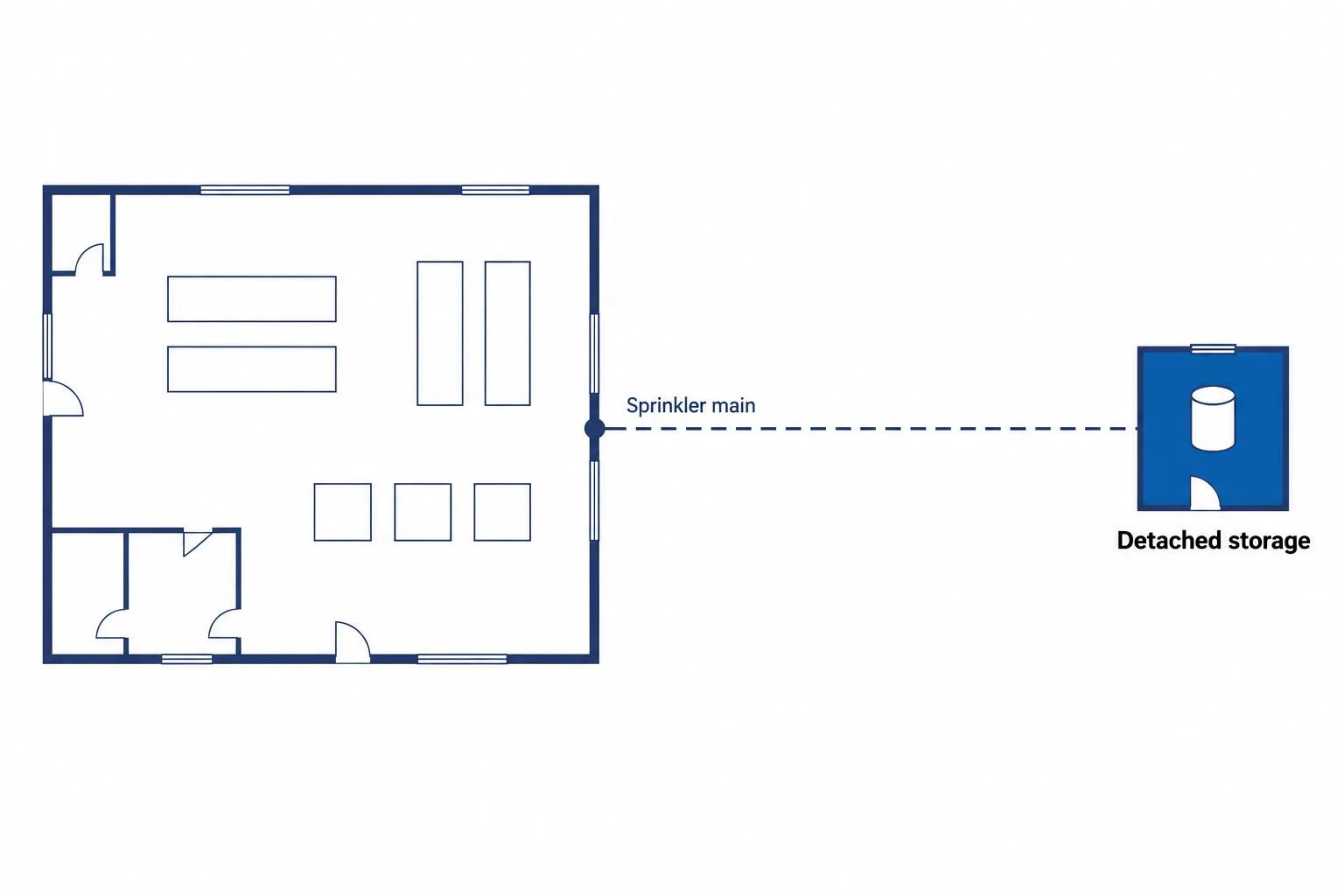
Detached hazmat storage buildings add a second problem. They often sit in a yard, past the reach of the plant sprinkler main, unstaffed overnight. The system inside the enclosure is the only response on site when the fire starts.
Water alone is not a universal answer. It reacts violently with water-reactive stock, and a hose stream can float and spread a solvent fire rather than end it.
NFPA 30 (flammable and combustible liquids) and NFPA 400 (hazardous materials) set the quantity limits and separation rules that push inventory out of the main plant and into hazardous material storage buildings. Once stock sits in that dedicated enclosure, the system inside it becomes the primary line of defense.
Types of Fire Suppression for Chemical Storage
Agent choice follows the inventory, the enclosure, and what you can tolerate on the floor afterward.
Related readingFlammable Liquid Storage Building Requirements GuideRead the guide →| System | Fire classes | Residue | Cleanup burden | Best fit |
|---|---|---|---|---|
| Dry chemical (ABC) | A, B, C | Fine powder, mildly corrosive | Heavy, plus stock loss | Mixed-material lockers |
| Dry chemical (BC) | B, C | Fine powder | Heavy | Solvent and fuel storage |
| Clean agent | Per agent listing | None | Minimal | Sealed, high-value enclosures |
| Foam | B (liquid pools) | Wet blanket | Moderate to heavy, plus runoff | Large solvent volumes, diked areas |
| Water mist | A, some B | Water only | Light, low runoff volume | Rated buildings with drainage |
| Condensed aerosol | B, C typical | Fine solid deposit | Moderate | Small lockers, retrofits |
Dry Chemical Systems: The Default for Hazmat Storage Containers
Pre-engineered dry chemical packages remain the common answer for hazmat storage containers. Mono-ammonium phosphate (ABC) covers ordinary combustibles, flammable liquids, and energized electrical equipment. Sodium and potassium bicarbonate (BC) agents address liquid and electrical fires only, which matters in a locker that also holds cardboard, absorbent, and pallets.
The agent interrupts the chemical chain reaction of combustion rather than relying on heat removal alone, which is why knockdown is fast.
Cylinders mount inside or beside the enclosure, and fixed pipe carries agent to nozzles placed per the manufacturer’s listed layout. Move a nozzle in the field and the listing no longer describes what you installed.
The trade-off is residue. Discharge coats the interior with powder that is mildly corrosive to metal and electronics, and open or damaged packages usually leave as waste.
Clean Agent Systems for Sensitive or Sealed Storage
Halocarbon and inert gas agents suppress without residue. No powder to shovel out, no wash-down. Stock that survived the fire can often stay in service. NFPA 2001 covers the design. Carbon dioxide and other gaseous agents carry a distinct life-safety risk:.
OSHA requires a pre-discharge alarm on CO2 and Halon 1211 systems at a design concentration of 4 percent or greater, and on Halon 1301 systems at 10 percent or greater, because these concentrations can displace enough oxygen to endanger anyone still inside the enclosure.
Total-flood performance depends on enclosure integrity. The agent must hold its design concentration for the full hold time, which a louvered locker will never do. A room integrity test answers that question before purchase, not after.
Occupant safety drives a pre-discharge alarm, a time delay before release, trained staff, and posted exposure limits at the door.
Foam, Water Mist, and Aerosol Options
Foam blankets the liquid surface and suppresses vapor, which suits large solvent volumes and diked containment. NFPA 11 governs it.
Water mist cools and displaces oxygen with a fraction of a sprinkler’s water volume, so it generates far less rinsate and contaminated runoff to capture and characterize. NFPA 750 applies.
Condensed aerosol units are modular, need no pipe network and no pressurized cylinder, and retrofit into small lockers where a dry chemical package will not fit.
Whatever discharges, plan for the aftermath. Agent plus firewater plus contaminated absorbent becomes a regulated waste stream, not a janitorial task.
How an Automatic System Actuates
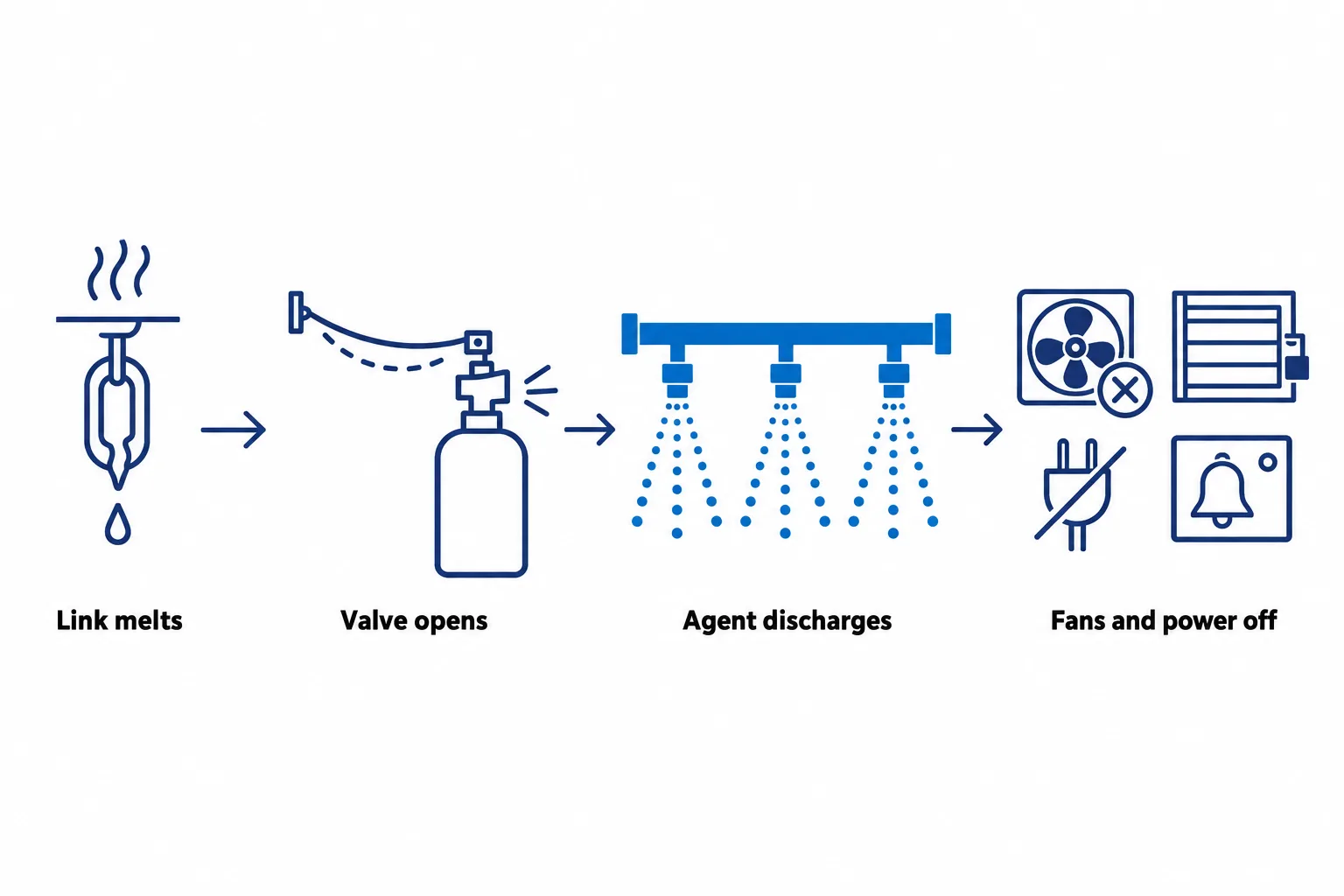
Detection. Most pre-engineered units use fusible links rated to a set temperature. Heat, flame, and optical detectors respond faster and suit fast-flame-spread inventories.
Actuation. The link melts, cable tension releases, the cylinder valve opens, and agent moves through fixed pipe to the nozzles.
Manual release. A pull station outside the door lets a trained operator discharge the system without entry.
Auxiliary functions. Discharge should stop mechanical exhaust fans, close dampers, cut power to the enclosure, and signal the fire alarm panel. A fan that runs through discharge dilutes the agent below design concentration.
Electrical components. Where flammable vapor is present, detection and shutdown hardware must carry the correct explosion-proof and NEMA ratings for the classified area.
NFPA 17 Compliance and the Wider Code Picture
NFPA 17 is the reference standard for dry chemical extinguishing systems and addresses design, installation, approval, inspection, and maintenance. Parallel standards cover the other agents discussed above:
NFPA 2001 for clean agent, NFPA 11 for foam, NFPA 750 for water mist, and NFPA 2010 for fixed condensed aerosol systems. NFPA 17A governs wet chemical systems for commercial cooking equipment and does not apply to chemical storage.
OSHA reaches the same equipment from the employer side. Under 29 CFR 1910.160, fixed systems must be inspected annually and kept in operating condition, and a pre-discharge alarm is required where the agent itself endangers occupants, as OSHA’s annual inspection requirement for fixed extinguishing systems sets out.
Local approval closes the loop. Your fire authority reviews the layout, the listed equipment, and the documentation. An NFPA compliant storage building needs all three on file, not just hardware on the ceiling.
How to Spec Fire Suppression for Chemical Storage: A Six-Point Checklist
- Chemical compatibility. Build the inventory from SDS data first. Flag water-reactive, pyrophoric, and oxidizer stock before agent selection.
- Enclosure volume. Pre-engineered packages carry a maximum protected volume and a fixed nozzle count. Exceed either and the listing no longer applies, which is where custom-engineered storage becomes the compliant answer rather than a larger off-the-shelf package.
- Ventilation interlock. Continuous mechanical exhaust dilutes any total-flood agent unless discharge shuts it down.
- Temperature range. Outdoor lockers see freeze and heat extremes that affect agent behavior and cylinder pressure.
- Containment integration. Sumps, spill decks, and the route firewater and rinsate take afterward belong on the same plan set as the nozzles.
- Aftermath. Decontamination, waste characterization, and volume reduction of contaminated debris drive real cost. Decide who owns that work before the system is bought.
Suppression Choices in Blast Resistant and Fire-Rated Buildings
Enclosure construction changes the answer, a point most suppression catalogs skip.
Fire-rated storage buildings are engineered to contain a fire, and a sealed envelope holds a total-flood agent well. Louvered and vented lockers do not, which pushes them toward dry chemical or aerosol.
Blast resistant buildings add a harder constraint. Every penetration for pipe, conduit, or a pull station has to leave the rated envelope intact, and blast proof buildings carry documented penetration details for exactly that reason.
A field-cut hole in a rated wall voids the rating and the warranty at once.
Coordinate those penetrations with the manufacturer before fabrication.
What Happens After Discharge: Cleanup and Waste Streams
Suppression ends the fire. It does not end the incident.
Dry chemical residue attacks metal and electronics, so removal is prompt work, not deferred work.
Contaminated absorbent, PPE, wipes, damaged drums, and rinsate are typically evaluated as regulated waste under RCRA. Confirm the characterization with your environmental group before any container leaves the pad.
Debris volume then drives disposal cost and transport frequency, which is where compaction earns its place. CTI compactors are built for this waste stream: NEMA 7 explosion-proof components for classified areas, liquid removal systems for solvents and residues, fire extinguishing fittings and inert-gas purge setups for high-risk material, HEPA and VOC/carbon filtration down to 0.3 microns at 99.97% efficiency, and stainless steel platens and chambers that decontaminate cleanly.
The CTI 8040, CTI 8550, and CTI 8560 deliver compaction force up to 60,000 lbs under programmable controls and safety interlocks.
Return to service follows a fixed path: recharge cylinders, replace fusible links, re-inspect nozzle placement, and file the documentation.
Inspection and Service Schedule
- Monthly visual. Cylinder gauge in range, seals intact, nozzle caps in place, discharge paths clear, pull station unobstructed.
- Scheduled service. Use a qualified contractor and the interval named in the applicable NFPA standard and the listed manual, not a vendor’s habit.
- Annual duty. Federal rules require that annual inspection for fixed systems, as the OSHA fixed extinguishing systems checklist makes explicit.
- Fusible links. Dust and vapor deposits change response temperature. Replace on the manufacturer’s schedule.
- Cylinders. Track the hydrostatic test date stamp and retire cylinders on cycle.
- Records. Your insurer and your OSHA file both want the same paper trail.
Frequently asked questions
Does a chemical storage locker legally require a fire suppression system?
Is dry chemical or clean agent better for a flammable liquid locker?
Can a standard water sprinkler protect hazmat storage containers?
How often does a fixed system need inspection?
What do we do with residue and contaminated waste after discharge?
Closing Takeaway
Agent choice follows the chemical inventory, never the catalog. Two lockers of identical size can need opposite systems because one holds water-reactive stock and the other holds acetone.
Treat suppression, enclosure rating, secondary containment, and post-incident waste as one system with four parts. A gap in any one of them shows up on the worst possible day. Start with an SDS-driven inventory review and a conversation with your fire authority before a purchase order goes out.