

Article summary: Yes, flammable liquids can be stored outside when the setup follows code. Doing it right means the right containers, correct setback distance from occupied buildings and property lines, secondary spill containment, vapor control, and the quantity limits set by OSHA 1926.152 and NFPA 30. This guide walks EHS officers and facility managers through the rules, the physical methods, and the point where a purpose-built storage structure becomes the smarter option.
Can Flammable Liquids Be Stored Outside? (Short Answer and Why Facilities Do It)
Yes. Flammable liquids can be stored outside, and in many plants outdoor storage is the safer, more compliant choice. It still has to meet the same regulatory framework that governs indoor storage: approved containers, setback distances, spill containment, and clear quantity limits.
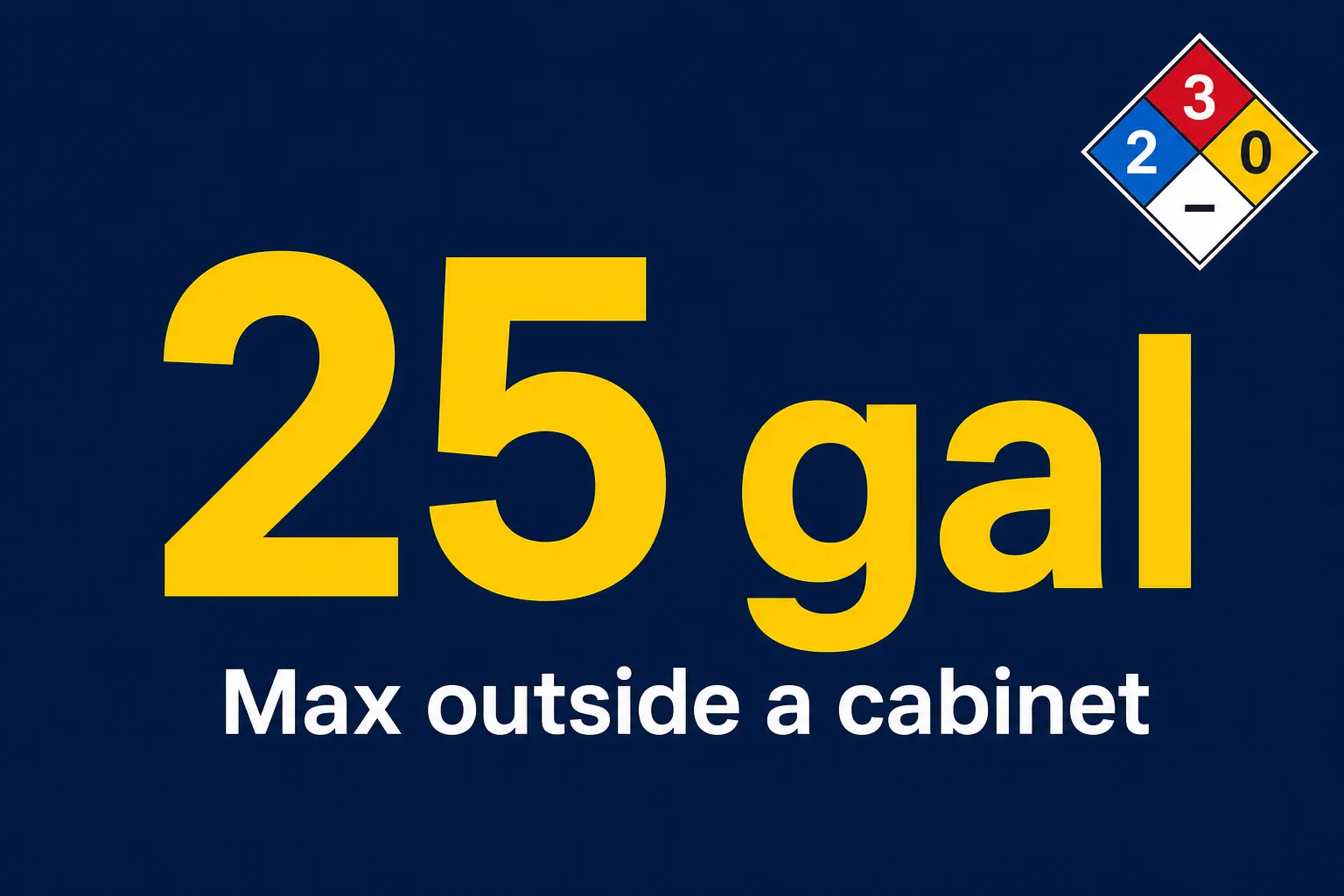
Facilities move flammables outdoors for good reasons. Indoor space fills up fast, and the rules tighten as it does. Under OSHA, no more than 25 gallons of flammable liquids may be kept in a room outside of an approved storage cabinet, a threshold spelled out in OSHA standard 1926.152 on flammable liquids. Once a shop or lab passes that point, outdoor placement often becomes the cleaner path to compliance. It also pulls ignition risk away from occupied work areas and takes advantage of natural ventilation that keeps vapor from collecting.
Terminology matters here. A flammable liquid has a flash point below 100°F, as defined by Cornell Environmental Health and Safety, so it gives off ignitable vapor at ordinary room temperature. A combustible liquid has a flash point at or above 100°F under OSHA standard 1910.106. Both need controlled storage, but flammables carry the higher urgency because their vapors ignite so readily.
Storage of Flammable Liquids Regulations: What the Codes Require
The storage of flammable liquids regulations that apply to your site come from two main sources plus your local authority. Knowing which is which keeps inspections short.
OSHA 1926.152 and 29 CFR 1910.106 Essentials
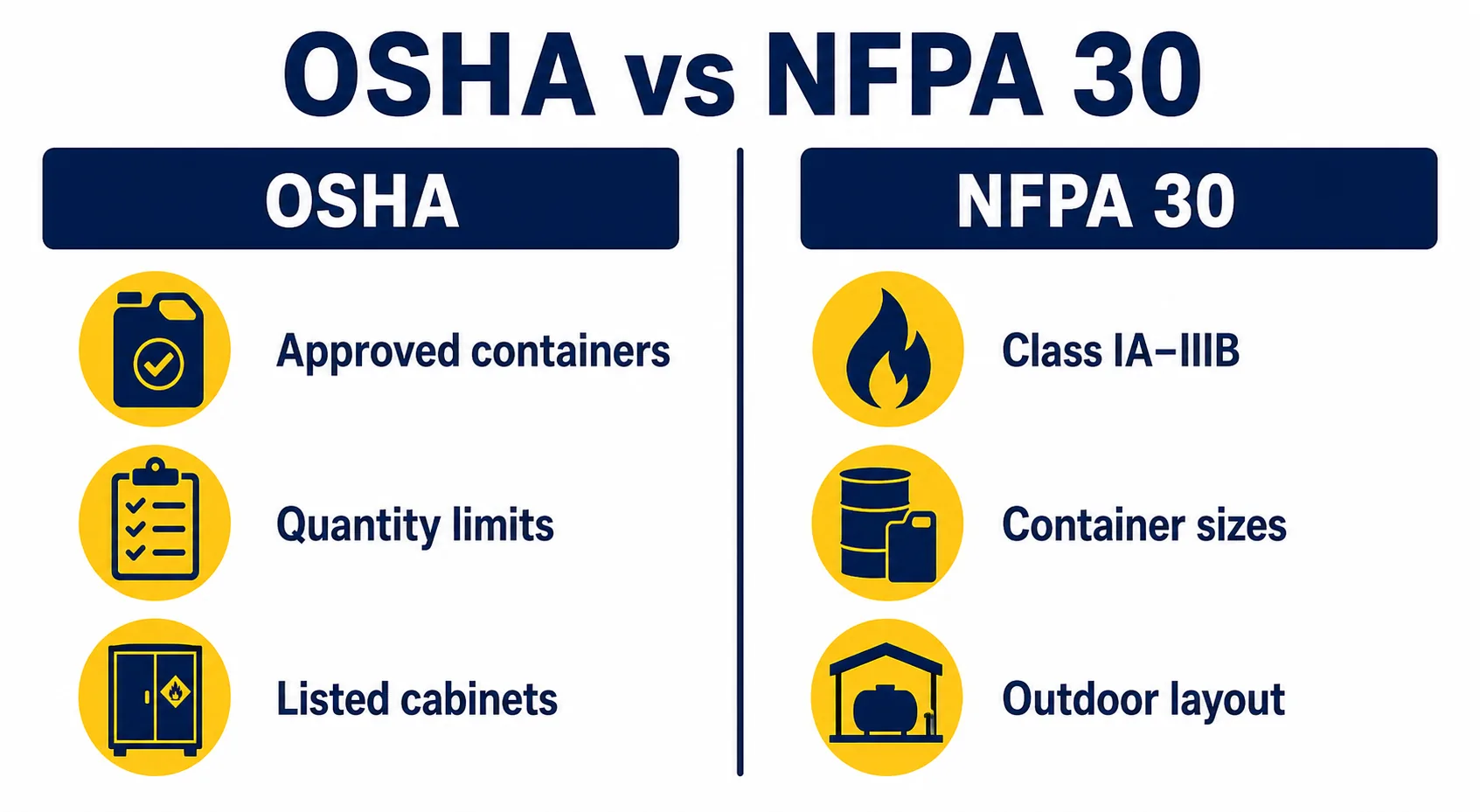
OSHA sets the federal floor. The construction standard, 1926.152, and the general industry standard, 29 CFR 1910.106, both require flammable liquids to be kept in approved closed containers, approved portable tanks, or listed storage cabinets. They cap the quantity allowed outside a cabinet, define approved container sizes by liquid class, and call for controls against spills and ignition. When facility managers ask what the OSHA requirements for storage of flammable liquids are, the short answer is: approved containers, quantity limits, listed cabinets, and separation from ignition sources, with tighter limits as volumes climb. University environmental health programs translate these rules into plain checklists, such as the University of Tennessee guidance on the use and storage of flammable and combustible liquids.
NFPA 30: Classification and Outdoor Storage Principles
NFPA 30, the Flammable and Combustible Liquids Code, adds the detail OSHA references. It classifies liquids by flash point and boiling point (Class IA through IIIB), sets maximum container sizes per class, and lays out how outdoor container storage areas should be arranged, separated, and protected. Many fire marshals adopt NFPA 30 directly, so it often carries the force of law even though it reads like a technical standard. The UC San Diego flammable and combustible liquids storage requirements show how these classifications drive real storage limits.
One caution: this article is guidance, not legal advice. Your local Authority Having Jurisdiction, usually the fire marshal, has the final word. Codes get amended locally, and a plan that clears the federal baseline can still need a permit or a design change in your county. Confirm before you build.
Setback Distances and Siting: Where Outdoor Storage Can Go
This is the part most short answers skip, and it is where outdoor storage succeeds or fails. Location decides how a small spill or leak behaves.
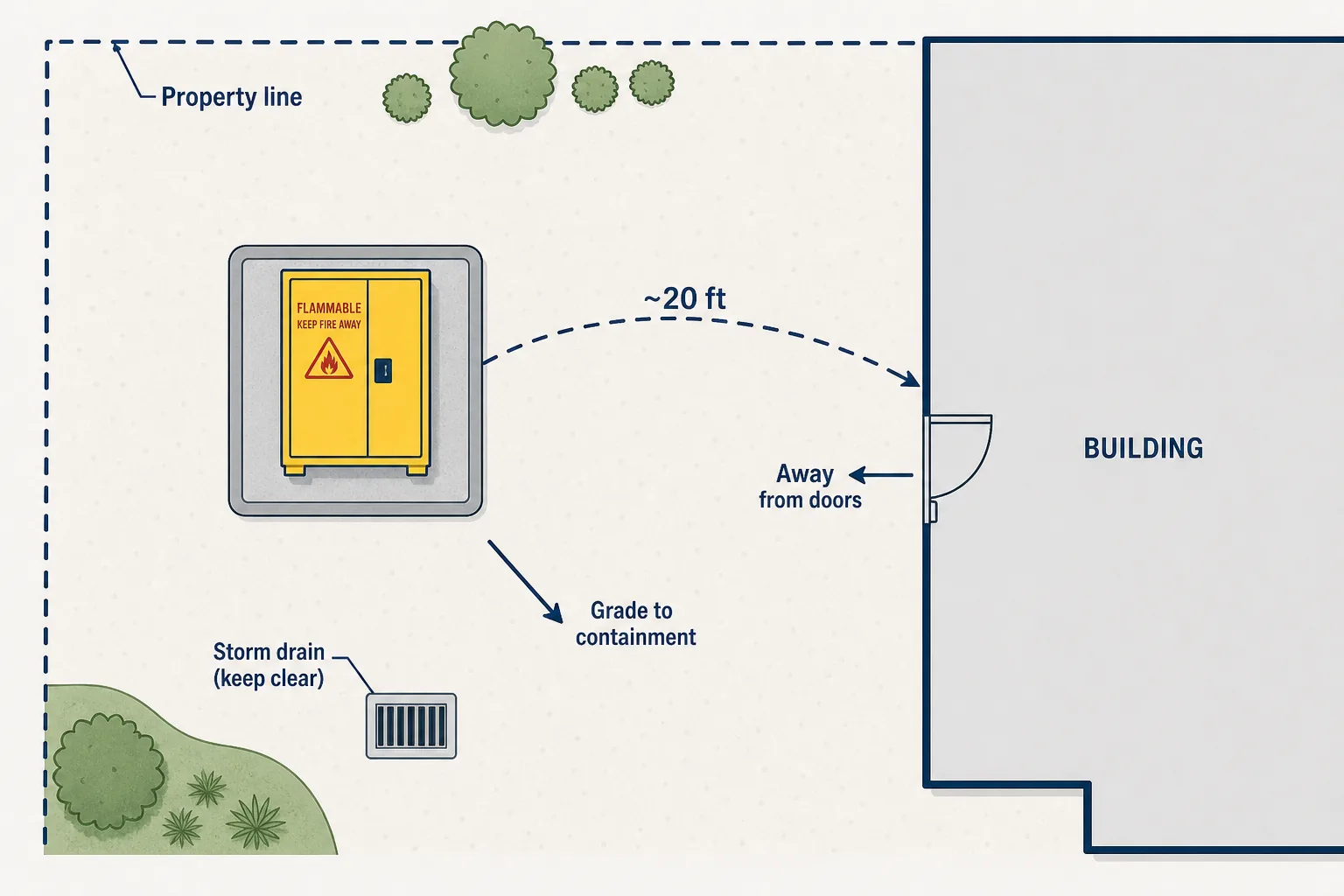
Keep containers and cabinets a safe minimum distance from occupied buildings, property lines, and ignition sources. A common benchmark referenced in outdoor storage guidance is roughly 20 feet from a building, though the exact figure depends on liquid class, aggregate quantity, and whether fire barriers are present. Treat the number as a starting point your AHJ will confirm, not a universal constant. Our guide to outdoor setups that survive inspection lists what reviewers measure and photograph once they arrive.
Separation from openings deserves the same care. Position storage away from doorways, exits, stairwells, and fresh-air intakes so vapor cannot drift indoors or block an escape route during a fire. Distance from floor and storm drains matters just as much, because a runaway spill that reaches a storm sewer turns a contained event into an environmental release.
Ground conditions round out siting. Set storage on an impervious pad, not bare soil, and grade the surface so any release flows toward containment rather than toward a waterway. Avoid low spots where heavier-than-air flammable vapor can pool. Utah State University’s flammable liquids storage guidelines give a useful reference point for separation and siting decisions on a working site.
Security belongs in the plan too. Outdoor stock is easier to reach, so fencing, locks, and access control protect against theft, tampering, and accidental contact. For operations that store sensitive or high-value materials, controlled access is part of the compliance picture, not an afterthought.
Approved Containers and Cabinets for Outdoor Use
Once the site is right, the container does the daily work. Two categories cover most needs.
Safety Cans and Approved Drums
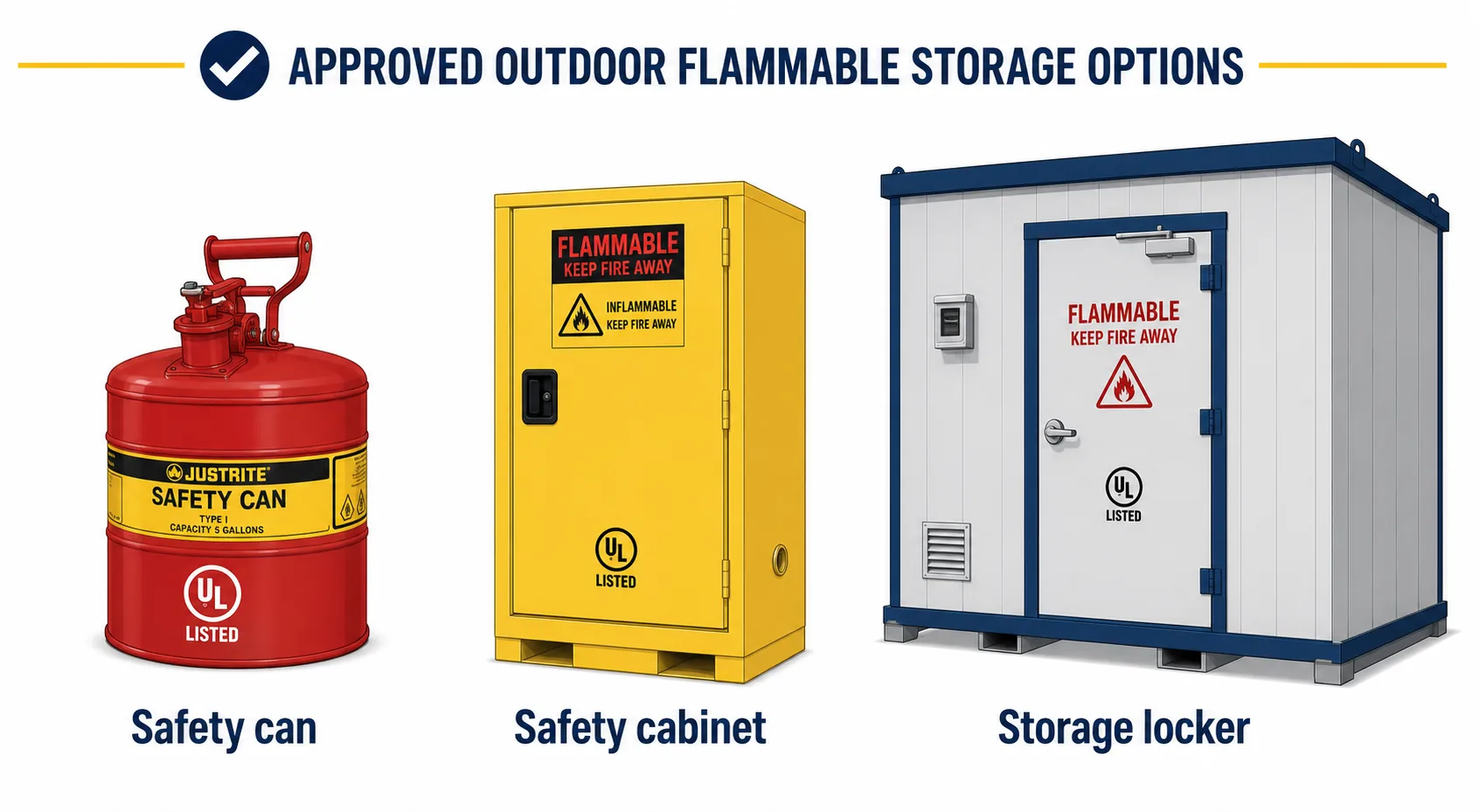
Approved safety cans are the workhorse of outdoor flammable storage. They use spring-loaded, self-closing lids and built-in flame arrestors that stop a flashback from reaching the liquid inside. When flammable liquids must sit outside a cabinet, safety cans are the preferred vessel for exactly this reason, a point echoed in University of Tennessee policy SAFS020-K on the use and storage of flammable and combustible liquids. Keep every container tightly closed, accurately labeled with its contents and hazard class, and made of non-glass material that will not shatter on impact. Approved drums serve larger volumes under the same principles.
Can a Flammable Cabinet Be Stored Outdoors?
Yes, a flammable cabinet can live outdoors, provided it is rated or listed for outdoor exposure. A standard indoor cabinet left in the weather will corrode, fade, and degrade until its fire rating no longer means anything. An outdoor-rated unit is built to handle rain, UV, corrosion, and temperature swings, and it should be anchored so wind cannot tip or shift it. That answers a related question buyers ask often: the best place to store a flammable liquid when not in use is a listed cabinet or safety can, sited outdoors away from ignition sources once indoor quantity limits are reached.
Container compatibility and static control matter during every transfer. Bond and ground containers when pouring or decanting so a static spark cannot find flammable vapor. The best method to store flammable liquids combines the right vessel, the right cabinet, and disciplined transfer practice, not any single product on its own.
Store flammable liquids, solvent waste, and oily rags in fire-resistant containers to reduce risk. Use robust metal tanks, well-ventilated …
Spill Containment and Rinsate Management
Containment is what separates a wet floor from a reportable release.
Provide secondary containment under every outdoor storage point: sumps, berms, or spill pallets sized to hold a meaningful volume if a container fails. A widely used design target is capacity equal to 110% of the largest single container, enough to catch a full failure plus rainwater. The containment surface has to be compatible with the liquids it may hold and free of cracks or drains that would let product escape.
Rinsate is the piece many programs overlook. Rinsate is the contaminated rinse water or solvent left after cleaning containers, drums, funnels, and equipment that held flammable or hazardous liquid. It is not clean water. It carries residual chemical and, in most cases, has to be captured, characterized, and handled as potential hazardous waste rather than poured on the ground or flushed to a storm sewer. Treating rinsate casually is one of the fastest routes to an environmental violation, since it converts a routine cleanup into an unpermitted discharge.
That reality points toward reducing waste volume. Captured rinsate, saturated absorbents, and contaminated solids all cost money to haul and dispose of, and disposal is priced by volume and hazard class. Equipment that compacts saturated waste and removes free liquid from solvents and residues shrinks that stream before it leaves the dock, which is where outdoor storage design and downstream waste handling meet.
Fire-Rated and Blast-Resistant Storage Buildings: The Scalable Solution
Cans and cabinets have a ceiling. When aggregate volume outgrows them, or when the liquids are volatile enough that a cabinet no longer feels adequate, the answer is a purpose-built structure. Code-compliant fire-rated safety storage buildings hold larger inventories while keeping occupancy separation, containment, and ventilation engineered in from the start rather than improvised on a pad.
Fire Ratings Explained: 2-Hour vs 4-Hour
A fire rating states how long an assembly resists fire before it fails, which sets how much time people have to evacuate and responders have to act. A 2-hour rating suits many general flammable storage needs and supports required separation from occupied spaces; 2-hour fire-rated hazardous storage buildings pair that rating with integral spill containment. Higher-hazard or higher-value inventories often call for 4-hour bi-directional fire-rated hazardous material storage buildings, which use continuously welded heavy-gauge steel for extended protection in both directions. Bi-directional ratings guard against a fire that starts inside the building as well as one that approaches from outside.
Blast-Resistant and Blast-Proof Buildings
Some flammables and process chemicals carry explosion potential, not just fire risk. Blast-resistant and blast-proof buildings, often called blast buildings, are engineered to withstand overpressure and to direct explosive force safely. Explosion relief construction, such as vent panels compliant with NFPA 68, gives an overpressure event a controlled path out rather than letting it destroy the enclosure. These features move a site from basic compliance toward genuine resilience, and they underpin the fire-rated safety storage products that protect people and operations. Modular, relocatable versions let a facility add capacity, or reposition it, without a permanent construction project, which suits sensitive materials that may need to move as operations change.
Here is how the common methods compare:
| Storage method | Typical capacity | Fire protection | Spill containment | Best-fit use case |
|---|---|---|---|---|
| Approved safety cans | Small (single containers) | Flame arrestor, self-closing lid | External pallet or berm needed | Daily-use quantities, point of use |
| Outdoor-rated cabinet | Moderate | Listed cabinet fire resistance | Built-in sump, limited volume | Shop or lab stock past the 25-gallon indoor limit |
| Fire-rated storage building | Large | 2-hour or 4-hour rated assembly | Integral containment sump | Bulk drums, multi-container inventory |
| Blast-resistant building | Large, high-hazard | Fire rating plus explosion relief | Integral containment | Volatile or explosive-potential liquids |
Liquid does not burn; its vapor does.
What Precaution Is Required to Control Flammable and Combustible Liquid Fires
The single most useful precaution to control flammable and combustible liquid fires is vapor control. Liquid does not burn; its vapor does. Keep storage well ventilated so vapor disperses instead of collecting, and keep it far from heaters, furnaces, water heaters, ovens, and gas appliances that provide a ready ignition source.
Ignition-source control comes next. Prohibit smoking and open flame in and around storage, specify spark-resistant tools, and use electrical equipment rated for the hazard: NEMA-rated enclosures where flammable atmospheres may exist, and explosion-proof components where the risk is highest. Bond and ground containers during every transfer so static cannot ignite vapor.
Finally, stay ready for the fire you hope never comes. Keep Class B extinguishers rated for flammable-liquid fires within easy reach, post clear hazard signage, and train staff on response. In hazardous environments, explosion-proof and NEMA 7 rated components on equipment near stored flammables are not a luxury; they are the difference between a contained incident and a catastrophic one. University safety programs, including UC San Diego, consistently stress the same triad: ventilate, remove ignition sources, and keep suppression close.
Cost, Compliance, and Waste Handling: The Operational Picture
Compliance reads like an expense until you price the alternative. OSHA penalties, environmental fines for an uncontrolled release, cleanup costs, business interruption, and liability after an injury dwarf the cost of doing storage right the first time. Correct siting, containment, and fire rating are cheap insurance against a very expensive bad day.
There is an upside beyond avoiding trouble. Hazardous-waste disposal is billed by volume and hazard class, so shrinking the waste stream directly lowers recurring cost. Industrial compactors built for hazardous and saturated waste reduce drum and container volume before disposal, and options such as liquid removal for solvents and residues and filtration for particulate and vapor extend that value. From an engineering standpoint, outdoor storage and waste compaction are two halves of the same problem: keep hazardous material controlled from the moment it arrives to the moment it leaves.
Handled this way, outdoor flammable storage stops being a liability to manage and becomes a system that protects people, keeps inspectors satisfied, and trims disposal spend at the same time.
Frequently asked questions
Where is the best place to store a flammable liquid when not in use?
What are the OSHA requirements for storage of flammable liquids?
What is the best method to store flammable liquids?
Can a flammable storage cabinet be left outdoors year-round?
How much flammable liquid can I store outside without a special building?
Closing Takeaway
Outdoor storage of flammable liquids is safe and fully legal when the fundamentals are handled to code: correct siting and setback, approved containers, secondary containment with disciplined rinsate management, vapor and ignition-source control, and a fire rating matched to the hazard. Cans and cabinets carry small volumes well; once you scale, fire-rated and blast-resistant storage buildings turn compliance into resilience. Build the system for the volume and hazard you actually handle, verify it with your local authority, and pair it with waste handling that keeps hazardous material controlled from arrival to disposal.