

7 Benefits of Modular Chemical Storage Buildings for Hazardous Material Compliance
Facility managers who store flammables, corrosives, or reactive chemicals face a hard question: build permanent on-site, or install a prefabricated unit? The benefits of modular chemical storage buildings answer most of that question, because these structures arrive engineered for the exact hazards you handle. They combine fire protection, blast options, secondary containment, and code compliance in a single delivered package.
This guide covers what these buildings are, the advantages they deliver, and how they compare with a permanent build.
What Is a Modular Chemical Storage Building?
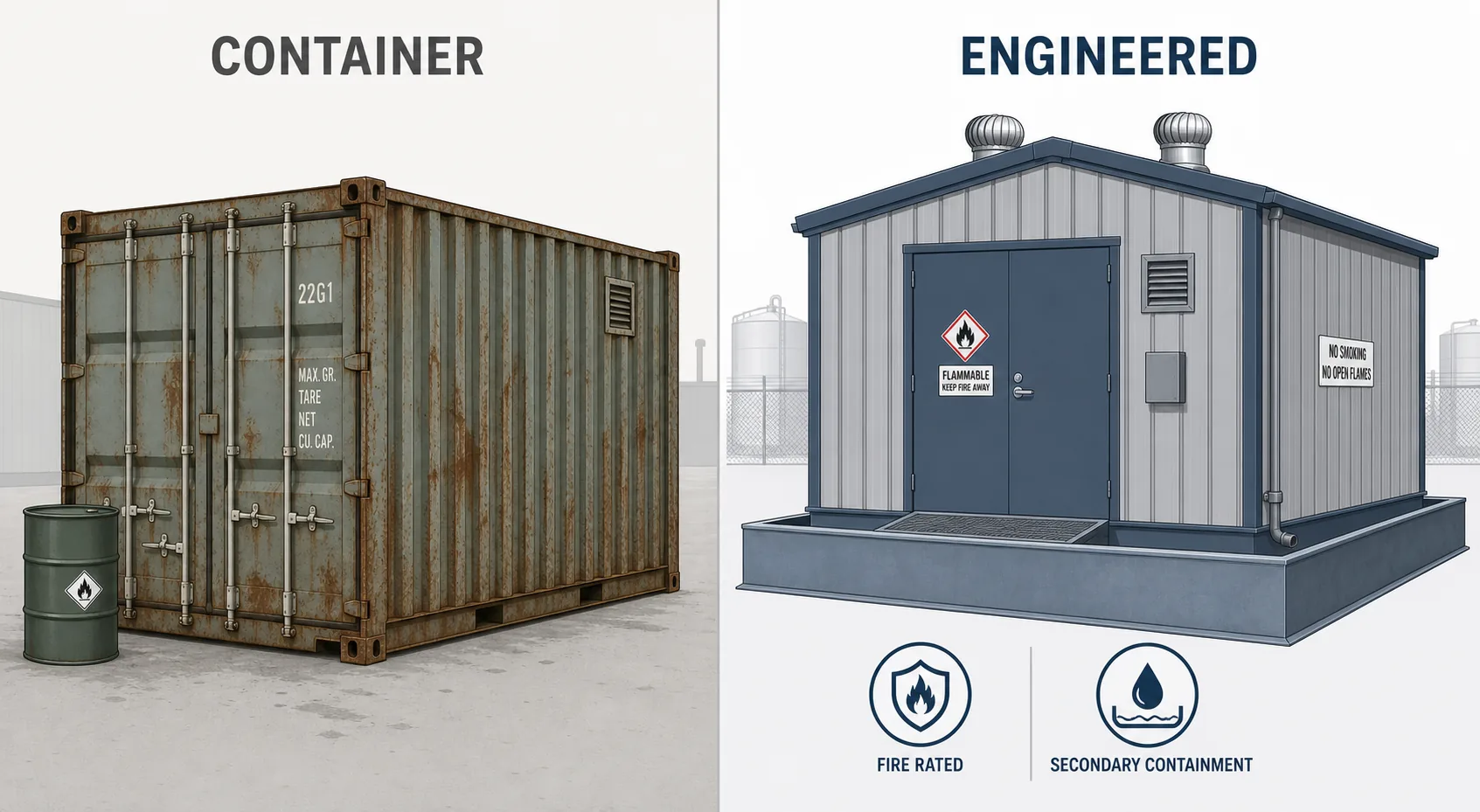
A modular chemical storage building is a prefabricated structure fabricated off-site, then shipped to your location ready for placement. Steel construction, engineered walls, and integrated safety systems make it a purpose-built enclosure for hazardous inventory, not a repurposed shed or shipping container.
That distinction matters. A container conversion improvises around the chemicals. A purpose-engineered unit is designed for compatibility, segregation, and containment from the first drawing. Dedicated, segregated storage reduces the risk of incompatible chemicals reacting, a principle the University of Wisconsin–Madison Environment, Health & Safety chemical storage guide treats as foundational.
These units fall under the broader category of hazardous materials storage buildings, sometimes called safety storage buildings. Their value comes from engineering rigor rather than four walls and a lock. For teams that want modular construction for hazardous material storage, the prefabricated route delivers predictable quality because the build happens in a controlled shop.
A container conversion improvises around the chemicals. A purpose-engineered unit is designed for compatibility, segregation, and containment from the first drawing.
Key Benefits of Modular Chemical Storage Buildings
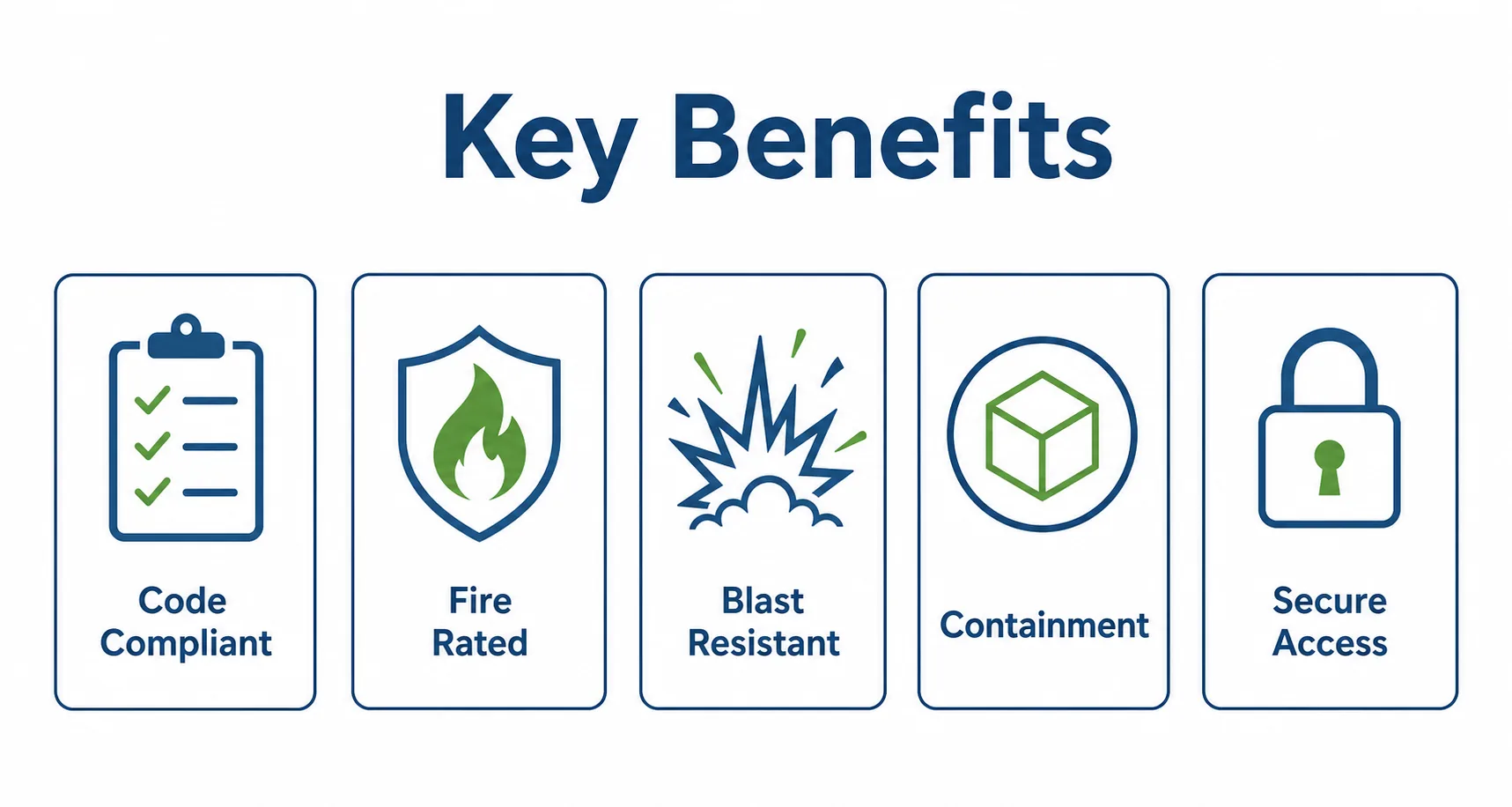
The advantages cluster around safety, compliance, and cost.
Built-In Regulatory Compliance from Day One
A prefabricated unit is engineered to the codes that govern hazardous storage: NFPA 30 for flammable and combustible liquids, OSHA storage requirements, IBC/IFC provisions, and FM Approvals where specified. Compliance is designed in, not bolted on after an inspector flags a gap. That lowers liability and shortens the path to occupancy.
Fire-Rated Protection for Flammable and Combustible Storage
Fire-rated storage buildings use 2-hour or 4-hour rated wall assemblies, steel shells, and insulation that resists flame spread. Fire detection and suppression can be added based on your inventory. The result protects staff, stock, and any adjacent structure if an incident occurs. For high-volume flammable storage, this rating is often the deciding specification.
Blast-Resistant Options
When materials carry explosion risk, whether solvents, reactive compounds, or energetic stock, the envelope itself becomes a control. Blast-resistant buildings use reinforced construction to contain or deflect overpressure. Not every site needs one, but where the hazard exists, a blast-rated shell protects occupants and neighboring assets in ways a standard wall cannot.
Secondary Containment and Rinsate Management
Sumped floors and engineered containment capacity capture leaks, spills, and rinsate, the contaminated wash and rinse water left after equipment or container cleanout. Contained on-site, that liquid never reaches soil, storm drains, or groundwater. This ties directly to environmental compliance and long-term site liability. A 2025 systematic review of life cycle assessment for storage systems underscores how containment design shapes a structure’s environmental footprint over its service life.
Secure Storage of Sensitive and High-Value Materials
Lockable, access-controlled, hardened enclosures make these units strong candidates for secure storage of sensitive materials. Restricted entry, reinforced doors, and monitored access protect controlled substances, high-value reagents, and regulated stock, keeping sensitive inventory in a defined, locked area rather than an open warehouse aisle.
Speed, Portability, and Total Cost of Ownership
Off-site fabrication runs in parallel with your site prep, so the building and the foundation progress at the same time. Installation then takes a fraction of a permanent build’s schedule, which cuts downtime and gets storage online faster.
Portability is often underweighted. When operations move or a lease ends, the unit relocates instead of becoming stranded capital, and that retained asset value shows up on the balance sheet. To see how this plays out in practice, review custom modular construction that transforms hazardous material storage.
Total cost of ownership favors modular in most scenarios. Capital costs are predictable, change orders are rare, and storage that flexes with the business avoids the sunk-cost trap of fixed construction.
Customization: Sizing, Racking, and Configuration
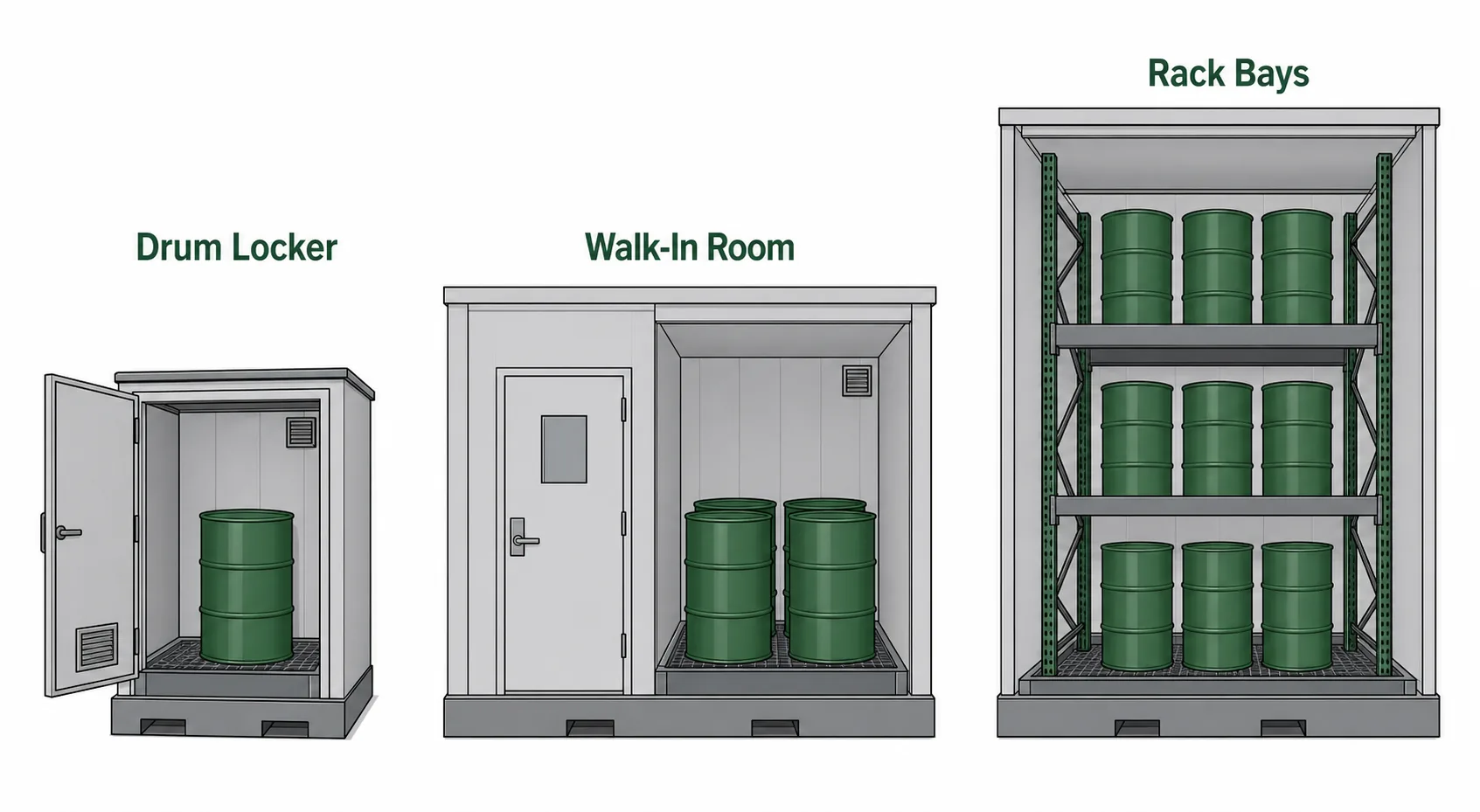
These buildings scale from single-drum lockers to walk-in rooms and multi-bay layouts. Walk-in designs suit staff access and larger containers; rack-style designs maximize vertical storage for palletized or drummed stock.
Options extend to mechanical ventilation, climate control, and electrical systems rated for hazardous locations, including explosion-proof and NEMA-classified components. Configuration is a buyer decision, and a manufacturer’s engineering depth determines how closely the unit matches your process.
Modular vs. Permanent Construction: Pros and Cons
Buyers frequently ask what the pros and cons of modular construction actually are. The honest answer: modular wins on speed, compliance certainty, and flexibility, while permanent construction can suit fixed, very large footprints where relocation will never happen.
| Factor | Modular Chemical Storage Building | Permanent On-Site Build |
|---|---|---|
| Build time | Weeks; fabricated off-site in parallel with site prep | Months; sequential site work |
| Compliance | Engineered to code before delivery | Verified in stages during construction |
| Fire / blast rating | Specified and factory-built into the shell | Added through custom design and trades |
| Secondary containment | Integrated sumped floors | Poured and sealed on-site |
| Relocatable | Yes | No |
| Cost predictability | High; few change orders | Variable; change orders common |
| Downtime / disruption | Minimal on-site work | Extended site disruption |
The cons are real. Modular units still need a prepared foundation, adequate delivery access for the modules, and forethought when a single span exceeds standard module width. For most hazardous storage needs, those constraints are minor next to the compliance and schedule gains.
Common Applications
- Government and military bases that store fuels, solvents, and ordnance-related chemicals
- Aerospace and defense manufacturing
- Universities and research laboratories
- Biomedical and pharmaceutical facilities
- Oil and gas operations
- Agriculture, including pesticides and the rinsate they generate
- Chemical processing and general industrial plants
How to Select the Right Modular Chemical Storage Building
What to Specify Before You Buy
Work through a short checklist before you request a quote:
- Chemical compatibility and segregation needs
- Fire rating and, where relevant, blast rating
- Required secondary containment volume
- Ventilation and climate control
- Electrical classification for the hazard present
- Local code jurisdiction and permit path
- Any future relocation plans
A manufacturer that engineers to these inputs delivers a compliant building the first time. Before the first official visit, work through a pre-inspection readiness checklist so nothing on site contradicts the specification you ordered. For projects that need a tailored footprint, custom modular construction lets you match size, rating, and layout to the exact material profile.
Frequently asked questions
What are the pros and cons of modular construction?
Are modular chemical storage buildings code-compliant?
What is the difference between a fire-rated and a blast-resistant storage building?
How do modular buildings handle rinsate and chemical spills?
Can a modular hazmat building be relocated later?
The Bottom Line
Modular chemical storage buildings give hazardous material handlers a faster, compliance-ready, and relocatable alternative to permanent construction, with fire, blast, and containment protection engineered for the specific materials on hand. As a U.S. manufacturer of custom prefabricated hazardous material storage buildings, Safety Storage builds these units to match the codes, hazards, and footprint your operation requires.